

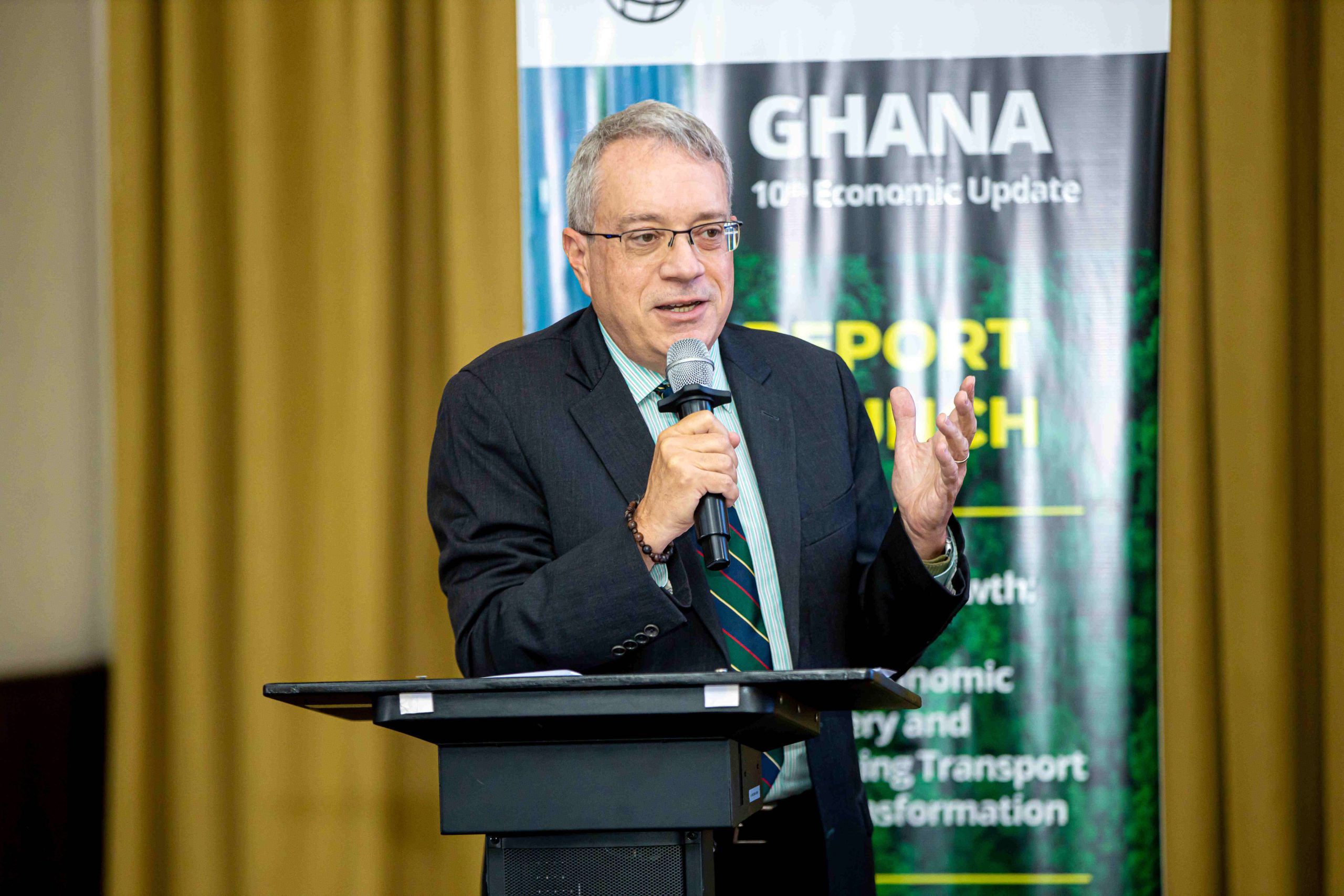

- World Bank Warns Ghana’s US$10bn Big Push Could Create Costly Liabilities Without Maintenance Reform
Ghana’s ambitious infrastructure expansion risks creating a new generation of expensive public liabilities unless government fixes longstanding weaknesses in road maintenance financing, project execution and contract management, the World Bank has warned.
In its 10th Ghana Economic Update, Reset for Growth: Sustaining Macroeconomic Recovery and Unlocking Transport for Transformation, the Bank argues that Ghana’s central transport challenge is no longer simply the amount of infrastructure being built, but whether the country can preserve those assets long enough to generate sustained economic returns.
The warning is particularly significant as government accelerates its US$10 billion Big Push programme, with about US$2.20 billion committed to transport investment in the 2026 budget.
“Every kilometer built under the Big Push without a sustainable maintenance plan is a contingent liability, not a durable asset,” the World Bank said.
That assessment exposes a structural contradiction in Ghana’s infrastructure model. Roads carry about 95.00% of passenger and cargo traffic, while the national network has expanded to roughly 94,000 kilometres. Yet only 47.00% of the network was estimated to be in good condition by the end of 2025, with 32.00% classified as fair and 21.00% poor.
About 73.00% of the network remains unpaved. The problem, according to the Bank, is that Ghana has historically devoted substantial resources to constructing and rehabilitating roads without establishing an equally dependable financing mechanism for preserving them.
Between 2018 and 2021, available Road Fund resources covered only about 45.00% of actual maintenance requirements, compared with a government target of 65.00%. Following fiscal pressures and the capping of earmarked funds, coverage fell further to about 37.00% in 2024.
The consequences extend beyond potholes and poor road surfaces. Once roads deteriorate significantly, rehabilitation can cost five to seven times what preventive maintenance would have required. Deferred maintenance therefore creates future fiscal obligations while simultaneously reducing the return on the original public investment.
The trunk road network alone is estimated to have a replacement value of about US$10 billion, while annual maintenance requirements are put at roughly US$685 million, equivalent to 0.83% of GDP.
Road Fund arrears had reached GHS5.75 billion by the end of 2024, while the wider maintenance backlog was estimated at more than GHS8 billion.
Those figures raise an uncomfortable question: can Ghana realistically expand its road network aggressively under the Big Push while it is still struggling to protect the value of assets already on the government’s balance sheet?
Transport absorbed 36.00% of Ghana’s total public capital expenditure between 2016 and 2021, making it the largest recipient of government capital spending. Yet maintenance funding remained inadequate and implementation capacity weakened.
The Ministry of Transport’s capital execution rate fell from 76.10% in 2022 to just 24.90% in 2023, when only GHS305.60 million of an approved GHS1.23 billion was spent.
The World Bank’s warning therefore goes beyond financing. It suggests that putting more money into infrastructure will not by itself solve the underlying problem if project preparation, procurement, execution and maintenance remain weak.
Ghana’s infrastructure sector had outstanding contractual commitments of about GHS172 billion at the end of 2024, more than five times the 2025 capital budget. At the same time, projects under the Ministry of Roads and Highways have recorded average cost overruns exceeding 90.00% of original contract values.
That makes accountability central to the success of the Big Push. If projects continue to be awarded faster than government can finance and execute them, the programme could reproduce the same backlog of unpaid commitments that has constrained capital investment in the past.
If cost overruns remain unchecked, projects initially approved at one value could consume almost twice the expected public resources.
The issue is therefore not whether Ghana needs more roads. It plainly does. The issue is whether those roads are being selected, costed, procured, delivered and maintained in a way that protects public money and produces lasting economic value.
The Road Maintenance Trust Fund Act, enacted in 2025, offers a possible route out of the cycle. The World Bank recommends fully operationalising the legislation, protecting Road User Charge revenues and gradually restoring maintenance coverage from current levels to at least 65.00%.
It also proposes raising the transfer rate for Road User Charges from 58.00% to 80.00% and introducing a mechanism to protect the real value of fuel levies against inflation.
Without indexation, inflation steadily erodes the purchasing power of fixed levies, meaning maintenance revenues can remain unchanged while the cost of asphalt, labour, equipment and other inputs continues to rise.
Such reforms will not be politically easy. Higher fuel-related charges can feed into transport costs and household budgets. The Bank therefore suggests sequencing levy adjustments alongside social protection and targeted support for low-income public transport users.
The broader economic case, however, is difficult to dismiss. Ghana faces an estimated annual transport infrastructure requirement of about US$8.60 billion, far beyond what government finances can provide. Every cedi lost to premature deterioration therefore widens the financing gap.
The Big Push consequently represents more than a test of Ghana’s ability to build infrastructure. It is a test of whether the country can finally move from a construction-driven model towards one based on lifecycle asset management.
For decades, the political incentives around infrastructure have tended to favour new projects and ribbon-cutting over routine maintenance. New roads are visible. Preventive maintenance is not.
But the fiscal consequences eventually return. A road that could have been preserved cheaply is allowed to deteriorate, and government later borrows, reallocates scarce resources or accumulates arrears to rehabilitate the same asset.
That is the cycle the World Bank is warning Ghana to break. If the Big Push is accompanied by predictable maintenance financing, stronger procurement controls, realistic costing and proper lifecycle planning, it could materially improve productivity and competitiveness.
If not, today’s infrastructure expansion could become tomorrow’s rehabilitation bill.
The ultimate measure of the Big Push will therefore not be how many kilometres Ghana can build, but how many it can afford to keep in good condition.

