

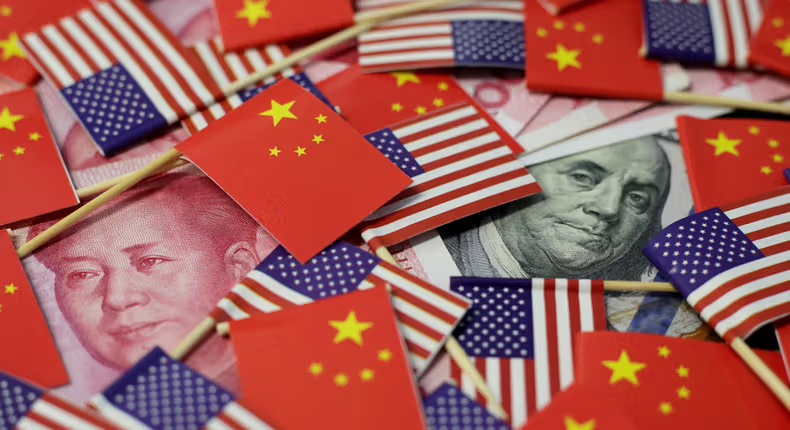

- Yuan Gains Ground in Africa as China Trade Nears US$400 billion
The Chinese yuan is gradually gaining ground in Africa’s trade and payments system, as the continent’s commercial ties with Beijing deepen and China-Africa trade moves closer to the US$400 billion mark.
The shift remains gradual and does not yet threaten the dominance of the United States dollar in African trade finance, reserves and cross-border payments.
But the increased use of the yuan in import payments, export settlements and trade finance signals a slow diversification of the currencies used by African businesses and financial institutions.
According to Business Insider Africa, the trend is being driven by rapidly expanding China-Africa trade, new cross-border payment infrastructure and Beijing’s policy push to increase imports from the continent through tariff reductions and wider market access.
China’s General Administration of Customs reported that bilateral trade between China and Africa rose by 17.70% in 2025 to a record US$348.05 billion, up from US$295.60 billion in 2024.
Chinese exports to Africa increased by 25.80% to US$225.03 billion, while imports from Africa rose by 5.40% to US$123.02 billion.
The figures reinforce China’s position as Africa’s largest trading partner and explain why the yuan is beginning to appear more frequently in trade-related transactions across the continent.
With trade experts expecting China-Africa commerce to approach US$400 billion by the end of 2026, the role of the yuan is likely to become more visible.
The change is partly commercial and partly strategic.
For African importers buying Chinese machinery, electronics, vehicles, industrial inputs, consumer goods and construction materials, yuan-denominated settlement can reduce dependence on the dollar in specific transactions.
For exporters selling into China, especially as Beijing expands tariff-free access for African goods, the yuan may become increasingly relevant in payment and settlement arrangements.
Business Insider Africa reported that Beijing has extended tariff-free access to exports from 53 African countries, a move analysts see as part of a broader strategy to support African exports amid rising global protectionism.
The policy could support growth in African exports to China and create more scope for yuan-based transactions.
The article cited rising African exports to China, including Kenyan avocado oil, South African apples and Nigerian cattle bone pellets, as examples of the broadening trade relationship.
For Africa, this is not simply a currency story.
It is a trade competitiveness story.
As China opens more space for African exports, countries on the continent will need to improve standards, logistics, financing, production capacity and export readiness if they are to benefit meaningfully.
The growing use of the yuan may reduce some transaction costs in China-linked trade, but it will not by itself solve Africa’s deeper trade challenges.
The dollar remains dominant because it is the world’s primary reserve currency, the main currency for commodities, and the central unit of pricing in international trade and finance.
Most African countries still hold reserves largely in dollars, borrow externally in dollars and price key imports such as oil in dollars.
That dominance will not disappear quickly.
However, the rise of the yuan reflects a broader global trend toward currency diversification, particularly among countries that trade heavily with China.
For African businesses, the practical question is not whether the yuan will replace the dollar. It is whether using yuan in China-linked transactions can reduce costs, improve payment efficiency and ease pressure on scarce dollar liquidity.
In many African economies, dollar shortages have become a recurring constraint on importers, manufacturers and traders.
When businesses cannot access dollars easily, imports are delayed, costs rise and supply chains weaken.
If yuan settlement becomes more available for China-related transactions, some firms may be able to reduce their dependence on dollar funding for specific trade flows.
This could be particularly relevant for countries with large trade volumes with China and persistent foreign exchange shortages.
Yet the benefits will depend heavily on banking infrastructure.
The yuan cannot become widely used in African trade unless banks can process payments, manage liquidity, provide hedging tools and support trade finance in the Chinese currency.
This is where China’s Cross-Border Interbank Payment System, known as CIPS, becomes important.
CIPS is designed to facilitate yuan settlements outside traditional Western financial networks.
Business Insider Africa reported that South Africa’s Standard Bank became the first African commercial bank to connect to the system in November, processing an estimated US$500 million in transactions within its first four months.
That development is significant because it shows that the yuan’s expansion in Africa is being supported by payment infrastructure, not just political rhetoric.
Ives Yang, head of sales for transactional banking at Standard Bank’s corporate and investment banking unit, said current activity is largely being driven by import-export transactions between China and African markets, with efforts underway to expand participation across the continent.
The Standard Bank example may encourage other African banks to explore similar arrangements, particularly institutions serving businesses with strong China trade exposure.
If more banks connect to yuan settlement systems, the currency could become easier to use for trade payments, documentary credits, supply-chain finance and corporate banking transactions.
Standard Chartered Kenya chief executive Birru Sanghrajka also told Reuters that yuan-denominated payments are becoming more visible in trade finance flows, although they are not yet at a scale that challenges existing reserve currencies.
He described the trend as complementary rather than disruptive to the dollar system.
That distinction is important.
The yuan’s growth in Africa is not yet a de-dollarisation shock.
It is better understood as a gradual expansion of currency choice in trade linked to China.
For African central banks, this raises policy questions.
Should countries hold more yuan reserves to match growing trade with China? Should payment systems be upgraded to support multi-currency settlement? Should regulators develop rules for yuan-denominated trade finance? Should exporters be allowed to keep yuan proceeds?
These questions will become more important as China-Africa trade volumes increase.
Countries that trade heavily with China may find it useful to diversify part of their reserve holdings and payment systems to reflect changing trade patterns.
But they will also need to manage risks.
The yuan is not as freely convertible as the dollar. Its international use is still shaped by Chinese policy, capital controls and market depth.
African firms and banks using the yuan will need to understand exchange rate risk, liquidity risk and settlement risk.
For smaller firms, unfamiliarity with yuan pricing and limited access to hedging products may slow adoption.
There is also a geopolitical dimension.
China’s promotion of the yuan forms part of a broader effort to reduce dependence on dollar-based systems and expand Beijing’s influence in global finance.
For African countries, the opportunity is to gain more payment options and possibly reduce transaction friction in trade with China.
The risk is becoming overly dependent on another currency system without developing domestic productive capacity and stronger regional trade.
That is why the yuan’s rise should be seen as a tool, not a development strategy.
The real prize for Africa is not merely settling more transactions in yuan.
It is using the expanding trade relationship with China to increase exports, build manufacturing capacity, improve logistics, attract investment and move up value chains.
If Africa continues mainly to import finished goods and export raw materials, currency diversification will have limited transformative value.
But if tariff-free access, trade finance and payment infrastructure help African producers export more processed goods to China, the economic impact could be more significant.
For Ghana and other African economies, the development carries practical lessons.
China remains a major source of imports, investment, infrastructure financing and trade opportunities.
Greater yuan usage may eventually affect how importers manage payments, how banks structure trade finance and how central banks think about reserve composition.
Businesses trading with China may increasingly need to understand yuan pricing, payment documentation and exchange-rate implications.
Banks, meanwhile, may need to build internal capacity for yuan liquidity management and correspondent banking relationships.
The rise of the yuan in Africa’s trade system is therefore likely to be incremental.
The dollar will remain dominant for the foreseeable future, especially in reserves, oil payments, global commodities and international borrowing.

