

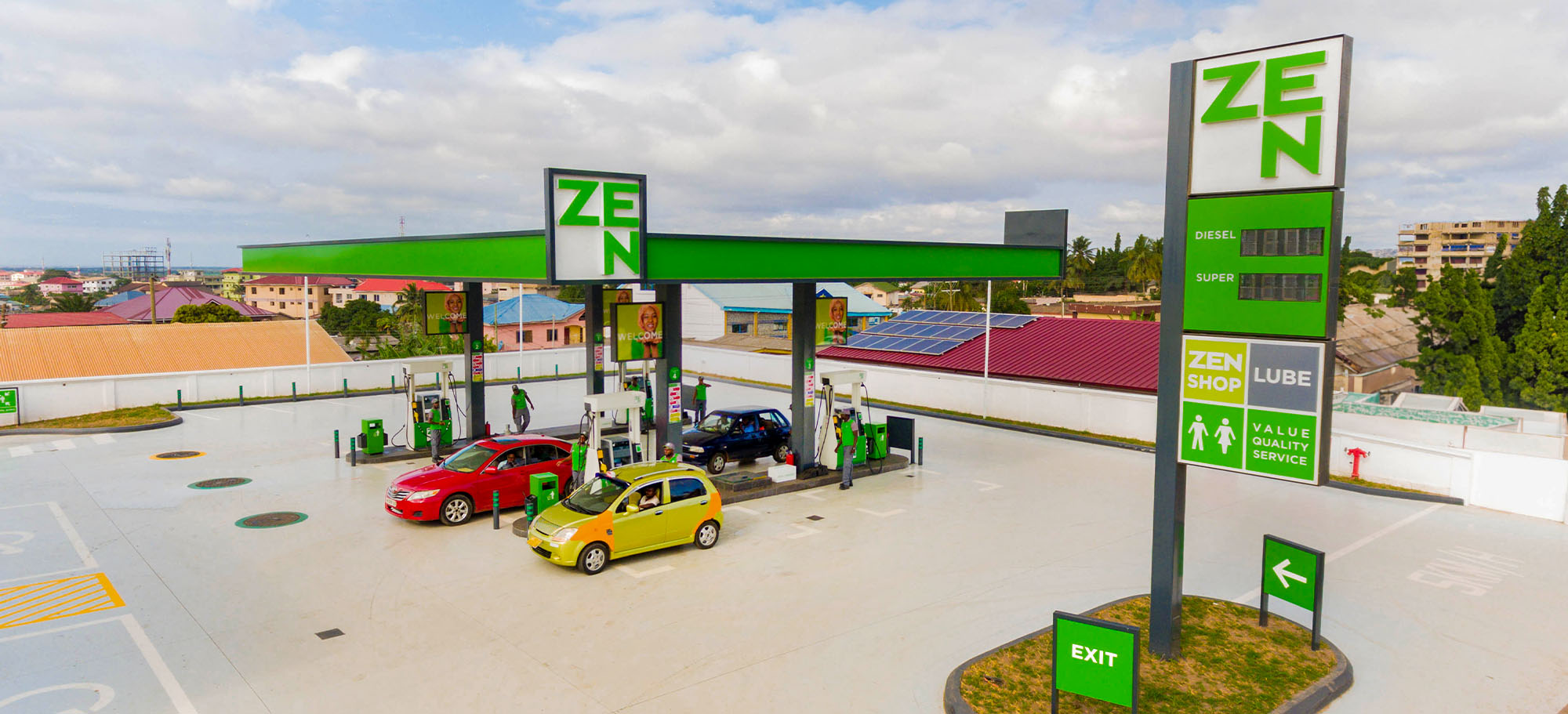

- ZEN Petroleum Delivers Strong Maiden Results, as Asset Disposal Gain Supports Profit
ZEN Petroleum Holdings Plc has delivered a profitable first half as a listed company, reporting GH¢172.62 million in profit after tax on revenue of GH¢3.56 billion for the six months ended September 30, 2026.
The results present a business with considerable turnover, a debt-free balance sheet and a strong equity position. However, a deeper reading shows that high inventory requirements, negative operating cash flow, limited immediately available liquidity and a material contribution from an asset-disposal gain deserve as much attention as the headline profit.
ZEN Petroleum Holdings was incorporated in December 2025 as the holding company for the ZEN group and listed on the Ghana Stock Exchange in April 2026. Its subsidiaries operate across fuel sourcing, storage, transportation and distribution, serving mining companies, filling stations and other customers.
Because the holding company did not exist during the corresponding period of 2025, the financial statements contain no comparative figures. This makes it difficult to determine the rate at which revenue, profit, costs and working-capital requirements are changing.
The company said second-quarter revenue was broadly in line with the first quarter, suggesting that turnover remained relatively stable during the six-month period. But without quarterly profit and cash-flow details, investors cannot determine whether margins improved or weakened between the two quarters.
ZEN generated revenue of GH¢3.56 billion and incurred cost of sales of GH¢3.19 billion, leaving gross profit of GH¢367.06 million. This translates into a gross margin of approximately 10.31%.
For a petroleum distributor, where high sales volumes can coexist with relatively narrow margins, the result is not necessarily weak. Yet it demonstrates the sensitivity of earnings to relatively small movements in product costs, selling prices, exchange rates and operating expenses.
A one-percentage-point decline in the gross margin, if applied to the reported revenue, would represent about GH¢35.61 million in lost gross profit. This means disciplined pricing, procurement and inventory management will be critical to protecting earnings.
Selling, general and administrative expenses totalled GH¢150.86 million, consuming approximately 41.10% of gross profit and 4.24% of revenue.
After those costs, the business generated GH¢216.21 million from its core gross profit before other income and net finance income. This indicates that the underlying operations were profitable, but the difference between gross profit and final profit remained significant.
Other income contributed GH¢43.86 million. Of this amount, GH¢31.42 million came from a gain on the disposal of property and equipment.
That disposal gain accounted for approximately 12.07% of profit before tax and 18.20% of profit after tax. Although legitimate, gains from selling assets are not normally considered recurring operating income unless asset disposals form an established part of the business model.
Excluding the disposal gain, profit before tax would have been approximately GH¢228.84 million rather than GH¢260.26 million. ZEN therefore remained strongly profitable without the transaction, but the adjustment provides a more conservative view of repeatable earnings.
Finance income was GH¢638,000, while finance costs were only GH¢449,000. The limited finance charge reflects one of the company’s strongest financial characteristics: it reported no borrowings at the end of September.
A debt-free position protects ZEN from rising interest costs, refinancing risk and pressure from lenders. It also provides borrowing capacity should management require funding for expansion.
The absence of conventional debt, however, does not mean that the group operates without external financing. Trade and other payables stood at GH¢563.38 million and represented approximately 93.31% of total liabilities.
Supplier credit is therefore playing a central role in financing operations. This is common in petroleum distribution, but it requires careful management because suppliers may tighten payment terms, reduce credit limits or demand faster settlement during periods of currency or commodity-market volatility.
ZEN recorded profit before tax of GH¢260.26 million, equivalent to a pre-tax margin of approximately 7.31%. After an income tax charge of GH¢87.64 million, profit for the period was GH¢172.62 million.
The effective tax rate was about 33.67%, while the net profit margin was approximately 4.85%. In practical terms, ZEN retained less than five pesewas as profit from every cedi of revenue.
This margin can still produce substantial earnings at high sales volumes, but it leaves limited room for operational mistakes. A sharp increase in fuel acquisition costs, foreign-exchange losses, customer defaults or distribution expenses could materially affect profitability.
Basic and diluted earnings per share were both GH¢0.27. Investors will need additional reporting periods before forming a reliable view of earnings growth, seasonality and the sustainability of this return.
The balance sheet appears well capitalised. Total assets stood at GH¢1.60 billion, while equity was GH¢1.00 billion. The equity-to-assets ratio was approximately 62.36%, leaving liabilities at 37.64% of assets.
Share capital accounted for GH¢614.86 million, retained earnings stood at GH¢292.53 million and the foreign-currency translation reserve was GH¢93.13 million.
The translation reserve represented about 9.31% of equity. Investors should recognise that translation gains form part of comprehensive income but are not equivalent to cash generated from sales.
The composition of assets reveals the operational intensity of the business. Inventories stood at GH¢656.56 million, representing approximately 40.93% of total assets and 60.60% of current assets.
Trade and other receivables amounted to GH¢327.57 million, equivalent to 20.42% of total assets. Together, inventories and receivables accounted for approximately 61.35% of the entire asset base.
That concentration means much of ZEN’s capital is tied up in products awaiting sale and amounts awaiting collection from customers. Both assets can support growth, but both carry risks.
Inventory exposes the company to product-price movements, storage costs, losses and possible changes in demand. Receivables expose it to delayed payments and customer default, particularly where large commercial buyers negotiate extended credit periods.
ZEN’s current assets of GH¢1.08 billion exceeded current liabilities of GH¢563.38 million, producing a current ratio of approximately 1.92. On the surface, this indicates a comfortable ability to meet short-term obligations.
Once inventories are removed, however, liquid current assets fall to approximately GH¢426.84 million. That produces a quick ratio of about 0.76, meaning liquid assets excluding inventory were lower than current liabilities.
Cash and cash equivalents stood at GH¢85.55 million, representing only 5.33% of total assets and 15.18% of current liabilities. The group therefore depends on inventory conversion, receivable collection and continuing supplier support to meet its obligations smoothly.
The cash-flow statement is the clearest area requiring attention. Despite reporting GH¢172.62 million in profit after tax, ZEN used GH¢13.64 million in operating cash.
Before tax payments, operations generated GH¢48.66 million in cash. Tax payments of GH¢62.30 million then moved the figure into negative territory.
The gap between profit and cash generation arose primarily from working-capital movements. Inventories absorbed GH¢106.38 million, while a reduction in trade and other payables used a further GH¢116.59 million. Receivables consumed GH¢4.13 million.
Increasing inventory may reflect preparation for future sales or a desire to guarantee supply to mining and retail customers. Reducing payables may also strengthen supplier relationships. Nevertheless, both decisions absorb cash and must ultimately produce sales and collections.
Cash used in investing activities was GH¢9.27 million. The group spent GH¢44.01 million on property and equipment, partly offset by GH¢34.10 million received from asset disposals.
The close relationship between capital expenditure and disposal proceeds deserves monitoring. Investors will want to know whether ZEN is replacing older assets, restructuring its fleet or selling property to fund new investment.
Financing activity tells an equally important story. ZEN received GH¢640.00 million from its share issuance and paid GH¢25.23 million in issuance costs, leaving net proceeds of GH¢614.77 million.
During the same period, it paid a GH¢600.00 million dividend that had been recognised in the financial year ended March 2026 but settled after year-end.
The dividend did not relate to the current six-month profit, but its cash effect was significant. It absorbed 97.60% of the net share-issue proceeds and was almost three-and-a-half times the profit generated during the reporting period.
After financing, operating and investing movements, cash declined by GH¢12.88 million to GH¢85.55 million.
ZEN’s strengths are clear: it is profitable, debt-free, strongly capitalised and positioned prominently in Ghana’s downstream petroleum market. The company identifies itself as the country’s fourth-largest oil marketing company, based on National Petroleum Authority statistics for January to August 2026, and the largest supplier of lubricants to the mining industry.
Its integrated logistics capabilities, including a tanker fleet and Ladybird Logistics’ 40 female drivers, can support service reliability and reduce dependence on third-party transportation.
The principal risks, however, lie in cash conversion and working-capital intensity. Profit is healthy, but operating cash flow is negative. Current assets cover current liabilities, but much of that cover consists of inventory. Supplier credit remains important, while cash represents a small portion of short-term obligations.
ZEN’s next results must therefore show whether its GH¢656.56 million inventory position converts into sales and cash, whether receivables remain collectible and whether core earnings can grow without relying on disposal gains.
The first-half numbers establish a credible platform, but the company’s long-term investment case will depend less on revenue size than on margin protection, cash generation and disciplined management of the capital tied up in every litre of fuel moving through its operations.

