

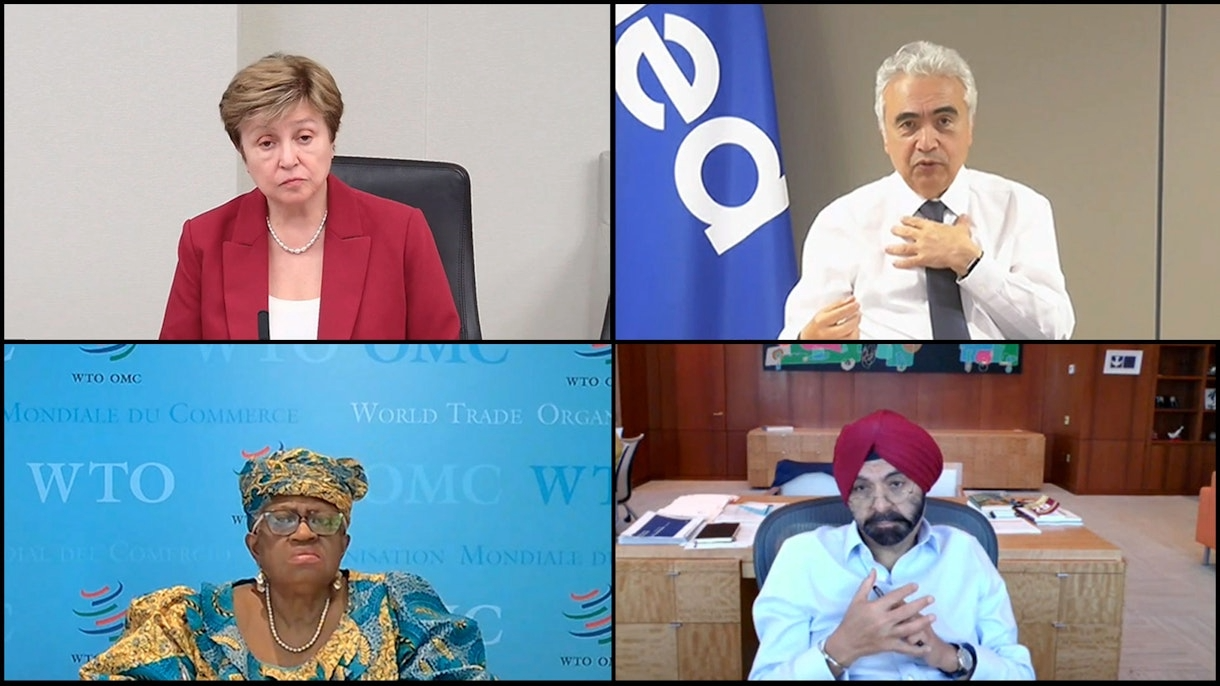

- IEA, IMF, World Bank and WTO Urge Vigilance as Middle East War Strains Global Economy
The heads of the International Energy Agency, International Monetary Fund, World Bank Group and World Trade Organization have warned that the global economy remains exposed to lingering shocks from the war in the Middle East, despite signs of broad resilience across markets and countries.
In a joint statement issued in Washington, DC, on July 8, the four institutions said they had met to assess energy, trade and economic developments, with particular attention to vulnerable countries facing pressure from disrupted energy supplies, food insecurity, commodity price shifts and weaker growth.
The meeting formed part of a high-level coordination group established in April to maximise the institutions’ collective response to the energy, trade and economic impact of the conflict.
“We met to take stock of energy, trade, and economic developments, to discuss the situation in vulnerable countries, and to further coordinate our support to those in need,” the heads of the four institutions said.
The statement is significant because it brings together the world’s leading institutions for energy security, macroeconomic stability, development finance and global trade at a time when the Middle East conflict continues to test the resilience of the global economy.
Their message was carefully balanced. The global economy has not collapsed under the weight of the conflict. But the shock has not disappeared either.
“The global economy has been broadly resilient to the shock from the war in the Middle East, even as some economies have experienced a slowdown in growth and an uptick in inflation,” the statement said.
That sentence captures the uneven nature of the crisis. Some countries have been able to absorb the shock better than others. Economies with stronger reserves, diversified energy sources, better fiscal buffers and more resilient trade systems are likely to cope better. But vulnerable countries, especially those heavily dependent on imported fuel, food and fertiliser, remain exposed.
For developing economies, including many in Africa, this is the more important part of the warning.
A war in the Middle East does not need to take place near a country’s borders to affect its economy. It can raise fuel import bills, increase shipping costs, disturb food supply chains, weaken currencies, complicate inflation management and create new pressure on public finances.
When oil and fertiliser prices rise, the effect can be felt quickly in transport fares, electricity generation costs, food production, public subsidies and household living costs. For countries already managing debt pressures, fiscal consolidation and currency volatility, such shocks can quickly disturb recovery.
The joint statement noted that the impact of the war has been “highly uneven,” affecting energy supplies, food security, various commodities and economic activity across many countries and regions. It said this has created “deeper concerns about growth and price stability.”
Those concerns go to the heart of current global economic management.
Many countries entered 2026 hoping for calmer inflation, more stable interest rates and stronger growth. But the Middle East conflict has reminded policymakers that inflation can return through external shocks, even when domestic policy is improving.
This is particularly difficult for central banks. If fuel prices rise and inflation expectations worsen, cutting interest rates becomes harder. But if geopolitical uncertainty slows investment and growth, keeping monetary policy tight can also damage recovery. That tension is now part of the global policy dilemma.
The four institutions also placed renewed emphasis on the Strait of Hormuz, one of the world’s most important energy shipping routes. They encouraged further progress towards resolving the conflict and reopening the Strait.
“We encourage further progress toward a resolution to the conflict and the reopening of the Strait of Hormuz,” the statement said.
That call reflects the importance of the waterway to global energy flows. Any disruption to shipping through the Strait can immediately affect oil and gas markets, with consequences for import-dependent countries around the world.
The institutions said fuel and fertiliser prices had dropped since their last meeting in June, offering some relief. But they warned that uncertainty remains high and that the effects of the war could linger.
“Energy markets and transit of goods are still facing strains,” the statement added.
This is the key point. Markets may calm temporarily, but supply chains and confidence do not always recover immediately. Businesses may delay investment. Shipping firms may reroute cargo. Governments may increase precautionary spending. Consumers may face higher prices before global conditions normalise.
The statement also called on governments and the international community to remain vigilant and to uphold freedom of navigation in the Strait of Hormuz and globally.
That call is not only about energy. It is also about trade.
Modern economies depend on predictable movement of goods. When shipping lanes are threatened, the cost of trade rises. Insurance premiums can increase. Delivery times can lengthen. Importers may pay more. Exporters may lose competitiveness. Consumers eventually bear part of the cost.
For poor and vulnerable countries, the effect is often harsher because they have less room to absorb higher import costs.
The heads of the IEA, IMF, World Bank and WTO therefore urged collective action to support economic recovery, protect jobs and livelihoods, strengthen energy and food security, and improve broader resilience to future shocks.
They also highlighted the need to improve port infrastructure and trade facilitation. This is important because resilience is not built only through emergency financing. It is also built through better logistics, faster customs systems, efficient ports, diversified supply routes and stronger food and energy systems.
For African economies, that part of the statement should be taken seriously.
The continent remains vulnerable to external price shocks partly because many countries import refined petroleum products, fertiliser, machinery, medicine and food staples while exporting raw commodities. Weak port infrastructure and inefficient trade systems make these shocks more expensive.
If global institutions are now linking Middle East instability to port infrastructure and trade facilitation, it shows that crisis response is moving beyond short-term relief. It is becoming a broader conversation about economic resilience.
The World Bank’s presence in the statement points to the development finance dimension. Vulnerable countries may need support to protect households, sustain critical imports and invest in long-term resilience. The IMF’s role points to macroeconomic stability, balance-of-payments support and policy advice. The IEA brings energy security expertise, while the WTO focuses on keeping trade open and predictable.
Together, the institutions are trying to prevent a geopolitical conflict from becoming a wider economic crisis.
“We will continue to work with each other and with our members to closely monitor energy, trade, and economic developments,” the statement said.
They also pledged to strengthen their readiness to act further if needed and to continue adapting support to countries as the situation evolves.
“That includes helping them build greater energy, food, trade, and economic resilience,” the statement added.
That final word resilience is the deeper theme of the statement.
The Middle East war has again exposed how dependent many economies are on distant supply chains, narrow energy sources and fragile trade routes. It has also shown that countries cannot build economic security only after a crisis begins.
For governments, the lesson is clear. Energy diversification, food security, efficient ports, strong reserves, prudent fiscal management and reliable trade systems are not optional policy ambitions. They are shields against external shocks.
For Ghana and other import-dependent economies, the warning is immediate. A conflict thousands of kilometres away can still affect pump prices, fertiliser costs, inflation, exchange rates and fiscal planning. The country’s ability to manage such risks will depend on how quickly it strengthens domestic production, improves trade logistics, deepens energy resilience and builds stronger macroeconomic buffers.
The joint statement does not suggest panic. It suggests caution.
The global economy has held up better than many feared. Fuel and fertiliser prices have eased since June. But uncertainty remains high, and the impact of the war may still be felt for months.
The message from the heads of the IEA, IMF, World Bank and WTO is therefore simple but serious: the world may have absorbed the first shock, but it is not yet safe from the aftershocks.
For vulnerable countries, that distinction matters.
Resilience is now the real test.

