

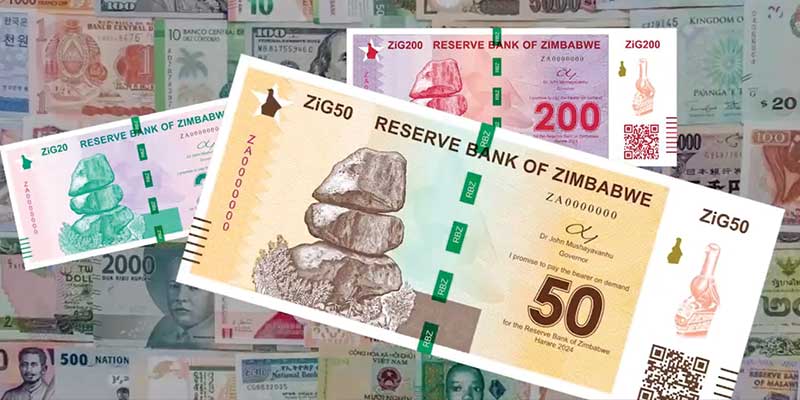

- Zimbabwe rolls out redesigned ZiG notes, but trust remains the real currency test
Zimbabwe has begun rolling out a redesigned series of Zimbabwe Gold, or ZiG, banknotes, in what the central bank hopes will mark another step towards stabilising the country’s troubled currency regime. But while the new notes may solve some practical problems, the deeper challenge remains unchanged: persuading Zimbabweans to trust local money again.
The Reserve Bank of Zimbabwe said the upgraded “BiG5 ZiG” notes entered circulation on April 7, 2026, in line with the February monetary policy statement and Statutory Instrument 37 of 2026. The rollout begins with the ZiG10, ZiG20 and newly issued ZiG50 denominations, while ZiG100 and ZiG200 notes will be introduced later, depending on transactional demand and broader monetary conditions. Existing ZiG notes will continue to co-circulate and will be phased out gradually once deposited into the banking system.
For the Reserve Bank, the redesign is both technical and symbolic. Governor John Mushayavanhu had earlier framed the move as part of a controlled expansion of the note family rather than a fresh monetary loosening. “There will be no increase in reserve money, as banks will exchange electronic balances for physical cash,” he said, while the central bank’s April 3 press release added that the notes had already been distributed countrywide in sufficient quantities to meet expected demand.
The new series is meant to address a simple but politically important weakness in the first generation of ZiG notes launched in 2024: they wore out too quickly. Business Insider Africa reported that the original notes faded easily, tore fast and proved unpopular with both traders and banks, prompting the authorities to improve durability and security features. The redesigned notes also carry the imagery of Zimbabwe’s “Big Five” wildlife, an attempt to give the currency a stronger national identity.
On paper, the macro backdrop is more supportive than it was a year ago. Business Insider Africa reported that inflation fell to 4.1 per cent in January 2026 and 3.8 per cent in February, the lowest levels in almost three decades, while reserves backing the ZiG rose from US$276mn at launch to about US$1.2bn by end-2025. The central bank has used that improvement to justify broader note issuance and to signal that it now has room to strengthen cash availability without reigniting instability.
The Reserve Bank is also trying to make the currency more usable in everyday life. It said the new notes will be available through bank halls, ATMs and HomeLink kiosks, while merchants and retailers have been encouraged to offer ZiG cashback and mobile money operators urged to resume ZiG cash-in and cash-out services. Weekly cash withdrawal limits were set at ZiG10,000 for individuals and ZiG100,000 for corporates. The bank urged the public to use the new notes “with pride and confidence” and described the currency in three words: “Stable, Secure, Sustainable.”
But confidence is precisely where the policy becomes difficult. Zimbabwe’s monetary history has left scars that new paper alone cannot erase. Business Insider Africa noted that after the ZiG launched in April 2024 at 13.56 per US dollar with gold and foreign-currency backing, it lost half its value within months and was officially devalued by 42.55 per cent in September 2024. That experience sits inside a much longer memory of hyperinflation, the collapse of the old Zimbabwe dollar, the bond note experiment and repeated shifts between local and foreign-currency systems.
That is why the real issue is not whether the notes look better, but whether people want to hold them. In practice, much of Zimbabwe’s economy still runs on the US dollar. Business Insider Africa reported that informal traders, transport operators, market vendors and many larger businesses continue to prefer dollar transactions, while some public services are still priced in foreign currency. That weakens the state’s own case for full domestic currency use: if the government itself still leans on the dollar, households and firms have little reason to take the opposite bet.
So the redesign changes the optics of Zimbabwe’s currency story, but not yet its underlying political economy. Stronger notes may improve circulation. Better supply may reduce transactional friction. Lower inflation and higher reserves may create room for cautious optimism. Yet the ZiG’s long-term credibility will depend less on fresh security features than on whether policy remains consistent enough for citizens to believe that this currency, unlike its predecessors, will preserve value rather than destroy it.

