


- World Bank Calls for Urgent Financing to Transform West Africa’s Rice Value Chain
The World Bank has called for an urgent acceleration of investment across West Africa’s rice value chain, warning that the region’s continued dependence on imported rice poses a growing economic and food security risk amid climate pressures, geopolitical uncertainty and tightening development finance.
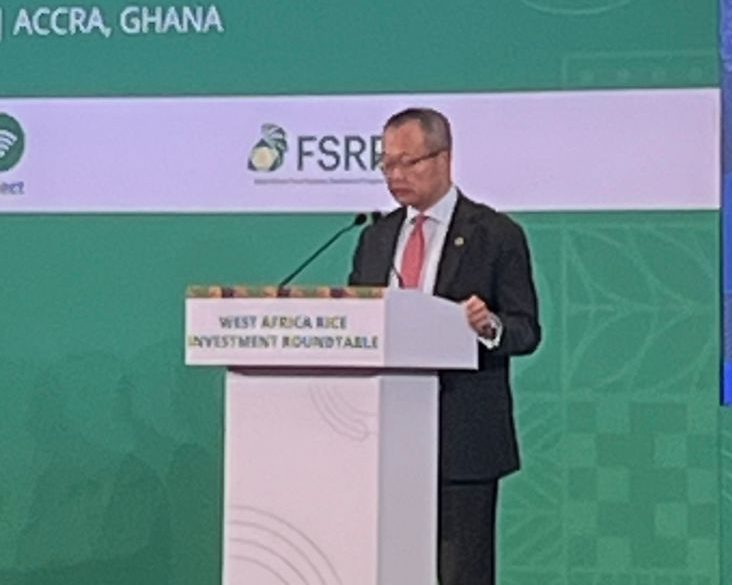
Speaking at the West Africa Rice Investment Roundtable in Accra, World Bank Vice President for Planet Guangzhe Chen said the region still imports roughly 40 per cent of the rice it consumes, costing ECOWAS member states an estimated $4 billion to $5 billion annually despite possessing the resources to become a competitive producer.
“Rice is central to both food security and economic growth,” Mr Chen told policymakers, investors and development partners gathered at the forum.
“A region with enormous agricultural potential should not remain dependent on volatile global markets for a staple food that it can competitively produce itself,” he added.
His remarks underscored growing concern among regional leaders that recent disruptions in global commodity markets, including fertiliser shortages and surging food prices, have exposed vulnerabilities in West Africa’s food systems and heightened the urgency of boosting domestic production.
Mr Chen said the region already possesses a framework for transformation through the ECOWAS Rice Observatory and national investment plans but argued that the next phase requires implementation and large-scale financing rather than additional policy discussions.
To support that effort, he highlighted the World Bank Group’s AgriConnect initiative, launched in October 2025, which seeks to move beyond fragmented agricultural interventions and deliver coordinated, value-chain-wide transformation.
Under the programme, the World Bank is mobilising approximately $1.2 billion through the Food Systems Resilience Programme to strengthen productivity, regional market integration and policy coordination across eight countries.
The initiative is expected to reach an estimated 3.2 million beneficiaries.
Additional investments planned in Nigeria, Togo, Burkina Faso and Guinea could bring a further $300 million to $400 million into the regional rice sector, Mr Chen added.
However, he acknowledged that access to finance remains one of the most significant barriers to growth.
Smallholder farmers continue to face difficulties securing credit for fertiliser, seeds and other essential inputs, leaving African fertiliser use well below the global average.
Mr Chen urged governments, financial institutions and development partners to scale up risk-sharing mechanisms, guarantees and blended finance instruments capable of attracting private capital into agriculture.
“The de-risking of financing is one of the key solutions,” he said. “The challenge is how to deploy these tools faster and more systematically across the region.”
Beyond production, the World Bank Vice President stressed the need for investment in storage, logistics, processing and market infrastructure, arguing that increasing yields alone would not deliver food security or industrial growth without stronger value chains.
“The real opportunity lies in building complete value chains that create jobs and competitive industries across the region,” he said.
The comments reflect a broader shift in how development institutions and governments are framing agriculture in West Africa.
Rice is no longer being treated only as a food security concern. It is increasingly being positioned as an industrial opportunity, with potential to support irrigation development, mechanisation, agro-processing, logistics, warehousing, regional trade and job creation.
A region that spends up to $5 billion annually importing rice is effectively exporting scarce foreign exchange, jobs and industrial opportunity to external producers.
Reducing that dependence would not only strengthen food security but also improve balance-of-payments resilience, support rural incomes and create space for private capital to participate in a structured regional value chain.
Mr Chen described the Accra gathering as a critical opportunity to convert policy ambitions into bankable investments at a time when population growth, climate change and geopolitical disruptions are placing unprecedented pressure on food systems.
“This is not just another conference,” he said. “It is an opportunity to turn plans into investment, and investment into results. The time for delivery is now.”
The roundtable, jointly convened by ECOWAS, the Government of Ghana and the World Bank Group, aims to mobilise public and private capital to advance West Africa’s long-term ambition of achieving rice self-sufficiency while strengthening economic resilience across the region.
The message from the World Bank is clear: West Africa already has the demand, the land and the policy framework.
What it now needs is execution financing for irrigation, inputs, storage, processing and logistics at the scale required to turn rice from an import burden into a regional growth industry.

