
- Central Bank Sells GHS 16.14 billion in 14-Day Bills as Liquidity Mop-Up Continues
The Bank of Ghana sold GHS 16.14 billion in short-term central bank bills at its latest auction, as the monetary authority continued efforts to manage liquidity conditions in the financial system.
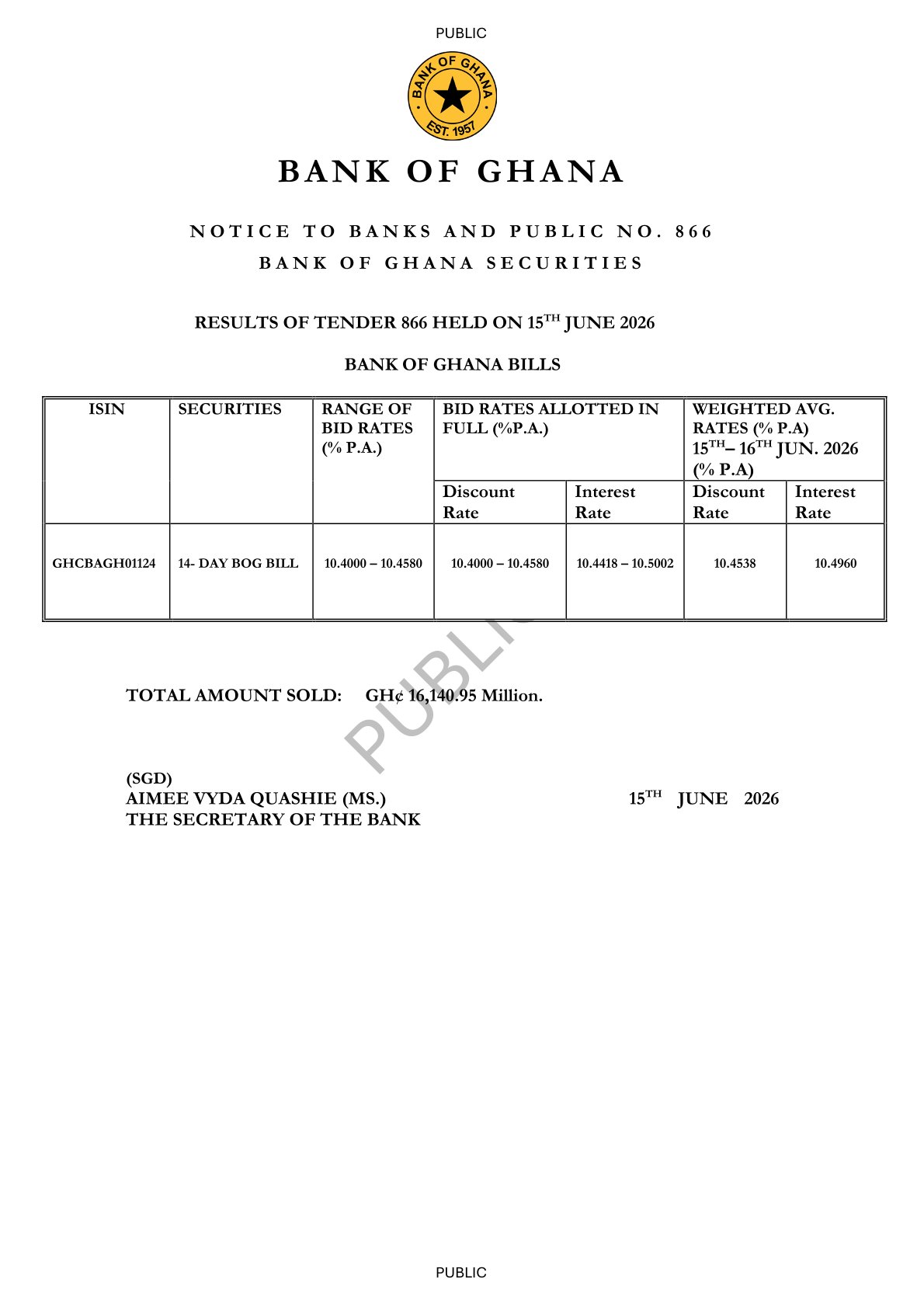
The results of Tender 866, held on June 15, 2026, show that the central bank issued 14-day Bank of Ghana bills with a total amount sold of GHS 16.14 bn.
The securities, which will run from June 15 to June 16, 2026, attracted bid rates ranging from 10.40% to 10.46% per annum.
According to the auction results, the bid rates allotted in full also ranged between 10.40% and 10.46% per annum, while the weighted average discount rate settled at 10.46%.
The weighted average interest rate was 10.50%.
The sale of the 14-day Bank of Ghana bills forms part of the central bank’s regular open market operations, which are used to manage excess liquidity in the banking system and support the transmission of monetary policy.
Unlike the Government of Ghana Treasury bills, which are used primarily to finance the government’s short-term borrowing needs, Bank of Ghana bills are central bank securities issued for liquidity management purposes.
The latest auction therefore points to continued liquidity absorption by the central bank as it seeks to maintain orderly money market conditions.
Liquidity management remains an important part of Ghana’s monetary policy framework, particularly at a time when policymakers are seeking to anchor inflation expectations, stabilise short-term interest rates and support broader macroeconomic recovery.
When banking system liquidity is high, it can increase pressure on short-term rates, foreign exchange demand and inflation expectations. Through central bank bills, the Bank of Ghana is able to withdraw excess funds from the system for short periods, helping to moderate liquidity-driven pressures.
The GHS 16.14 billion sold under Tender 866 indicates a sizeable short-term liquidity operation by the central bank.
The 14-day tenor also suggests that the operation is designed to manage near-term liquidity rather than provide long-term investment instruments.
For banks and institutional investors, Bank of Ghana bills offer a short-term placement option with relatively low risk, while helping the central bank manage the volume of money circulating in the financial system.
The weighted average interest rate of 10.4960% also provides a signal of short-term money market pricing for central bank securities.
Although the rate is lower than yields on longer-dated government securities, the 14-day maturity gives investors flexibility and limits duration risk.
The auction comes at a time when Ghana’s fixed income market remains active across both government and central bank securities.
Recent Treasury bill auctions have shown strong investor appetite for short-term government instruments, while the Bank of Ghana continues to conduct liquidity management operations through its own securities.
Market analysts say the interaction between Treasury bill issuance and Bank of Ghana bills will remain important for liquidity conditions, interest rate direction and broader market sentiment.
If the central bank continues to absorb large volumes of liquidity, it could help contain excess money supply pressures in the short term.
However, sustained liquidity tightening may also influence banks’ balance sheet positioning, interbank activity and appetite for other money market instruments.
The central bank’s liquidity operations also have implications for monetary policy transmission.
By issuing short-term bills, the Bank of Ghana can influence the availability and pricing of funds in the banking system, supporting its broader policy stance.
This is particularly important in an environment where inflation management, exchange rate stability and financial market confidence remain key priorities.
The latest auction results show that all bids accepted fell within a narrow range, suggesting relatively stable pricing expectations among participating institutions.
The difference between the lowest bid rate of 10.40% and the highest bid rate of 10.4580% was minimal, pointing to limited dispersion in market expectations for the 14-day instrument.
The weighted average discount rate of 10.45% and weighted average interest rate of 10.50% further indicate that the auction cleared close to the upper end of the bid range.
For the banking sector, the large amount sold may reflect both liquidity availability and continued preference for short-term, low-risk securities.
Banks often use central bank bills for liquidity placement, especially when they have excess funds that need to be parked safely over short periods.
The operation may also help the Bank of Ghana sterilise liquidity that could otherwise flow into foreign exchange demand or add pressure to inflation-sensitive sectors.
Ghana’s economy underwent a period of adjustment following macroeconomic challenges, including inflationary pressures, exchange rate volatility and fiscal consolidation measures.
In that context, liquidity management by the central bank remains critical to maintaining stability in the financial system.
The Bank of Ghana has consistently used a mix of monetary policy tools, including policy rate decisions, reserve requirements and open market operations, to influence market liquidity and support price stability.
The sale of GHS 16.14 billion in 14-day bills therefore fits within the wider framework of monetary control.
The short tenor also gives the central bank flexibility to adjust liquidity conditions quickly as market dynamics evolve.
If liquidity pressures rise, the Bank of Ghana can continue to issue short-term bills to withdraw funds. If conditions ease, it can reduce the scale of operations or allow maturing securities to release liquidity back into the system.
The June 15 auction confirms that the central bank remains active in short-term liquidity management and that demand for its instruments remains firm.
With GHS 16.14 billion sold at a weighted average interest rate of 10.50%, the operation underscores the continued role of Bank of Ghana bills in shaping money market conditions and supporting monetary policy implementation.