

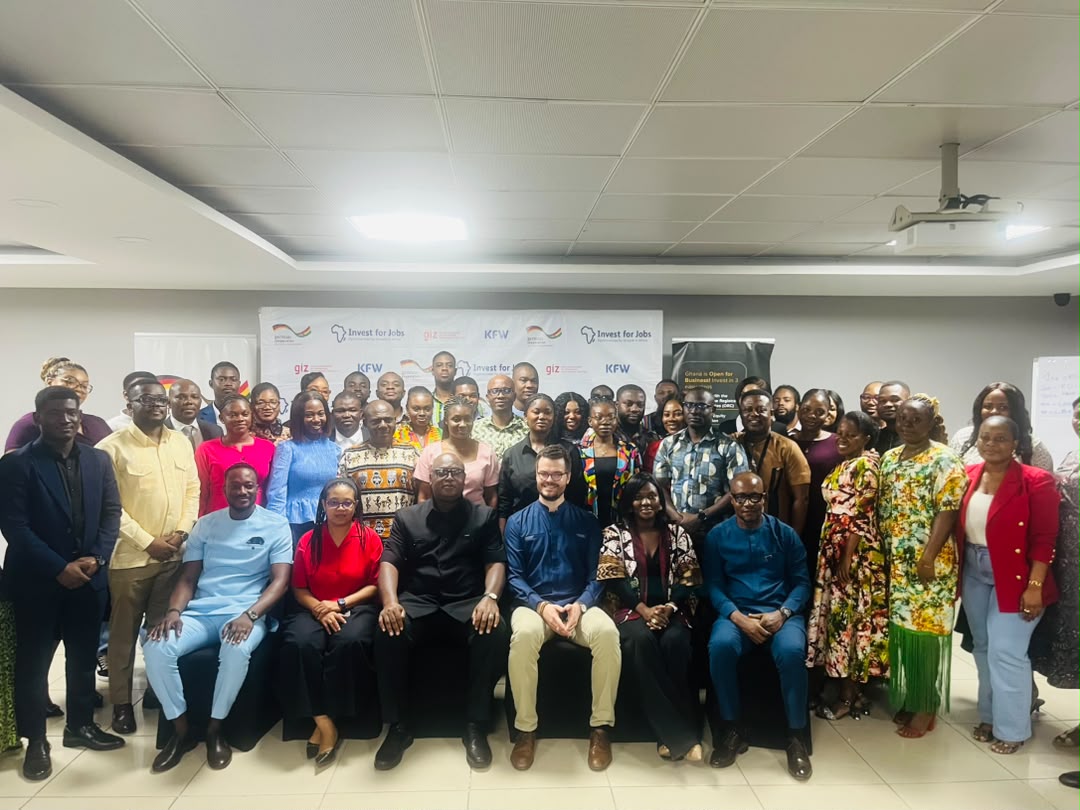

- GIPC, GIZ Train 50 Staff to Sharpen Ghana’s Investment Promotion Capacity
The Ghana Investment Promotion Centre has strengthened the capacity of 50 staff members as part of efforts to improve Ghana’s competitiveness in attracting, facilitating and retaining quality investments.
The training, delivered through a five-day Investment Promotion Workshop organised in partnership with German Development Cooperation through GIZ Ghana, forms part of a broader institutional reform push to modernise Ghana’s investment promotion architecture at a time when countries are competing more aggressively for capital, technology and strategic partnerships.
The programme targeted officers across key operational departments of the Centre, including investment promotion and business development, investor services, research and international cooperation, aftercare, investor grievance management, regional operations, marketing and communications.
The initiative reflects the changing role of investment promotion agencies globally. Increasingly, such agencies are moving beyond traditional investment attraction and promotional activity toward proactive investment generation, sector targeting, investor intelligence, facilitation, aftercare and retention.
For Ghana, that shift is critical. Attracting foreign direct investment is no longer simply about presenting the country as politically stable or resource-rich. Investors are increasingly looking for clear opportunities, credible data, predictable regulation, responsive institutions, efficient aftercare and strong coordination across government.
Simon Hochstein, Head of Component, Invest for Jobs at GIZ Ghana, said stronger institutional capacity remains central to building a competitive and sustainable investment ecosystem.
“Strengthening the capacity of investment promotion professionals is essential to building a competitive and sustainable investment ecosystem,” he said.
He added that the programme equips GIPC officers with the knowledge and tools needed to attract quality investments, enhance investor confidence and contribute to Ghana’s economic transformation.
The workshop exposed participants to international best practices through practical case studies, interactive discussions and collaborative exercises. The sessions focused on investment intelligence, sector targeting, investor facilitation, retention strategies, stakeholder coordination and the use of modern tools in investment promotion.
GIZ said the programme promoted a whole-of-institution approach to investment promotion, recognising that every department within an investment agency contributes to shaping the investor experience.
That approach is significant because investors rarely judge a country’s investment climate by one institution alone. Their decisions are shaped by the speed of responses, the quality of information received, the clarity of procedures, the consistency of communication and the ability of public institutions to solve problems when they arise.
Chief Executive Officer of GIPC, Simon Madjie, said the training had improved staff understanding of their professional responsibilities and strengthened their capacity to support the Centre’s expanding mandate.
“The knowledge and practical insights you have gained should be reflected in the quality of your work, the standard of your engagement with investors and stakeholders, and your contribution to strengthening the Centre’s performance,” Mr Madjie said.
He reaffirmed management’s commitment to continuous learning and professional development, noting that improved staff capability will be essential if GIPC is to deliver more effective investor services.
The training comes as Ghana seeks to leverage its position as host of the African Continental Free Trade Area Secretariat to attract regional and international investors seeking access to the wider African market.
That ambition places additional responsibility on GIPC. Ghana’s investment proposition must now be framed not only around the domestic market, but also around regional value chains, export platforms, manufacturing opportunities, logistics, agribusiness, services, technology and job-creating investment.
With competition for foreign direct investment intensifying across emerging markets, institutional readiness has become a decisive factor. Countries that identify investors more strategically, respond faster, package bankable opportunities better and support investors after entry are more likely to secure long-term capital.
The workshop was implemented under Germany’s Federal Ministry for Economic Cooperation and Development Special Initiative, “Decent Work for a Just Transition,” through the Invest for Jobs programme. The initiative supports investments with significant employment potential across Africa.
The partnership between GIPC and GIZ is therefore not only a training intervention. It is part of a wider effort to strengthen Ghana’s private-sector ecosystem, improve investor confidence and build the institutional foundation required for long-term economic transformation.
For GIPC, the immediate test will be whether the training translates into improved investor engagement, better project preparation, stronger aftercare, faster issue resolution and more effective regional investment promotion.
For Ghana, the broader challenge remains clear: attracting quality capital will require more than incentives. It will require credible institutions, well-prepared investment opportunities, transparent processes and a stronger focus on investments that create jobs, transfer technology and expand productive capacity.
The GIPC-GIZ initiative is therefore a timely step in strengthening the country’s investor-facing machinery. Its success will ultimately be measured by how effectively Ghana converts investor interest into sustainable projects, employment and economic growth.

