

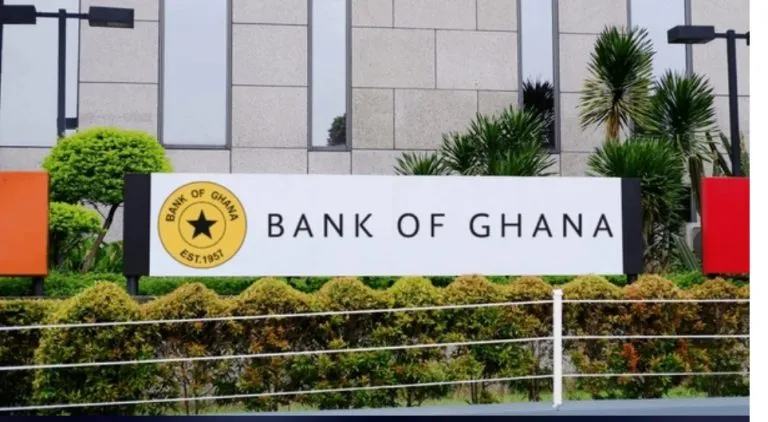

- Average Bank Loan APR Hits 17.64% as Household Rates Climb To 39.27%
The Bank of Ghana’s latest annualised percentage rate data shows that borrowing costs for households, small businesses and corporates remain uneven across the banking industry, with advertised APRs ranging from as low as 5.03% to as high as 39.27% in May 2026.
The report, compiled from information submitted to the central bank by banks, covers one-year, three-year and five-year loan facilities for households, SMEs and corporates. The APR, according to the Bank of Ghana, reflects the true cost of a loan and includes the Ghana Reference Rate, bank-specific risk premiums and other bank-specific charges.
The May Ghana Reference Rate stood at 10.03%, while the average APR across all categories was 17.64%. The lowest reported APR was 5.03%, offered by OmniBSIC Bank Ghana Limited on five-year household credit, while the highest reported APR was 39.27%, charged by Universal Merchant Bank Limited on three-year household credit.
The data points to a significant dispersion in lending costs even within the same banking system, raising important questions about credit pricing, borrower risk assessment, fees, competition and the speed with which lower benchmark rates are transmitted to customers.
For households, the most expensive category was three-year credit, where Universal Merchant Bank reported an APR of 39.27%. The lowest rate in that same category was 11.59%, offered by Stanbic Bank Ghana Limited. For one-year household loans, Agricultural Development Bank reported the highest APR at 28.13%, while Stanbic Bank reported the lowest at 11.62%.
Five-year household credit showed the widest and most striking contrast. United Bank for Africa Ghana reported the highest APR at 32.97%, while OmniBSIC Bank Ghana reported the lowest APR of 5.03%. That gap highlights the importance of comparison shopping by borrowers, especially for longer-tenor facilities where small differences in loan cost can translate into large repayment burdens over time.
For SMEs, the highest one-year APR was 33.58%, reported by Guaranty Trust Bank Ghana, while Standard Chartered Bank Ghana recorded the lowest at 11.03%. On three-year SME credit, Universal Merchant Bank again reported the highest APR at 31.09%, compared with the lowest of 13.34% at Stanbic Bank Ghana. For five-year SME loans, Agricultural Development Bank reported the highest APR of 25.07%, while Ecobank Ghana recorded the lowest at 13.97%.
The SME figures are particularly important because small businesses remain central to job creation, production and domestic enterprise growth. High borrowing costs can limit working capital, delay expansion and discourage formal credit use, especially among firms already exposed to high operating costs, tax pressures and uncertain demand conditions.
Corporate borrowers generally appeared to benefit from lower borrowing costs than households and SMEs, reflecting stronger balance sheets, better collateral, larger transaction sizes and lower perceived risk. The lowest one-year corporate APR was 7.62%, offered by Absa Bank Ghana, while the highest was 24.67%, reported by Guaranty Trust Bank Ghana.
For three-year corporate credit, Absa Bank again reported the lowest APR at 9.78%, while Agricultural Development Bank recorded the highest at 23.56%. Five-year corporate credit showed a wider range, with Ecobank Ghana reporting the lowest APR at 13.16% and United Bank for Africa Ghana reporting the highest at 35.52%.
The report reinforces a long-running concern in Ghana’s credit market: policy-rate reductions and lower reference rates do not automatically translate into cheaper credit for all borrowers. The final cost to borrowers is shaped by risk premiums, bank charges, borrower profile, collateral quality, tenor and each bank’s internal pricing model.
The central bank itself cautions that the published APRs are indicative. A typical customer may face an actual APR different from the reported figure, depending on the bank’s assessment of the borrower’s specific circumstances.
Still, the publication gives borrowers an important transparency tool. It allows households, SMEs and corporates to compare indicative borrowing costs across banks before beginning loan negotiations.
The data also shows that fees and charges remain a material part of the effective borrowing cost. In several categories, processing fees, facility fees, insurance fees and arrangement fees contributed to the final APR beyond the lending rate itself. This means borrowers who focus only on the quoted interest rate may underestimate the true cost of credit.
For example, one-year household credit showed lending rates that differed significantly by bank, with some institutions reporting average lending rates close to the Ghana Reference Rate while others applied wider spreads. Stanbic Bank’s one-year household APR stood at 11.62%, while Agricultural Development Bank’s APR reached 28.13%.
In the one-year SME category, Standard Chartered Bank reported an average APR of 11.03%, while Guaranty Trust Bank Ghana reported 33.58%. GCB Bank also recorded a relatively high SME APR of 29.54%, while Agricultural Development Bank reported 27.48%.
For corporate borrowers, one-year facilities were priced more competitively by some banks. Absa Bank Ghana recorded an APR of 7.62%, while Standard Chartered Bank Ghana posted 8.70%. By contrast, Guaranty Trust Bank Ghana reported 24.67% and Agricultural Development Bank recorded 23.82%.
The sharp variation in APRs suggests that Ghana’s credit market remains segmented. Stronger borrowers, particularly corporates with better credit profiles, appear to access cheaper funding, while households and SMEs continue to face higher costs and wider spreads.
For policymakers, the figures underline the need to deepen competition, improve credit information systems, reduce default risk, strengthen collateral enforcement and encourage more efficient transmission of monetary policy to the real economy.
For banks, the data also carries reputational pressure. As the Bank of Ghana continues to publish comparative APRs, institutions with persistently high borrowing costs may face greater scrutiny from customers, analysts and regulators.
The central issue is not only whether interest rates are falling, but whether credit is becoming affordable enough to support consumption, enterprise growth and investment.
The May 2026 APR data shows that Ghana’s lending market is gradually becoming more transparent. But it also shows that the cost of borrowing remains high and highly uneven, particularly for households and SMEs that are most sensitive to credit costs.

