

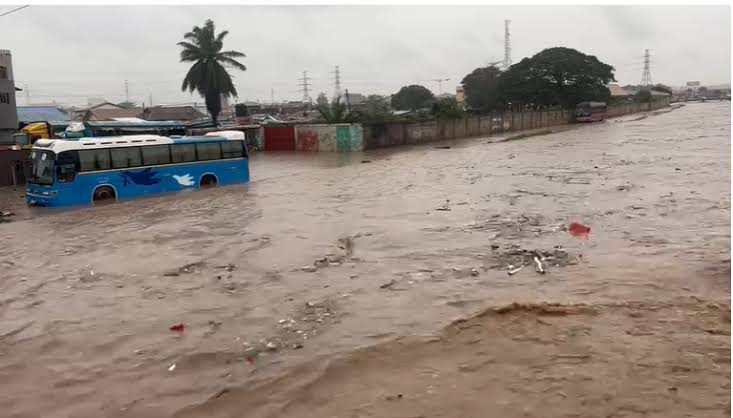

- DACF Tells Assemblies Flood Fight Is Already in their Mandate
The Office of the Administrator of the District Assemblies Common Fund has urged Metropolitan, Municipal and District Assemblies to treat flood prevention as a core statutory responsibility, warning that Ghana’s worsening urban flooding problem will not be solved by new laws or fresh institutions but by enforcement, coordination and disciplined use of existing financing.
In a July 2026 thought leadership paper titled The Flood Is Already in Your Mandate, the DACF said Assemblies already have the legal authority, planning responsibility and financing channels required to act decisively against flooding in their jurisdictions. The paper, issued for official circulation to MMDAs, argues that the challenge is not the absence of policy instruments but the failure to deploy them consistently.
The intervention follows an open letter addressed to President John Dramani Mahama on June 29, 2026 by a citizen, Moses Kanduri, who called for international engineering expertise, underground stormwater infrastructure, stronger planning enforcement and a fundamental rethinking of how Ghana’s cities are built.
While acknowledging the authenticity of the public frustration, the DACF said most of the solutions being demanded already exist within Ghana’s governance framework.
“The binding constraint is not law or institutions but enforcement, inter-agency coordination, financing continuity across electoral cycles, and political resolve against encroachment interests the President himself has named,” the paper said.
The statement is a pointed message to local authorities. It shifts the flood conversation away from general national lamentation and places responsibility directly on Assemblies, especially in areas where poor drainage, weak planning enforcement, waterway encroachment and fragmented local investment have repeatedly turned rainfall into disaster.
According to the DACF, a National Anti-Flood Taskforce has already been constituted, chaired by the Deputy Chief of Staff in charge of Operations, with the Ministers for Water Resources, Works and Housing, Local Government, National Security and NADMO represented. The paper also notes that the Greater Accra Flood Control Master Plan is being integrated into Ghana’s National Climate Resilience Strategy.
The World Bank-financed Greater Accra Resilient and Integrated Development programme, with an investment envelope exceeding US$350 million, is already delivering major structural drainage works, including dredging of the Odaw Basin, channel lining, detention ponds and pump station rehabilitation.
The DACF also pointed out that the “living with water” philosophy often cited from the Netherlands is already embedded in the GARID engineering approach, with Dutch Government support through performance-based contracting on basin dredging.
That argument is important because it challenges the perception that Ghana must first import an entirely new flood management model before meaningful progress can be made. The DACF’s position is that international technical expertise is already involved, but must be deepened, sequenced and matched by local enforcement.
A central part of the paper is the financing argument. The DACF notes that the President’s 2025 directive routing 80.00% of Common Fund allocations directly to MMDAs was intended to strengthen local government capacity to respond to precisely such challenges. It further states that the Common Fund has always been a constitutionally mandated financing line for district drainage and sanitation under Article 252 and Act 936.
The paper is therefore blunt in its diagnosis: Ghana’s flood response deficit is not primarily about law, institutions or money. It is about sequencing, enforcement and the willingness of every tier of government to exercise powers it already holds.
The DACF identifies several responsibilities that Assemblies must now treat as operational imperatives. These include development control and planning enforcement under the Land Use and Spatial Planning Act, 2016, Act 925, and the Local Governance Act, 2016, Act 936. Assemblies, the paper said, already possess instruments such as stop-work orders, abatement notices and statutory demolition processes.
But it also cautions against unlawful or politically theatrical enforcement. The paper stresses that enforcement must proceed through statutory notice and due process, warning that actions taken outside legal procedure could be overturned in court and weaken public confidence.
“Process is not the enemy of urgency. Process is what makes urgency durable,” the paper said.
On riparian buffer zones, the DACF said Assemblies must audit compliance across their areas, identify encroachments and initiate statutory removal processes where violations are confirmed. It warned that delay in addressing waterway encroachment amounts to complicity in the next flood.
The paper also places strong emphasis on district-level drainage investment. It says DACF allocations are a legitimate capital financing line for cleaning drains, maintaining culverts, desilting local channels and connecting community-level systems to larger basin works being executed under GARID.
That “last-mile” point is crucial. Major national drainage projects may fail to deliver their full benefit if local drains, culverts and community channels remain blocked, poorly maintained or disconnected from larger infrastructure. In effect, billions spent upstream can be undermined by neglect at the Assembly level.
The DACF further urged Assemblies to make flood risk management a central objective in their Medium-Term Development Plans, rather than treating it as an annex. It said where current plans do not reflect flood resilience as a priority, revision is overdue.
On resettlement, the paper warned Assemblies against arbitrary relocation of communities affected by flood control works. It said Article 20 of the Constitution requires prompt, fair and adequate compensation, while the Land Act, 2020, Act 1036, governs compulsory acquisition. For GARID-financed works, the World Bank’s Environmental and Social Framework also requires formal resettlement processes.
The paper describes Ghana’s central governance challenge as the absence of a rules-based society rather than the absence of rules. It says the country has legislation, institutions and increasingly financing, but has lacked consistent enforcement insulated from political and commercial pressure around waterway encroachment.
With GARID expected to close in December 2027, the DACF warned that Assemblies must match the pace of national infrastructure delivery with local enforcement, planning compliance and last-mile drainage investment. Failure to do so, it said, would amount to building infrastructure into an environment that continues to undermine it.
The financing structure, according to the DACF, is clear: 80.00% of DACF flows directly to MMDAs for local priorities including drainage, GARID finances major capital works, and the national budget under the Public Financial Management Act covers the balance. “Money and mandate are present. The remaining variable is Assembly-level will,” the paper said.
The Office of the Administrator said it will work with relevant ministries and the Anti-Flood Taskforce Secretariat to track flood-related capital expenditure by MMDAs and ensure that direct disbursements are channelled into compliant, costed and properly sequenced drainage programmes.
It also plans to engage the National Development Planning Commission to align DACF disbursement reporting with MMDA development plan milestones on flood resilience, making the Fund’s contribution measurable, auditable and publicly accountable.
The message to Assemblies is direct. Ghana does not need to wait for another law, another taskforce or another funding source before acting on floods. The mandate already exists.
“The floods are not waiting for new laws. The mandate is already yours. Use it,” the paper concluded.

