


- Investor Service Quality Critical to Ghana’s FDI Ambitions – GIPC
The Ghana Investment Promotion Centre is strengthening the technical capacity of its workforce as Ghana seeks to defend and improve its position in an increasingly competitive global market for foreign direct investment.
The move comes at a time when countries across Africa and other emerging markets are intensifying efforts to attract limited investment flows, making the quality of investment promotion, investor facilitation and aftercare a critical part of national competitiveness.
Chief Executive Officer of the GIPC, Simon Madjie, said the changing investment environment requires the Centre to build a highly skilled and responsive team capable of delivering world-class investor services across the full investment cycle.
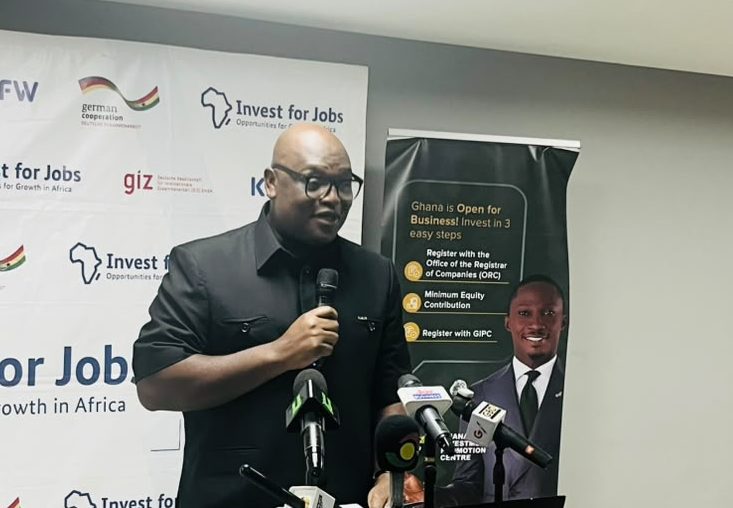
Speaking at the closing ceremony of a five-day investment promotion capacity-building workshop for GIPC staff in Accra, Mr Madjie said Ghana cannot rely on its natural advantages alone, but must ensure that the institutions responsible for engaging investors are technically prepared, commercially aware and service-oriented.
“Ghana is competing with many other countries for foreign direct investment, and investors today have more choices than ever before,” he said.
The workshop was organised with support from GIZ under Germany’s BMZ Invest for Jobs Special Initiative. It focused on strengthening staff capacity in digital investment promotion, investor facilitation, strategic investment marketing, negotiation, stakeholder engagement and communication.
For the GIPC, the training forms part of a broader institutional effort to modernise Ghana’s investment facilitation architecture and position the country more effectively in the global investment market.
Mr Madjie said modern investment promotion agencies are expected to do more than provide information to prospective investors. They must identify bankable opportunities, target investors strategically, provide credible market intelligence, support investment decisions, coordinate across government agencies and deliver effective aftercare once investors are established.
He said the training was designed to equip staff with the professional judgement, technical understanding and practical tools required to meet those expectations.
“The knowledge and practical insights you have gained should reflect in the quality of your work, the standard of your engagement with investors and stakeholders, and the contribution you make to strengthening the performance of the Centre,” he told participants.
The comments underscore a growing recognition that investment attraction is increasingly shaped by institutional efficiency. Investors assessing Ghana do not only look at market size, political stability, natural resources or incentives. They also assess how quickly institutions respond, how clearly opportunities are presented, how predictable regulatory processes are, and how effectively concerns are resolved.
In that context, the GIPC’s role has become more central to Ghana’s economic strategy, particularly as the government seeks to attract sustainable investment into sectors capable of supporting growth, exports, industrialisation and job creation.
Mr Madjie also highlighted the importance of GIPC’s regional offices, describing staff stationed across the country as important ambassadors for Ghana’s investment drive.
He said investment promotion must not be limited to Accra, particularly as many of Ghana’s strongest opportunities in agribusiness, manufacturing, logistics, tourism, renewable energy and agro-processing are located outside the capital.
The regional offices, he noted, are expected to help identify local investment opportunities, engage domestic and foreign investors, support regional economic development and ensure that Ghana’s investment story reflects opportunities across the country.
The GIPC CEO said every interaction between staff and investors matters, because investor confidence is shaped not only by policy statements but by the practical experience investors have when dealing with state institutions.
“The experience investors have with GIPC is shaped by every interaction they have with us. The professionalism, responsiveness and commitment you demonstrate each day will influence how they perceive our institution and, ultimately, Ghana as an investment destination,” Mr Madjie added.
His remarks point to a wider challenge facing Ghana’s investment climate. The country has long presented itself as one of West Africa’s most stable and attractive investment destinations, but it now faces stronger competition from peer economies offering improved business reforms, targeted incentives, sector-specific investment programmes and faster administrative processes.
Attracting quality investment will therefore require more than promotional campaigns. It will demand better coordination between ministries, agencies and local authorities, clearer project pipelines, faster investor facilitation, credible data, stronger aftercare and consistent policy implementation.
The capacity-building programme is also expected to support GIPC’s expanded mandate, which places greater emphasis on investment generation, facilitation, tracking, policy advocacy and investor support.
Mr Madjie said management remains committed to continuous professional development to ensure the Centre is able to deliver effectively on that mandate.
He expressed appreciation to GIZ for its continued support, describing the partnership as vital to strengthening institutional capacity within Ghana’s investment promotion ecosystem.
The collaboration with GIZ also reflects the growing role of development partners in supporting investment readiness, especially in countries seeking to mobilise private capital for job creation and structural transformation.
For Ghana, the stakes are significant. Foreign direct investment can support industrial upgrading, technology transfer, export diversification and employment, but only when supported by strong institutions, predictable policy and a competitive operating environment.
The GIPC’s latest training initiative is therefore not simply an internal staff development exercise. It is part of a broader attempt to sharpen Ghana’s investor-facing machinery at a time when capital is becoming more selective, investors are demanding clearer value propositions, and countries are competing aggressively for the same pools of investment.
The challenge now is to translate the new skills into measurable improvements in investor engagement, faster facilitation, better opportunity packaging and stronger investor confidence.
If the Centre succeeds, it could strengthen Ghana’s ability to attract the kind of sustainable investment needed to support growth, exports and jobs in a more competitive global economy.

