

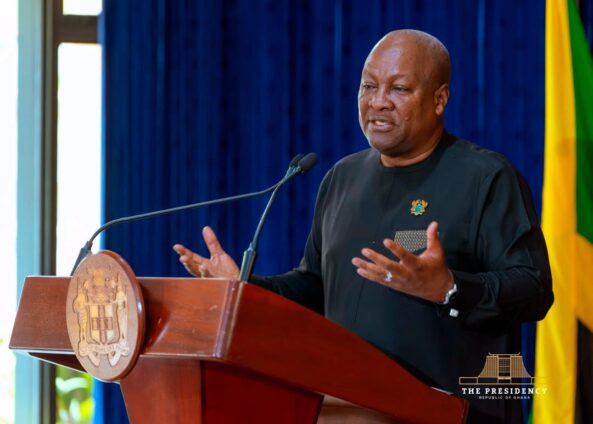

- President Mahama Says Africa’s Next Liberation Struggle Is Economic Independence
President John Mahama has called for a new phase of African liberation centred on economic independence, arguing that the continent’s most consequential battle is no longer political sovereignty but the ability to build productive economies, industrialise, create jobs and retain more value from its natural resources.
Speaking during talks with Jamaican Prime Minister Andrew Holness, Mahama said Africa had largely completed the historic struggle for political independence but had yet to secure the level of economic self-reliance required to deliver sustained prosperity.
He described economic transformation as the continent’s “next battle”, framing the issue as a continuation of Africa’s broader liberation project.
The argument is significant because it shifts the development debate away from sovereignty in a constitutional sense towards sovereignty in production, trade, finance and industrial capability.
For Mahama, political independence without a sufficiently strong productive base leaves African economies vulnerable to external shocks, commodity-price cycles, imported inflation and dependence on foreign capital and technology.
The challenge, therefore, is not simply to grow faster, but to change the structure of African economies.
That means expanding manufacturing, building regional value chains, increasing agricultural productivity, creating higher-value employment and processing more of the continent’s natural resources before export.
Mahama’s comments also placed stronger Africa-Caribbean economic cooperation within that wider strategy.
He argued that the two regions share not only deep historical and cultural ties but also significant commercial opportunities that remain underdeveloped.
Closer trade, investment and industrial cooperation, he suggested, could help African and Caribbean economies diversify away from traditional markets and develop new business relationships anchored in shared interests.
That agenda could become increasingly important as global trade patterns fragment and countries seek to reduce excessive dependence on a small number of external markets.
For African businesses, the Caribbean represents a relatively underexplored commercial corridor. For Caribbean economies, stronger engagement with Africa could create access to a large and increasingly integrated continental market.
Mahama’s position is also closely aligned with Ghana’s support for the African Continental Free Trade Area.
AfCFTA is intended to reduce trade barriers across the continent and create a single market capable of supporting larger-scale production.
But its long-term success depends on African countries producing more goods that can actually be traded among themselves.
That is why industrialisation sits at the centre of the economic independence argument.
If intra-African trade expands primarily through imported finished goods being redistributed across borders, the continent would capture only a limited share of the value generated.
Greater economic sovereignty requires stronger domestic and regional production.
That could include processing cocoa into finished food products, refining minerals into industrial inputs, developing pharmaceuticals, expanding petrochemicals and manufacturing machinery, textiles and consumer goods.
Africa possesses significant natural resources but has historically captured a relatively small share of the value created after those resources enter global supply chains.
Mahama’s intervention therefore reinforces a long-standing concern among African policymakers: the continent often exports raw materials and imports higher-value finished products manufactured from those same resources.
Changing that structure requires capital, energy, infrastructure, skills and policy consistency.
Many individual African economies are too small to support globally competitive industrial production at scale. A continental market provides manufacturers with a larger customer base and potentially allows firms to spread fixed costs across multiple countries.
Mahama’s Africa-Caribbean proposal extends the same logic beyond the continent.
Stronger commercial links could create new markets for African manufactured products, agricultural goods, financial services and technology while opening additional investment opportunities.
The message also carries implications for Ghana’s own economic strategy.
As one of the principal advocates of AfCFTA and host of its Secretariat, Ghana has sought to position itself as a gateway for continental trade and investment.
If Mahama’s economic emancipation agenda is to translate into policy, Ghana will need to demonstrate domestically the kind of structural transformation being advocated at the continental level.
That means addressing longstanding constraints including the cost of finance, unreliable infrastructure, logistics bottlenecks, skills gaps and the relatively low level of manufacturing in the economy.
Economic independence, in that sense, does not mean isolation.
Mahama’s comments point instead towards a model built on stronger African productive capacity combined with deeper trade and investment relationships globally.
The objective is to engage the world from a position of greater economic strength rather than dependence.
Africa will continue to require foreign capital, technology and international markets. The policy challenge is ensuring those relationships support domestic value creation rather than reinforcing a pattern in which raw materials leave the continent while higher-value production takes place elsewhere.
The president’s emphasis on production and jobs also reflects Africa’s demographic reality.
With a young and rapidly growing population, the continent will need to create millions of productive jobs over the coming decades.
Political stability alone will not be sufficient if economies cannot absorb that labour force into productive activity.
Industrialisation, services, agriculture and cross-border trade will therefore increasingly be judged by their capacity to generate employment and improve living standards.
For investors, Mahama’s argument suggests that Ghana and other African governments may place greater emphasis on sectors capable of advancing value addition, export diversification and regional integration.
That could increase policy attention on manufacturing, agro-processing, logistics, energy and infrastructure.
Africa has produced numerous industrial strategies and integration agreements over several decades, but execution has often been constrained by fragmented markets, weak infrastructure, policy inconsistency and financing gaps.
President Mahama’s formulation therefore sets a demanding standard. If economic independence is to become Africa’s next liberation struggle, success will require more than political declarations.
It will require countries to build competitive firms, invest in productive capacity, deepen regional trade and create institutions capable of sustaining industrial policy over decades.
The central message is that Africa’s political independence was only one stage of the continent’s development journey.
The next, in Mahama’s view, is to convert sovereignty into productive power an economy capable of creating jobs, adding value and engaging the rest of the world on stronger commercial terms.

