

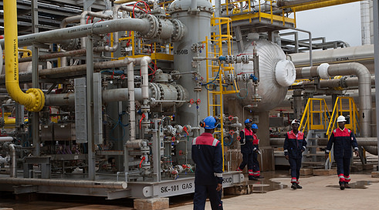

- Africa Needs Pipelines, Processing and Storage to Turn Gas Reserves into Economic Value — Ghana Gas
Africa’s natural gas opportunity is being constrained less by the availability of resources than by the infrastructure required to process, transport, store and distribute them, Ghana National Gas Company chief executive Judith Adjobah Blay has warned.
Ms Blay is calling for significantly greater investment in the continent’s midstream gas infrastructure, arguing that the next phase of Africa’s energy development will depend on connecting existing gas resources to the power plants, industries and markets that can convert them into economic value.
“Africa has the gas resources. The next frontier is building the infrastructure that connects those resources to the people, industries and economies that need them,” she said during Africa Oil Week 2026 in Accra.
Her comments highlight one of the continent’s most persistent economic contradictions: African countries possess substantial hydrocarbon resources while businesses and households continue to contend with unreliable and expensive energy.
For Ghana, the issue is particularly consequential because gas sits at the intersection of electricity generation, industrialisation and energy security. The economic value of the resource depends not simply on what lies underground or offshore, but on whether sufficient infrastructure exists to move gas from producing fields to processing plants and from there to power stations and industrial consumers.
Ms Blay said inadequate infrastructure for processing, transportation, storage and distribution continues to prevent African economies from extracting the full value of their gas resources. She called for stronger partnerships among governments, national oil and gas companies, private investors and development institutions to mobilise the capital required to close that gap.
Africa has invested heavily in exploration and production, but the commercial value of those discoveries can remain constrained where pipelines, processing plants, compression facilities, storage systems and distribution networks are inadequate.
That creates a costly disconnect between resource ownership and economic utilisation.
Gas can effectively become stranded when there is no commercially viable route from a field to a processing facility or from a processing plant to a customer. In such circumstances, the existence of reserves does not automatically translate into energy security, industrial competitiveness or fiscal revenue.
For Ghana, that distinction matters because domestic gas has become increasingly important to the electricity-generation system. A more reliable gas network can reduce exposure to imported fuel, improve the predictability of power generation and potentially lower the foreign-exchange burden associated with energy imports.
But those benefits depend on infrastructure capable of managing changing patterns of supply and demand.
Investment in processing capacity, transmission pipelines, compression, storage and distribution therefore has consequences far beyond the petroleum sector. It can influence electricity reliability, the cost structure of manufacturers and the viability of new industrial projects.
Gas infrastructure should consequently be viewed as economic infrastructure rather than simply petroleum infrastructure.
For Ghana, that is particularly relevant as the country seeks to expand domestic production and attract investment into manufacturing and other sectors capable of creating jobs and export earnings.
A reliable gas network can support electricity generation while also providing feedstock and energy for industries such as fertiliser, petrochemicals, cement and other energy-intensive manufacturing activities.
That creates a potential multiplier effect.
Midstream infrastructure can unlock downstream investment, while stronger downstream demand can improve the economics of pipelines and processing facilities. The two sides of the market therefore need to develop together.
The central policy question is not simply how much gas Ghana possesses. It is whether the country can build a sufficiently integrated and commercially credible market to support sustained investment in both gas production and infrastructure.
If infrastructure remains inadequate, Ghana risks having resources that cannot be monetised efficiently while power producers and industries continue to face supply constraints.
A more developed network, by contrast, could provide the foundation for a stronger industrial economy and a more resilient energy system.
Large-scale gas infrastructure is expensive and generally requires long investment horizons before returns are realised. That makes financing structures particularly important.
Governments across Africa face competing demands on public resources, while private investors require predictable regulation, credible off-take agreements and confidence that infrastructure projects can generate stable cash flows.
Development finance institutions can therefore play an important role in reducing project risk and mobilising private capital.
The Africa Finance Corporation has similarly identified infrastructure as a major constraint on the continent’s ability to monetise energy resources, with opportunities extending across gas processing, LNG, gas-to-power projects and regional pipeline interconnections.
For Ghana, the financing model will matter almost as much as the physical infrastructure itself.
A heavily state-funded model could place additional pressure on public finances, while a purely private approach may struggle where demand, tariffs or payment security are insufficient to support commercial returns.
Blended financing could therefore become increasingly important, combining public investment, private capital, development finance and long-term commercial contracts.
That structure can help allocate risks more efficiently, but only if projects are supported by credible demand forecasts and commercially enforceable agreements.
Regional integration could also improve the economics.
Gas infrastructure does not necessarily need to stop at national borders. Regional pipeline systems and interconnected energy markets could allow gas-producing countries to serve neighbouring economies, creating larger demand pools and improving project viability.
For West Africa, the opportunity could be particularly significant.
Countries with gas resources could increasingly supply neighbouring markets where power systems and industries require more reliable fuel. Larger regional markets could support infrastructure projects that individual domestic markets may struggle to justify on their own.
But that will require coordinated regulation, compatible infrastructure standards and contracts that remain credible across jurisdictions.
The economic prize is potentially substantial: a regional gas market large enough to support investment, improve energy security and strengthen industrial competitiveness.
Ms Blay’s intervention therefore points to a broader development challenge.
Africa’s energy problem can no longer be described simply as one of resource scarcity. It is increasingly a problem of infrastructure, capital allocation and execution.
A country can possess gas and still experience energy insecurity.
It can attract exploration investment while failing to build the pipelines and processing infrastructure required to turn those discoveries into reliable power or industrial feedstock.
The solution lies in building the connective tissue between resources and economic activity.
For Ghana, that means continued investment in midstream infrastructure alongside stronger demand, credible regulation and financing structures that do not create unsustainable liabilities for the state.
The long-term objective should be clear: turn gas into lower-cost and more reliable energy, stronger industrial capacity and new sources of investment.

