- Lawyer Challenges GRA Passenger-Duty Discretion Under Ghana’s Exemptions Regulations
A Ghanaian lawyer has filed a constitutional action at the Supreme Court challenging the authority of the Commissioner-General of the Ghana Revenue Authority to determine, on a case-by-case basis, whether goods carried by individual passengers qualify for customs-duty exemptions.
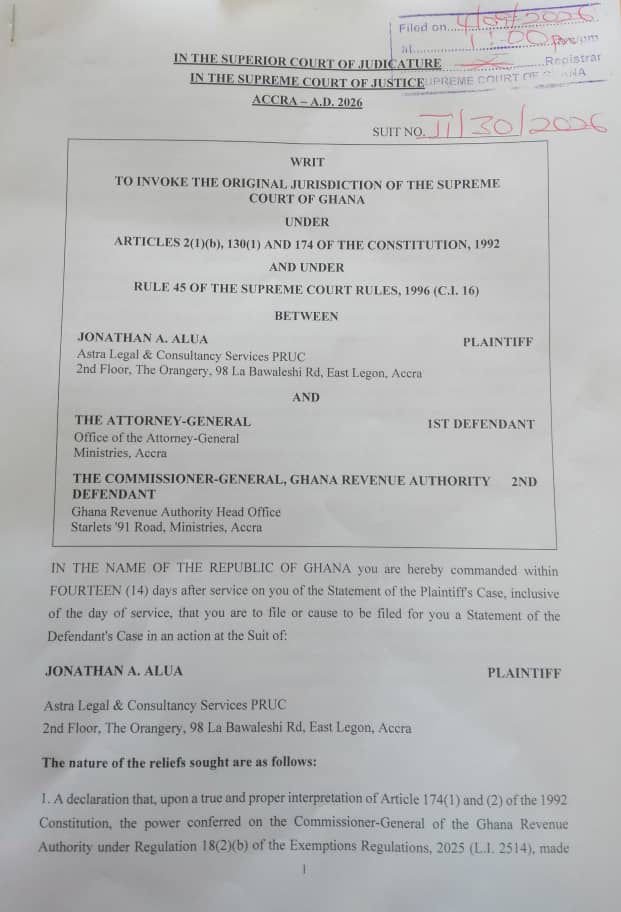
Jonathan A. Alua is asking the Court to declare that aspects of Regulation 18(2)(b) of the Exemptions Regulations, 2025 (L.I. 2514) are inconsistent with Ghana’s 1992 Constitution to the extent that they permit the Commissioner-General, or Customs officers acting under the Commissioner-General’s authority, to grant or withhold exemptions without prior parliamentary approval.
The action, filed in the Supreme Court’s original jurisdiction in Accra, names the Attorney-General as the first defendant and the Commissioner-General of the Ghana Revenue Authority as the second defendant.
At the centre of the dispute is the relationship between the administrative powers exercised under the Exemptions Regulations and Article 174 of the Constitution, which governs the imposition and waiver of taxation.
The plaintiff argues that the power granted under Regulation 18(2)(b), when read alongside section 17(3) of the Exemptions Act, 2022 (Act 1083), effectively allows the Commissioner-General to determine the quantity of a passenger’s baggage that may be exempted from customs duties and taxes without first obtaining approval from Parliament.
Mr Alua contends that such discretion amounts to the exercise of a power to waive or vary taxation in favour of individual persons or authorities and should therefore be subject to parliamentary approval under Article 174(2) of the Constitution.
The reliefs sought go beyond a general interpretation of the law.
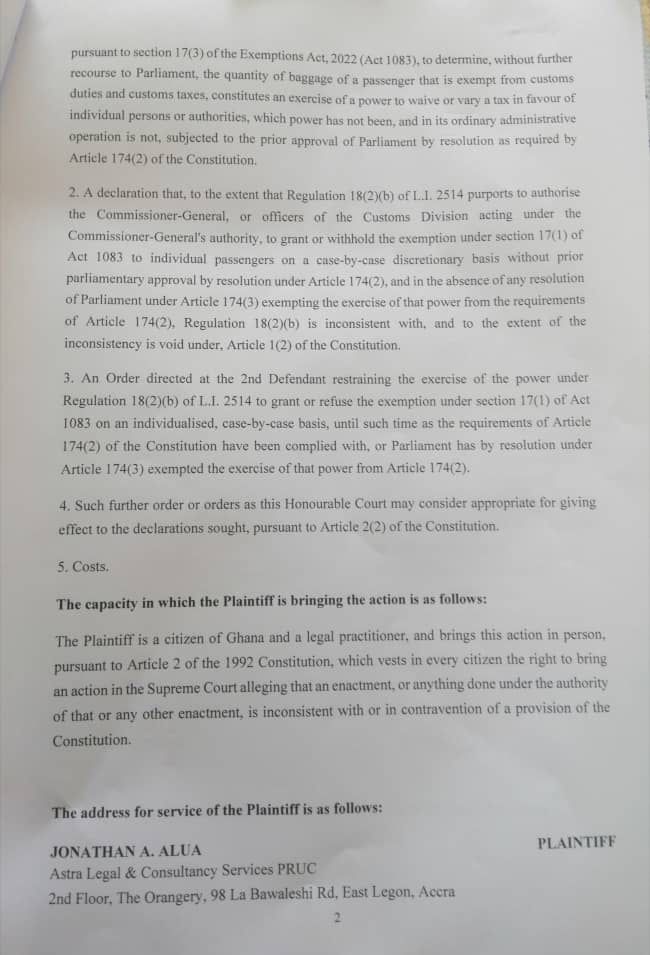
The plaintiff wants the Supreme Court to declare that, to the extent Regulation 18(2)(b) authorises the Commissioner-General or Customs officers to grant or withhold exemptions to individual passengers on a discretionary, case-by-case basis without prior parliamentary approval, the provision is inconsistent with the Constitution and should be declared void to that extent.
He is also seeking an order restraining the Commissioner-General from exercising the power under Regulation 18(2)(b) to grant or refuse exemptions under section 17(1) of Act 1083 on an individualised basis until the constitutional requirements he relies upon have been satisfied.
The writ asks the Court to maintain that restraint until Parliament has acted by resolution under the relevant constitutional provisions or otherwise exempted the exercise of the power from those requirements.
The plaintiff is additionally seeking any further orders the Court considers appropriate to give effect to the declarations sought, as well as costs.
The case could have important implications for the way Customs officers treat passenger baggage and personal effects at Ghana’s ports of entry, particularly where officers exercise discretion over whether particular items qualify for duty exemptions.
That issue has recently attracted heightened public attention following debate over how Customs should treat mobile phones and other personal items carried by travellers.
The constitutional action, however, goes beyond any specific category of goods. Its broader concern is whether an administrative officer can effectively determine individual tax exemptions without Parliament having directly approved the exercise of that discretion.
Mr Alua states that he is bringing the action in his capacity as a citizen of Ghana and a legal practitioner under Article 2 of the Constitution, which allows a citizen to invoke the Supreme Court’s jurisdiction where an enactment, or an act carried out under an enactment, is alleged to be inconsistent with or in contravention of the Constitution.
The case therefore raises a fundamental separation-of-powers question.
Tax administration necessarily involves discretion. Customs officers routinely have to assess the nature, quantity and purpose of goods carried by travellers and determine whether the goods fall within lawful concessions or should attract duties and taxes.
The plaintiff’s argument is that the point at which that discretion becomes an individualised power to grant or withhold a tax exemption engages constitutional safeguards over who is permitted to waive taxation.
If the Supreme Court accepts that interpretation, the consequences could extend beyond passenger baggage procedures.
The ruling could clarify the boundary between Parliament’s constitutional authority over taxation and the administrative powers that may lawfully be delegated to tax authorities when implementing exemptions already provided for under legislation.
For GRA, the operational issue is equally significant. Modern customs administration depends heavily on officers making real-time determinations at airports, ports and land borders. Requiring a different legal framework for individual exemptions could therefore affect how passenger concessions are structured and administered.
But the case does not itself establish that the existing regime is unconstitutional. That is the question the Supreme Court is being asked to determine, and the Attorney-General and Commissioner-General will have the opportunity to respond to the plaintiff’s legal interpretation.
The writ directs the defendants to file their Statement of Defence within 14 days after service, inclusive of the day of service.
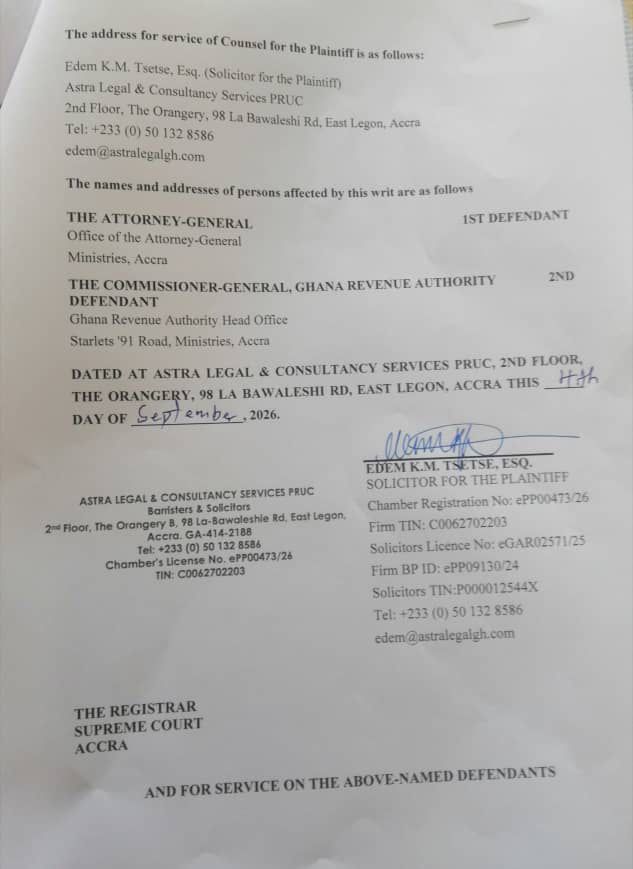
The documents show that the action was initiated in September 2026, with service addresses provided for the Office of the Attorney-General and the Ghana Revenue Authority headquarters in Accra.
The dispute could become an important test of Ghana’s constitutional architecture around tax exemptions at a time when the government is seeking to strengthen revenue mobilisation while also making customs procedures clearer and more predictable for travellers and businesses.
The central legal question is ultimately narrow but consequential: Can the Commissioner-General of the GRA determine passenger-specific customs exemptions through administrative discretion, or does such a power require prior parliamentary approval under Article 174 of the Constitution?
The Supreme Court’s answer could reshape the legal basis on which passenger concessions are administered across Ghana’s customs system.