

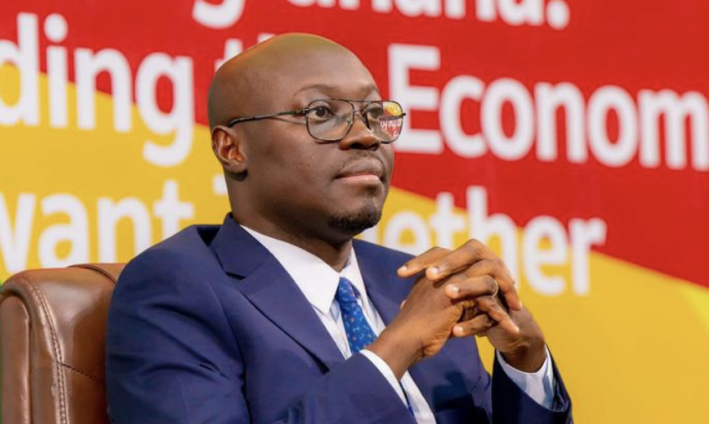

- Africa Risks Exporting Minerals and Importing Batteries Without Cheaper, Reliable Power — Ato Forson
Africa’s ambition to move from exporting raw commodities to building globally competitive manufacturing industries risks being undermined by an energy system that investors still consider too costly and risky to finance, Ghana’s Finance Minister, Dr Cassiel Ato Forson, has warned.
Speaking at the 2026 Future of Energy Conference in Accra, Dr Forson argued that industrialisation, energy security and macroeconomic stability can no longer be treated as separate policy agendas because the cost and reliability of electricity increasingly determine whether productive investment can take place.
“We cannot industrialise a continent the world considers too risky to power,” he said.
The warning captures a longstanding contradiction in Africa’s development model. The continent holds vast reserves of gas, hydro, solar and wind resources, as well as many of the minerals required for the global energy transition, yet nearly 600 million Africans still lack access to electricity and the continent attracts only about 2.00% of global clean-energy investment.
Without reliable and competitively priced electricity, African economies will struggle to process minerals, expand manufacturing, support agro-processing and build the logistics and digital infrastructure required for higher-value production.
Dr Forson said the problem begins with the broader macroeconomic environment. High inflation, exchange-rate volatility, elevated interest rates, unsustainable debt and fiscal indiscipline all increase the risk premium investors attach to long-term infrastructure projects.
That higher risk premium translates into more expensive financing, which ultimately raises the cost of electricity for businesses and households.
“Macroeconomic stability is therefore not separate from industrial policy; it is indeed the foundation,” he said.
Ghana’s recent stabilisation programme illustrates the point. Inflation has fallen sharply from crisis-era levels, economic growth has strengthened and financial conditions have begun to improve.
But Dr Forson cautioned against treating stabilisation as the end goal.
“Stability is obviously not the destination; it is the launchpad for transformation,” he said.
The accountability test is therefore whether improved macroeconomic indicators can now be converted into productive investment, industrial capacity and employment.
That transition is especially important as Africa seeks to capture more value from the global demand for lithium, cobalt, manganese, graphite and copper.
Dr Forson warned that the continent risks repeating an old pattern in which it exports raw materials and imports finished products at far higher value.
“Across Africa, we export cocoa and import chocolate. We export bauxite and import aluminium products. Now we risk exporting critical minerals only to import batteries. This must change,” he said.
The concern is that Africa could become indispensable to the global green transition without becoming significantly more industrialised itself.
Possessing critical minerals is not enough. Processing and manufacturing require dependable power, competitive logistics, skilled labour and financing structures that can support large capital-intensive projects over long periods.
That financing requirement is considerable, and many African governments have limited fiscal space because of high debt-service obligations and competing social expenditure.
Dr Forson said public budgets cannot deliver the required investment alone.
“Public budgets cannot carry this investment alone. We need guarantees, blended finance, local currency funding, deeper capital markets, and credible public-private partnerships,” he said.
That is likely to be decisive because large power projects often require financing over several decades. Where currencies are unstable, utilities financially weak and regulation unpredictable, investors demand higher returns to compensate for risk.
The result is that projects which may be technically viable can become commercially unattractive.
Reducing electricity costs therefore requires more than adding generation capacity. It also requires financially sustainable utilities, credible regulation, stronger transmission infrastructure and investment frameworks capable of attracting patient private capital.
Ghana is attempting to place energy infrastructure at the centre of its own industrial strategy.
Government is advancing plans for a 1,200-megawatt state-owned combined-cycle gas-fired power plant at Kafodzidzi-Abrobeano in the Central Region, with the first 600MW phase expected to be commissioned in 2028.
The project is intended to strengthen baseload generation and improve reliability for households and industry.
Government estimates suggest the plant could eventually contribute to a reduction in electricity tariffs of between 10.00% and 20.00%, while creating more than 2,000 direct and indirect jobs during the first phase.
Ghana is also expanding the use of domestic natural gas for power generation in an effort to reduce dependence on more expensive liquid fuels.
Government says the Gas-to-Power strategy generated fuel savings of about GH¢3.08 billion, equivalent to roughly US$268.50 million, during the first half of 2026.
For industry, those savings matter because energy costs are embedded across virtually every stage of production, from mineral processing and aluminium smelting to agro-processing, cold storage and data infrastructure.
Industrialisation under the African Continental Free Trade Area will require stronger regional power pools, interconnected transmission networks and investment strategies capable of matching areas with abundant energy resources to emerging industrial centres.
Africa may possess many of the minerals required to power the world’s transition to electric vehicles, battery storage and renewable energy, but unless the continent can also mobilise affordable capital and deliver reliable electricity at competitive prices, much of the value will continue to be captured elsewhere.
Dr Forson’s intervention therefore amounts to more than a call for additional generation capacity.
It is a challenge to governments to align macroeconomic management, energy policy and industrial strategy.
For Ghana and the wider continent, the real test will not be how much lithium, manganese, cobalt, gas or renewable potential exists beneath the ground.
It will be whether governments can build the financial and energy systems required to transform those resources before they leave African shores.
Without that shift, Africa risks remaining central to global industrial supply chains while still failing to industrialise at home.

