


- Building Inflation Rises to 4.00% As Plant, Plumbing and Tools Drive New Cost Pressure
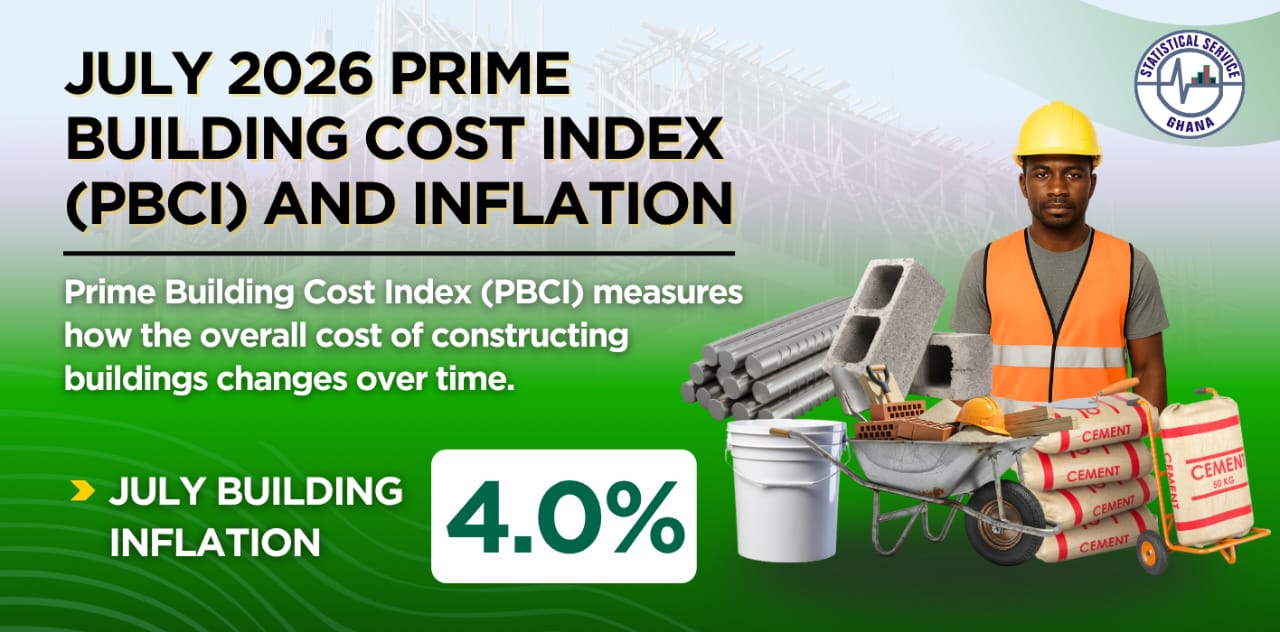
Ghana’s building-cost inflation rose to 4.00% in July 2026 from 3.10% in June, signalling a renewed but still contained increase in construction costs as higher prices for plant, tools and selected installation materials offset falling labour, cement and steel costs.
The latest Prime Building Cost Index from the Ghana Statistical Service shows that overall construction costs were 4.00% higher than a year earlier and 0.30% higher than in June. The index itself increased to 138.3 in July from 133.0 in July 2025, while annual average inflation stood at 4.90%.
The headline number remains significantly below the 14.20% recorded in July 2025, confirming that the sharp inflationary pressures that previously dominated the construction sector have eased substantially. But the underlying composition of the index suggests that the risk has shifted rather than disappeared.
The most important emerging concern is plant and equipment.
Plant inflation accelerated to 18.00% year-on-year in July from 16.00% in June, even though the category accounts for only 4.00% of the Prime Building Cost Index basket. Its month-on-month increase stood at 1.10%, and the group contributed 18.20% of the upward pressure on headline building inflation.
That is significant because the cost of machinery, equipment and tools can have an outsized effect on project budgets even when their formal weight in the index is relatively small. Construction firms do not simply buy cement, steel and sand. They rely on mixers, lifting equipment, cutting tools, generators, specialised machinery and other equipment whose acquisition and replacement costs can quickly affect project margins.
Small tools recorded inflation of 22.60%, while equipment prices were 11.90% higher than a year earlier.
The implication is that a contractor may experience lower costs for some of the most visible inputs while simultaneously facing higher expenditure on the equipment required to put those inputs to use.
Materials remain the dominant component of the index, accounting for 76.50% of the basket. Material inflation increased to 5.10% in July from 3.90% in June and contributed 97.30% of the upward pressure on the overall index.
That dominance means movements in materials will continue to determine the broad direction of construction inflation.
But here too, the July data show a deeply uneven picture.
Plumbing recorded the highest year-on-year inflation among the 23 sub-groups at 25.30%, followed by small tools at 22.60%, roofing sheets at 21.40%, glazing at 20.40% and reinforcement at 20.20%. Electrical works and metalwork both recorded 18.70%, toilet accessories rose 17.20%, ironmongery increased 16.80%, doors were up 13.00%, surface finishes rose 12.20% and equipment increased 11.90%.
Fourteen of the 23 sub-groups recorded inflation above the national building-cost average of 4.00%. Those figures matter because they show that low headline inflation does not mean broad-based cost relief.
For households, developers and contractors, the cost of a project depends heavily on what type of construction is being undertaken and which stage of the building process has been reached.
A project in its early structural phase may benefit from lower cement and steel prices. Another at the finishing and installation stage may face much stronger pressure from plumbing, electrical works, glazing, roofing and metal fittings.
This creates a more complex budgeting environment than the headline 4.00% figure might suggest.
Cement prices were 9.80% lower than a year earlier, making cement the weakest-performing sub-group in inflation terms. Steel prices were down 8.90%, fine aggregate declined 5.00%, unskilled labour fell 5.20%, and skilled labour was 2.00% lower.
The decline in cement and steel is particularly important because both are fundamental construction inputs with large effects on the cost of structural works.
For developers, that creates an opportunity to reprice certain projects or improve margins, especially where procurement contracts allow companies to take advantage of lower current market prices.
But the Ghana Statistical Service cautions against assuming that every construction input is following the same direction.
Its July release explicitly advises households to update building budgets using current prices and to compare supplier quotations rather than assuming that all materials have become more expensive. For businesses, it recommends managing exposure to plant, tools and high-inflation materials and using flexible procurement and transparent price-adjustment clauses.
That guidance is especially relevant in a sector where long project timelines can leave contractors exposed to rapid changes in input prices.
A tender priced several months earlier can become commercially unviable if selected inputs rise sharply before procurement is completed.
At the same time, price-adjustment clauses can shift risk back to clients and government, particularly on public infrastructure contracts, making accurate and timely cost data essential for protecting value for money.
The July figures also reveal a major divergence between labour and capital-related costs.
Labour inflation stood at -3.20%, meaning labour costs were lower than in July 2025, compared with plant inflation of 18.00%. Skilled labour was down 2.00%, while unskilled labour declined 5.20%.
That divergence raises an important question about the changing cost structure of Ghana’s construction industry.
If labour becomes relatively cheaper while machinery, tools and equipment become more expensive, firms may face difficult decisions over how much to automate, mechanise or substitute equipment for labour.
For smaller contractors with limited access to capital, rising machinery costs could become a significant barrier, particularly if they are forced to rent equipment at higher prices.
The figures also carry implications for government infrastructure spending. The Ghana Statistical Service argues that the lower inflation environment should be used to improve project delivery, while government should closely monitor plant and installation costs and strengthen local supply chains.
That is important because public infrastructure projects are particularly vulnerable to cost overruns when price movements are concentrated in specialised materials and machinery.
If policymakers focus only on broad construction inflation, they may underestimate the financial pressure facing specific categories of projects.
A public building requiring extensive mechanical, electrical, plumbing or specialised equipment could still experience significant cost escalation even when the overall PBCI remains low.
The data therefore support a more targeted approach to procurement and project management.
Building inflation has fallen sharply from 14.20% in July 2025 to 4.00% in July 2026. It declined steadily through much of the period, reaching 2.20% in March and April before edging up to 2.70% in May, 3.10% in June and 4.00% in July.
That trajectory suggests construction-cost disinflation has largely held, even though the pace of cost increases has begun to pick up again.
For Ghana’s property and construction markets, this could provide some relief after a period of intense cost escalation.
Lower inflation can improve the predictability of project budgets, reduce the risk premium contractors build into bids and improve the feasibility of residential and commercial developments.
But the benefit will depend on whether the current pressures in machinery and installation materials remain contained.
The July numbers show that electrical works alone accounted for 47.90% of the upward contribution to headline inflation, followed by metalwork at 27.30%, glazing at 26.20%, plumbing at 21.80% and tiles at 17.30%.
Those contributions demonstrate how inflation can become concentrated in specialised areas while basic structural materials move in the opposite direction.
The Ghana Statistical Service measures the PBCI using monthly prices for 406 construction items collected from 489 outlets across 16 markets, covering materials, labour and plant or equipment. The index is weighted across 23 sub-groups and uses 2023 as its base year.
That breadth makes the index an important signal for contractors, investors, households and policymakers attempting to understand how construction costs are evolving beyond individual supplier quotations.
The July message is therefore not simply that building inflation has risen. It is that Ghana has moved into a more uneven cost environment.
Cement, steel and labour are providing relief. Plant, plumbing, tools, roofing, glazing and reinforcement are pushing in the opposite direction.
For the construction sector, the policy and commercial challenge is to avoid mistaking low headline inflation for uniformly low cost pressure.
For households, that means budgeting carefully. For contractors, it means managing procurement risk. For government, it means protecting project delivery against cost escalation in specialised inputs.
And for investors, the most important question may no longer be whether construction costs are rising rapidly across the board. It is which parts of the cost structure are rising fastest and whether those pressures can be contained before they become the next source of broader construction inflation.

