


- Africa Will Resist New Scramble for Critical Minerals – President Mahama Tells UN
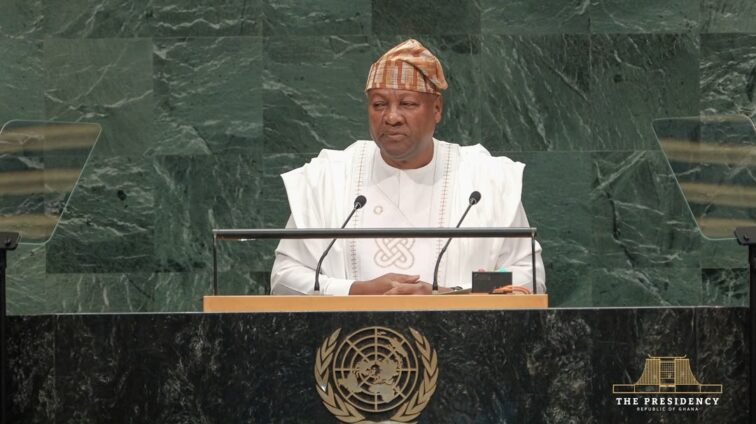
Ghanaian President John Dramani Mahama has warned that Africa will resist efforts by global powers to extract the continent’s critical minerals without building local industries, as he demanded fundamental changes to international finance, trade and political governance.
Addressing the 81st Session of the United Nations General Assembly in New York, Mr Mahama said Africa’s resources must support domestic processing, job creation and industrial development rather than reproduce extractive relationships associated with colonialism.
“Africa will not remain a passive arena for a new scramble for resources,” he said.
“Critical mineral extraction must not replicate colonial-era exploitation. We will process our minerals at home, build local industries, create dignified jobs for our youth, and retain the value of our natural resources.”
The declaration places Ghana within a growing campaign by mineral-producing countries to capture a larger share of the economic value generated by resources essential to electric vehicles, renewable-energy infrastructure, batteries and other low-carbon technologies.
African countries possess significant deposits of lithium, cobalt, manganese, graphite and other transition minerals. Yet much of the continent’s output continues to be exported in raw or minimally processed form, with manufacturing and high-value employment concentrated elsewhere.
Mr Mahama said the African Continental Free Trade Area, whose secretariat is based in Accra, should serve as the continent’s platform for deeper intra-African commerce, industrialisation and structural transformation.
“Africa does not seek charity,” he said. “Africa seeks equal partnership anchored in mutual respect.”
The Ghanaian president linked the continent’s industrial ambitions to what he described as deep inequalities within the global financial system.
Developing countries face borrowing costs as much as eight times those available to industrialised economies, he said, restricting their capacity to invest in infrastructure, healthcare, education and climate adaptation.
Governments vulnerable to climate-related disasters are frequently forced to borrow heavily to rebuild after floods and droughts for which they bear little historical responsibility.
“Governments are forced into a tragic choice: to service predatory debt or serve their people,” Mr Mahama said. “We demand reform.”
He called for long-term, affordable and accessible concessional financing that would allow developing countries to invest in human capital, industrialisation and climate resilience without deepening debt distress.
The appeal comes as African policymakers press multilateral development banks and international financial institutions to expand concessional resources, lower the cost of capital and revise risk-assessment practices that they argue penalise developing economies.
Mr Mahama also criticised “discriminatory credit ratings”, unfair trade systems and economic structures that allow value addition and employment to occur outside countries producing the underlying resources.
He presented these imbalances as modern extensions of historical exploitation rather than unrelated weaknesses within the present global economy.
“Real repair demands structural transformation,” he said. “It requires dismantling the persistent engines of exploitation: unfair global trade regimes, predatory resource extraction, discriminatory credit ratings, unsustainable debt burdens, and the continued export of raw materials from Africa while real value addition and job creation occur elsewhere.”
Reparatory justice occupied a central part of Mr Mahama’s address. He said Ghana’s campaign for international recognition of the transatlantic trafficking and enslavement of Africans was intended to promote truth, acknowledgement and meaningful repair rather than division.
“Some cautioned that we were reopening old wounds,” he said. “But we came not to provoke division or render empty judgment. We came to seek healing.”
“True healing requires truth; truth requires acknowledgement; and acknowledgement must lead to meaningful repair.”
Mr Mahama said the transatlantic slave trade should not be described in language that obscures the active role played by people, institutions and governments.
Millions of Africans “did not vanish”, he said, but were hunted, captured, trafficked, bought, sold and exploited for profit.
“Their unpaid labour built the cities, industries, banking institutions, and empires of the modern Western world,” he said. “Meanwhile, the African continent was left depopulated, with split families, structural disruption, and generational trauma.”
The president said 123 countries supported a Ghana-sponsored UN resolution on March 25, 2026, recognising the transatlantic slave trade and racialised chattel enslavement as the gravest crimes against humanity.
He welcomed moves by the Netherlands, Germany and France to engage in conversations about reparatory justice but argued that symbolic recognition must be followed by changes to contemporary economic systems.
Mr Mahama also renewed Africa’s demand for permanent representation on the UN Security Council, including the rights and veto powers enjoyed by existing permanent members.
Africa accounts for about 1.5 billion people and more than 18% of the global population, while forming the largest regional voting bloc in the General Assembly. Yet the continent has no permanent Security Council seat.
“This is fundamentally unacceptable in the 21st century,” Mr Mahama said.
“Security Council reform is not a favour to Africa; it is an imperative for the legitimacy, credibility, and survival of the United Nations.”
He argued that a governance structure based on the geopolitical settlement reached after the Second World War could no longer credibly claim to represent the sovereign equality of nations.
The president warned that the UN faced a crisis of authority as unilateral action, geopolitical rivalry and inconsistent application of international law weakened public trust in multilateral institutions.
“The veto power must never serve as a licence for impunity,” he said. “Sovereign equality cannot be a privilege reserved only for nations aligned with global superpowers.”
Mr Mahama delivered some of his strongest remarks on the conflict in Gaza, criticising what he described as diplomatic language that obscured the scale of civilian suffering.
“We must stop using diplomatic euphemisms to veil the human carnage taking place in Gaza,” he said.
He described collective punishment, enforced starvation and mass displacement as violations of international law and reaffirmed Ghana’s recognition of a sovereign Palestinian state.
Ghana remained committed to a two-state solution under which Israel and Palestine could exist alongside each other within secure and guaranteed borders, he said.
The president also condemned the terrorist acts committed by Hamas that triggered the conflict and insisted that all parties comply with international humanitarian law.
“Our moral standards cannot be selective,” he said.
Mr Mahama called for the lifting of the economic, commercial and financial embargo on Cuba and urged greater international attention to Sudan, which he described as the world’s worst humanitarian crisis.
He also expressed solidarity with countries confronting terrorism across the Sahel and called for negotiations to address the wider Middle East crisis.
“Across every conflict, whether in Europe, the Middle East, or Africa, the standard must remain uniform: respect sovereign integrity, protect civilians, ensure unhindered humanitarian access, and hold perpetrators of war crimes accountable,” he said.
Climate change was another central theme of the address. Mr Mahama said Africa contributed less than 4% of global greenhouse-gas emissions but suffered disproportionately from drought, flooding, coastal erosion and desertification.
He cited torrential rain that struck seven coastal regions of Ghana and other parts of West Africa on June 29. More than 160 millimetres of rain fell within 24 hours, killing 39 people and leaving one person missing, according to the president.
“Climate justice demands that developed nations fulfil their long-overdue financial commitments,” he said.
“Mitigation support must be operationalised with predictable, non-debt-creating grants, not loans that further indebt fragile economies.”
Mr Mahama called for a more equitable global health system, including regional manufacturing of vaccines and therapeutics, stronger epidemic surveillance and greater investment in public-health infrastructure across the Global South.
The president acknowledged that African leaders could not demand fairness abroad while neglecting governance failures at home.
“Whoever comes into equity must come with clean hands,” he said, invoking the legal maxim.
“African leadership must be transparent and accountable. We must fight corruption and ensure that every dollar of our people’s money counts and is used efficiently in their interest.”
Mr Mahama described Ghana as one of Africa’s most stable democracies and said his administration’s “Resetting Ghana Agenda” had produced what some observers were calling a “Ghanaian miracle”.
He said fiscal discipline and anti-corruption measures had restored growth, reduced inflation, stabilised the cedi and lowered the public-debt burden.
The president did not provide detailed figures in the address, but said multilateral financial institutions and international rating agencies had validated the country’s economic recovery.
He cautioned that stronger macroeconomic indicators would be meaningless unless they improved living standards.
“Economic growth must have a human face,” he said.
The government’s Big Push infrastructure programme would expand roads, digital connectivity, schools and healthcare facilities while reducing inequalities between rural and urban communities, he added.
The administration’s 24-Hour Economy and Accelerated Export Development Programme, together with a planned “New Ghana, New Economy” policy, would seek to turn Ghana into a higher-productivity industrial hub.
The policies would promote round-the-clock commercial activity, value addition in agriculture and mining, and employment for young people and women.
Mr Mahama highlighted Ghana’s Free Primary Health Care Programme, which he said would provide essential community-level services without direct charges.
He also cited the Ghana Medical Trust Fund, popularly known as MahamaCare, as a mechanism for subsidising treatment for renal failure, cancer, cardiovascular disease, diabetes and other non-communicable conditions.
“I have always believed that democracy must deliver tangible social benefits,” he said.
“Citizens must experience democracy not only through the ballot box every four years, but through improved access to food, quality education, decent housing, accessible healthcare, and economic opportunity.”
The president said Ghana would use its assumption of the African Union chairmanship in January 2027 to promote continental integration, accelerate implementation of the AfCFTA and press for peace in conflict-affected regions.
Ghana will also mark the 70th anniversary of its independence in March 2027.
Mr Mahama closed his address by returning to the idea of belonging, warning against the use of identity to justify nativism, xenophobia, persecution and war.
“The freedom of any nation is insecure unless it is linked to the freedom of all humanity,” he said.
“Our national prosperity is fragile unless it is shared. Our global peace is unviable unless it is anchored in justice.”

