

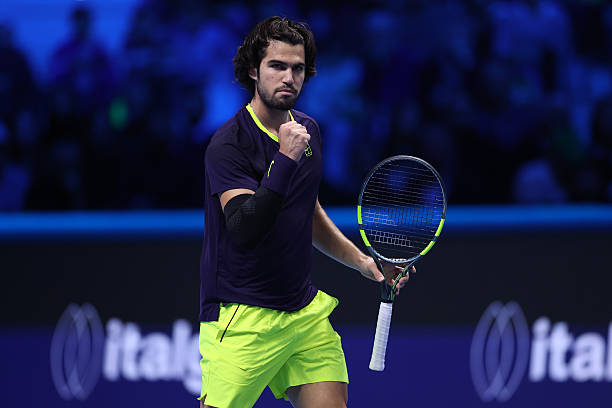

- Alcaraz’s Winning Run Carries Him into the ATP Finals Semi-Finals
Carlos Alcaraz’s bid for a first Nitto ATP Finals title is gathering force. A controlled 6-2, 6-4 victory over Daniil Medvedev in Turin on Wednesday extended the Spaniard’s winning streak to 11 matches and put him through to the semi-finals with a group match still to play.
The scoreline was emphatic, but the detail beneath it was more revealing. Alcaraz did not face a break point, converted three of the four opportunities he created and won 54 of the 95 points played. Medvedev, a former world No. 1, was never allowed to turn the match into the prolonged, uncomfortable contest that often tests Alcaraz’s patience.
Alcaraz’s victory also showed how much control he has built into his game. He took the opening set 6-2, breaking Medvedev twice, then moved ahead early in the second. Medvedev had moments of resistance, but could not make the Spaniard defend a service game under pressure. The match lasted just over 71 minutes.
“I think I did everything well,” Alcaraz said afterwards, pointing to his return game and his ability to attack Medvedev’s second serve. That was more than a tidy summary of one performance.
It was an account of how Alcaraz has been imposing himself through the indoor season: taking time away from opponents, turning defensive situations into attack and keeping his own service games largely beyond reach.
The result moved Alcaraz to 2-0 in the Ivan Lendl Group. Later on Wednesday, Frances Tiafoe won the opening set against Flavio Cobolli, the result Alcaraz needed to secure qualification. He had conceded only 10 games across his two group wins, against Tiafoe and Medvedev.
His final round-robin match, against Cobolli on Friday, will now serve as preparation for the knockout stage rather than a test of whether he advances.
That margin matters at an event where the group format can make every set consequential. A player may be in control of the tournament one day and exposed to the arithmetic of games won and lost the next.
Alcaraz has removed that uncertainty early. His qualification gives him room to manage his energy but also places a different demand on him: he must keep his level sharp without adding unnecessary physical strain.
There is a reason the question of his condition now sits alongside his form. Alcaraz received treatment on his upper left leg during the second set, after taking a break. The tournament’s account said he did not appear hindered as he finished the match, but he later described feeling a minor hamstring problem.
The episode does not erase the authority of the win; it does make his recovery before the semi-finals a matter to watch.
That concern arrives at a crucial point in a demanding run. Alcaraz returned to competition in August after a wrist injury had kept him out for about five months. Since coming back, he has won 22 of 24 matches and collected titles in Tokyo, Vienna and Paris, according to the match report. The 11-match streak now includes the momentum he carried into Turin from his Vienna and Paris victories.
A long winning streak can be read as evidence of dominance. It can also create its own pressure: each match adds expectation, and each physical niggle invites questions about whether the run is sustainable.
At the Finals, where the season’s leading players meet in a compressed week, managing the body is part of the competition. Alcaraz’s challenge is not simply to keep winning; it is to preserve the explosiveness that makes his game so difficult to contain.
Against Medvedev, he did not need to overreach. He won enough points on his second serve to prevent the Russian from gaining a foothold, while his return put Medvedev under pressure from the start of rallies.
Alcaraz’s 16 winners and 13 unforced errors made for a positive balance; Medvedev struck 15 winners but made 21 unforced errors. The figures point to a match in which Alcaraz’s aggression was measured, while Medvedev was forced into riskier choices.
The remaining group contest still matters for Medvedev and the other players chasing the second semi-final place. Alcaraz’s passage has been secured, but the group’s other qualifying position remains to be decided.
For the Spaniard, Friday’s meeting with Cobolli offers a chance to maintain rhythm while learning how the leg responds to another match. For his rivals, the prospect is less comfortable: Alcaraz has arrived in the knockout rounds with confidence and a minimum of time spent on court.
He also has unfinished business at the tournament. Alcaraz was runner-up to Jannik Sinner in last year’s final and is seeking his first ATP Finals crown.
This is his third semi-final appearance in four visits, a record of consistency that underlines how close he has come to converting his season-long quality into a year-end championship.
The ATP Finals are a different test from the tournaments Alcaraz has just won. The round-robin format rewards sustained concentration, while the semi-finals and final leave little room to recover from a poor stretch.
His clean win over Medvedev sends a message to the field, but it does not settle the questions that will shape the weekend: how healthy is his leg, and can he carry this level through consecutive high-stakes matches?
For now, Alcaraz has done the most important thing: taken control of his group before the final round.
The streak is 11, the semi-final place is secured, and only 10 games have been conceded in two matches. The statistics describe an outstanding week. The next test is whether the body behind that performance is ready for the harder part of the tournament.

