

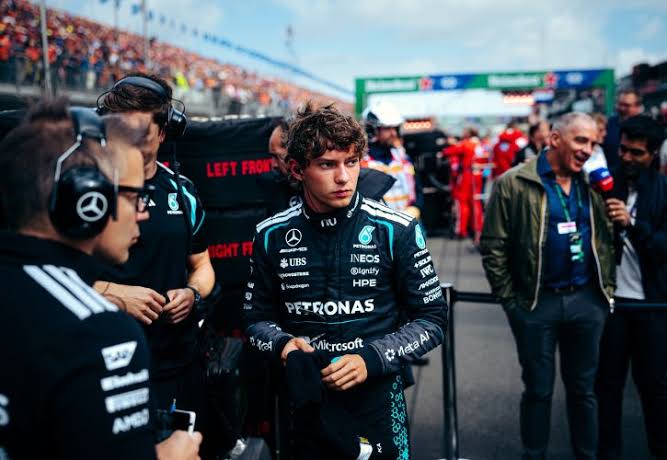

- Antonelli To Aid Russell in Monza Qualifying as Mercedes Turns Grid Penalty into Team Strategy
Kimi Antonelli is prepared to help Mercedes team-mate and Formula One title rival George Russell in qualifying at the Italian Grand Prix, with the championship leader already condemned to start from the back of the grid because of a power-unit penalty.
Mercedes is exceeding the permitted allocation of power-unit components on Antonelli’s car following reliability problems earlier in the season, triggering a back-of-the-grid start at Monza regardless of where the Italian qualifies. Antonelli leads Russell and Ferrari’s Lewis Hamilton by 59 points, while McLaren’s Lando Norris is 83 points behind after winning the previous two races.
The penalty has created an unusual tactical opportunity for Mercedes. Because Antonelli’s starting position is effectively fixed, the team can potentially use him to provide Russell with a slipstream during qualifying on Monza’s long straights, where a well-timed tow can generate a meaningful straight-line speed advantage.
Antonelli confirmed that the possibility had already been discussed internally. “If the team will ask me to do so, I will do it,” he said, adding that although he would still enjoy setting the fastest qualifying time, his grid penalty changes the strategic value of his own session.
The arrangement reflects the balance Mercedes is trying to maintain between two drivers who are both still involved in the championship fight. Russell said Antonelli’s willingness to assist demonstrated the team culture developed under Toto Wolff and argued that the same support would be expected if the roles were reversed.
Russell is expected to take his own engine-related grid penalty later in the season, with Mercedes still to decide when to introduce the additional components. Sky Sports reported that Baku, with its long straights and overtaking possibilities, could emerge as one of the more logical venues for such a penalty.
For Antonelli, however, Monza is particularly painful because it is his home race and comes at a point when his championship advantage is already under pressure. The back-row start gives Russell and Hamilton an opportunity to reduce the 59-point deficit substantially if Antonelli struggles to recover through the field.
Russell insisted the situation would not change his own approach. He said his focus remained on maximising his own performance rather than becoming distracted by the championship arithmetic created by Antonelli’s penalty.
That discipline will be important because Mercedes no longer appears to hold the clear competitive advantage it enjoyed earlier in the season. Russell acknowledged that McLaren currently has momentum, while Ferrari arrives at Monza with upgrades and Red Bull is expected to benefit from the circuit’s emphasis on power-unit performance.
Mercedes has won two of the last six races, but Russell conceded that recent results have not fully reflected the underlying competitive order. He said McLaren should currently be regarded as the team to beat, particularly after Norris’s strong form in the previous two grands prix.
Monza could nevertheless suit the W17 better than the last two circuits. Russell suggested the Italian track places more emphasis on power-unit performance and less on some of the chassis characteristics that limited Mercedes elsewhere, potentially bringing the team back into contention for victory.
The qualifying tow could therefore become more than a symbolic act of teamwork. If Mercedes is genuinely in the fight for pole, even a small aerodynamic advantage could influence the front of the grid on a circuit where straight-line efficiency is critical.
There are risks, however. Coordinating a tow requires precise timing, particularly in Q3 when track position, traffic and tyre preparation can determine whether a driver improves or loses an entire lap.
Mercedes must also avoid compromising Antonelli’s own qualifying programme unnecessarily. Although he will start at the rear, a strong qualifying run could still provide valuable data on the car and conditions before the race.
The wider championship implications are significant. Antonelli’s penalty creates one of the clearest opportunities yet for Russell and Hamilton to cut into his lead, while Norris could continue his recent charge if McLaren maintains its form.
For Mercedes, the weekend has therefore become an exercise in damage limitation and opportunity at the same time. Antonelli needs to recover as many points as possible from the back, while Russell has a chance to turn his team-mate’s misfortune into a stronger qualifying and race position.
The dynamic also highlights how Formula One’s power-unit allocation rules can shape a championship beyond pure performance. Reliability problems accumulated over previous races are now forcing Mercedes into a strategic compromise at one of the season’s most important events.
Antonelli appears willing to accept that compromise. His readiness to assist Russell suggests Mercedes is prioritising the team’s overall result while recognising that the championship fight may eventually require similar cooperation in the opposite direction.
The Italian Grand Prix could therefore become a critical weekend in the title race. Antonelli arrives with the largest points total but the weakest starting position, while Russell has both the incentive and potentially the tactical assistance required to make significant ground.
If the tow works and Mercedes has genuine pace, Russell could place himself at the front of the grid while Antonelli begins the race from the opposite end.
For Mercedes, that would turn a penalty into a strategic opportunity. For Antonelli, it would be a reminder that protecting a championship lead sometimes requires helping the rival sitting in the other side of the garage.

