


- Armah-Kofi Buah Urges Miners to Embrace Electric Haulage as Ghana Targets Efficiency Gains
Ghana’s mining industry is being urged to accelerate its transition from diesel-powered haulage to electric trucks as government seeks to reduce operating costs, improve productivity and move the sector towards a more technologically advanced production model.
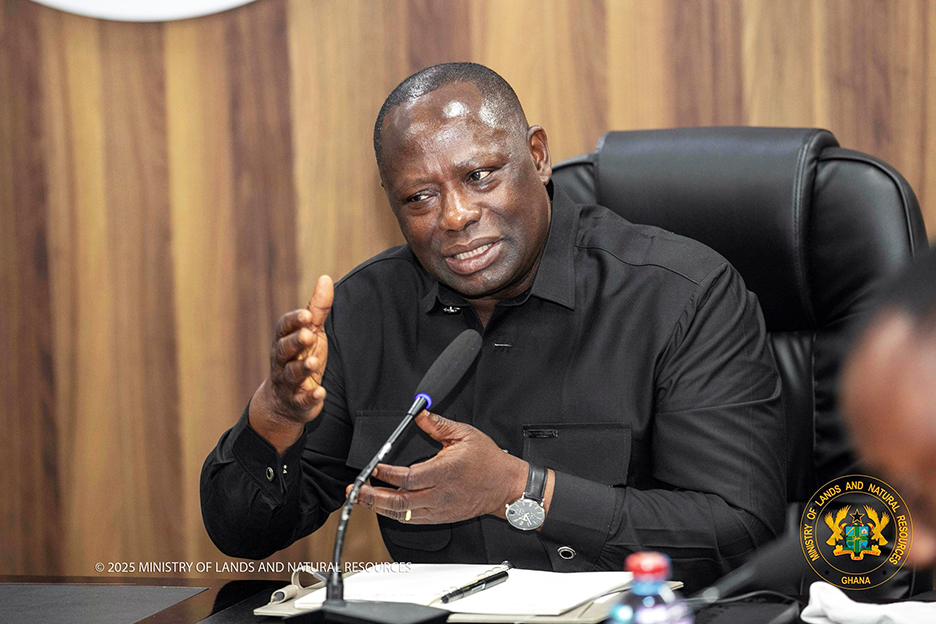
Lands and Natural Resources Minister Emmanuel Armah-Kofi Buah has called on mining companies to embrace electric haulage, arguing that the technology could reduce dependence on conventional fuel and improve the economics of large-scale mining. “Mining firms must embrace electric trucks to cut costs,” the minister said.
The intervention comes at a significant moment for Ghana’s mining industry, with government simultaneously pushing for greater local participation, stronger value retention and modernisation of the sector.
The issue is not simply whether diesel engines can be replaced with batteries, but whether miners can extract more value from each tonne of ore while controlling one of their most persistent cost centres: energy. That makes the electric-truck debate as much an economic and industrial-policy question as an environmental one.
Haulage is among the most energy-intensive parts of open-pit mining. Heavy trucks move huge volumes of rock between pits, processing plants and waste dumps, often operating continuously across mine sites, meaning fuel costs are embedded throughout the production chain. The source document notes that diesel is therefore more than a transport expense; it feeds directly into extraction, logistics, maintenance and ultimately the cost of producing an ounce of gold.
The economic case for electrification rests partly on efficiency. Electric drivetrains generally have fewer moving parts than conventional internal-combustion engines and can potentially reduce maintenance requirements while converting energy into motion more efficiently. For mining companies, that could lower long-run production costs and reduce exposure to fluctuations in global oil prices and domestic fuel costs.
But the transition would carry significant upfront costs. Electric mining trucks require charging infrastructure, sufficient grid capacity, carefully designed operating schedules and heavy-duty battery systems that are far more demanding than those used in passenger vehicles. The document therefore cautions that “the business case will consequently depend on the economics of the entire system rather than the sticker price of an individual truck.”
Ghana’s electricity system will consequently be central to whether the transition works commercially. The source notes that “an electric truck is only as clean and economically attractive as the electricity used to charge it,” while reliability is equally important for mining operators that cannot afford prolonged interruptions to haulage. Electrification could therefore increase pressure on mines to secure dependable generation, transmission and on-site energy storage.
That challenge could also create an opportunity for mining companies to rethink their energy strategies. Large operators may increasingly combine grid power with solar generation, battery storage and other energy-management systems to reduce exposure to outages and make costs more predictable. The document suggests mines could gradually evolve from being large electricity consumers into sophisticated energy-management systems in their own right.
The electric-truck push also fits into government’s broader effort to retain more mining expenditure within Ghana. International operators are facing a December 2026 deadline to transition certain mining activities to Ghanaian contractors, part of a strategy aimed at building domestic mining-service companies and increasing local participation. Electrification could add another layer to that policy if Ghanaian companies are able to supply, finance, maintain and operate electric fleets.
The potential domestic value chain could extend beyond the trucks themselves. Local firms could provide charging infrastructure, battery maintenance, fleet-management software, electrical engineering and specialised technical support, turning a cost-reduction exercise into an opportunity to build technological capability. The source argues that this would be more economically meaningful than simply importing electric trucks and leaving the associated services offshore.
There is, however, a risk in treating electrification as an automatic solution to mining costs. Diesel-powered trucks can often be refuelled quickly and returned to work, while electric fleets require charging strategies that must be built into mine schedules. Battery degradation, charging times, replacement costs and the availability of skilled technicians will all affect whether the economics are genuinely superior.
That is why government will need to avoid turning technological modernisation into an unfunded regulatory obligation. The source document argues that “the strongest case for electric trucks is one in which companies adopt the technology because it improves their economics, rather than because they are compelled to do so before the necessary infrastructure exists.” That distinction will matter if Ghana wants to modernise mining without weakening its attractiveness to investors.
The government has itself framed Ghana as an investor-friendly mining jurisdiction. At the 2026 Mining Indaba, Mr Armah-Kofi Buah described the country as “the most attractive mining jurisdiction in Africa” and emphasised its predictable legal and political environment. The challenge now is to reconcile stronger expectations around local participation and sustainability with the commercial predictability miners need to make large capital investments.
The electric-truck proposal therefore raises a larger question about what Ghana wants its mining industry to become. For decades, the sector has largely been built around extracting and exporting minerals, but the next phase could be defined increasingly by productivity, technology, local industrial capacity and greater value retention. Government’s push for electric haulage sits directly within that transition.
If implemented successfully, electrification could reduce exposure to fuel-price volatility, lower emissions and create new opportunities for Ghanaian engineering and technology firms. But it will require reliable power, charging infrastructure, financing, technical skills, regulatory clarity and commercial incentives strong enough to justify the investment. As the document puts it, the key calculation for mining companies is straightforward: “does electrification lower the cost of producing gold over the life of the mine?”
If the answer is yes, mining companies may not need much persuasion. The policy opportunity is to ensure that the economics increasingly favour modernisation while allowing a meaningful share of the technology, expertise and value created by that transition to remain in Ghana.
In that sense, electric trucks are not merely new equipment; they are a test of whether Ghana can turn its mineral wealth into a more efficient, technologically capable and domestically integrated industrial economy.

