

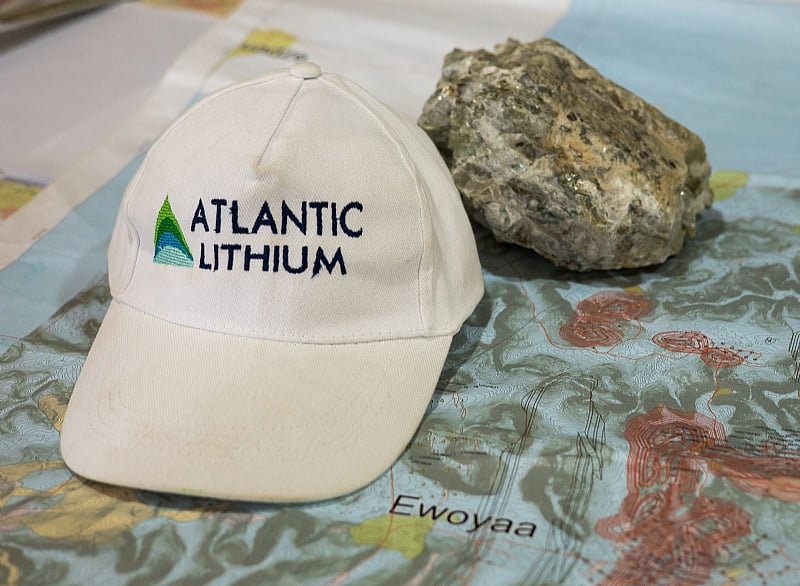

- Atlantic Lithium Clears Major Funding Hurdle as Huayou Replaces Elevra at Ewoyaa
Atlantic Lithium has completed the transfer of Elevra Lithium’s rights and obligations in the Ewoyaa Lithium Project to Zhejiang Huayou Cobalt, clearing a significant financing hurdle confronting Ghana’s proposed first lithium mine.
The completion means Huayou now holds rights to a 22.50% interest in Atlantic Lithium’s broader Ghana portfolio, including Ewoyaa, and assumes Elevra’s previous spodumene-concentrate offtake rights and obligations under the project agreements.
More importantly, Huayou will begin sole-funding the remaining US$66 million of a US$70 million Stage 3 development commitment. By completing that funding, the Chinese battery-materials group can earn an additional 27.50% interest, taking its total stake in the Ghana portfolio to 50.00%.
Development costs incurred beyond the agreed US$70 million threshold will be shared equally between Huayou and Atlantic Lithium.
The transaction has been completed following confirmation from Ghana’s Ministry of Lands and Natural Resources that it has no objection to Huayou becoming a controller of the relevant Ghanaian and Singaporean entities connected to the lithium portfolio.
That clearance gives legal and commercial effect to a restructuring first announced in May 2026 and removes uncertainty over whether Elevra’s existing rights could be transferred to Huayou.
The most immediate significance is financial. Mining projects frequently possess licences, resources and promising feasibility studies but remain undeveloped because their sponsors cannot mobilise sufficient construction capital.
Ewoyaa had reached that difficult stage. Ghana’s Parliament ratified its mining lease in March 2026, while the project had previously secured an Environmental Protection Authority permit and a mine operating permit. However, regulatory clearance alone could not finance construction.
Huayou’s assumption of the funding obligation introduces a partner with the balance sheet, technical experience and strategic interest required to move the asset closer to a final investment decision.
“Completion of the Novation Agreement represents a significant milestone for Ewoyaa,” Atlantic Lithium Chief Executive Keith Muller said, adding that Huayou was assuming Elevra’s remaining sole-funding commitments.
He described Huayou as bringing “considerable financial strength, technical capability and extensive experience” in developing and operating major African projects.
The arrangement does not constitute an unconditional promise that production will commence immediately. A development agreement can provide capital access, but construction schedules, engineering decisions, commodity prices and final investment approvals will still determine when Ewoyaa becomes operational.
Nevertheless, the transaction reduces one of the project’s most consequential risks: uncertainty surrounding who would provide the first tranche of development capital.
Elevra had earned its initial 22.50% interest by providing US$17 million towards exploration and feasibility work. Under the original structure, it could earn another 27.50% by sole-funding the first US$70 million of development expenditure.
Huayou has effectively stepped into that position. Atlantic Lithium’s statement indicates that the development-cost conditions precedent have either been satisfied or waived, enabling the new partner to begin funding without waiting for those outstanding conditions to be completed.
Atlantic Lithium retains operatorship under the project structure, while Huayou’s interest could rise to 50.00% once it fulfils the remaining funding commitment.
For Atlantic Lithium, the attraction is clear. It can advance a capital-intensive project without immediately carrying the full development burden. For Huayou, the agreement provides exposure to a potentially important source of spodumene concentrate and associated offtake rights.
That combination of equity participation and product access is becoming increasingly important in the global battery-materials industry. Companies are seeking not only returns from mines but also dependable supplies of lithium feedstock for downstream processing and battery manufacturing.
Ewoyaa contains a mineral resource estimate of 36.80 million tonnes grading 1.24% lithium oxide, with 81.00% classified in the higher-confidence measured and indicated categories. Atlantic Lithium’s development model envisages conventional open-pit mining and dense-media separation processing.
The project also benefits from its proximity to existing infrastructure. It lies near the Accra-Takoradi highway, grid electricity and about 110 kilometres from the Takoradi port, potentially reducing some of the infrastructure expenditure that complicates other African mining developments.
Yet the transaction raises a wider policy question for Ghana: whether the country’s first lithium mine will become principally a source of exported concentrate or a foundation for deeper domestic industrialisation.
Huayou’s entry strengthens the likelihood that Ewoyaa can be financed. But financing a mine and building a lithium economy are not the same thing.
The offtake structure gives the project partner rights linked to 50.00% of annual spodumene-concentrate production at market prices once the relevant funding requirements are satisfied.
That arrangement may provide the commercial certainty lenders and investors require. However, Ghana must ensure that production also supports domestic employment, local procurement, skills transfer, tax revenue and, where commercially sustainable, greater processing within the country.
The risk is that Ghana celebrates the commissioning of its first lithium mine while capturing only a limited share of the value generated further along the battery supply chain.
The opportunity is to use Ewoyaa as an anchor for services, processing knowledge, geological expertise and future investments in battery-related industries. Achieving that objective will require more than obligations written into a mining lease. It will demand coordinated implementation by the government, regulators, the project partners and local businesses.
Huayou’s participation may help this process because it is not simply a financial investor. Its experience across cobalt, nickel, lithium and battery materials could offer technical and commercial links extending beyond mine development.
That experience, however, will benefit Ghana only if the partnership deliberately transfers capability into the domestic economy.
There is also a cost question. The US$66 million commitment represents the remainder of Huayou’s Stage 3 sole-funding obligation, not the project’s entire construction requirement. Atlantic Lithium’s earlier definitive feasibility work estimated development capital substantially above the initial partner-funded amount.
Once the US$70 million ceiling is reached, Atlantic Lithium and Huayou will share further expenditure equally. Both parties must therefore remain capable of financing cost increases and the balance of construction.
Lithium-price volatility adds another layer of uncertainty. A technically attractive mine can experience delays if spodumene prices weaken sufficiently to reduce projected returns or restrict access to additional capital. The project must consequently be resilient under less favourable price assumptions rather than depending on a return to peak battery-material prices.
Mr Muller said Atlantic Lithium was working with Huayou to establish Ewoyaa as Ghana’s first lithium mine. The completed novation gives that ambition a more credible financial foundation.
For Ghana, however, the ultimate measure of success will not be the transfer of rights from Elevra to Huayou, nor even the mobilisation of US$66 million.
Success will be determined by whether the financing leads to a safely constructed and commercially viable mine and whether the country converts its lithium resources into durable jobs, industrial capabilities and public revenue rather than another cycle of raw-material exports.

