

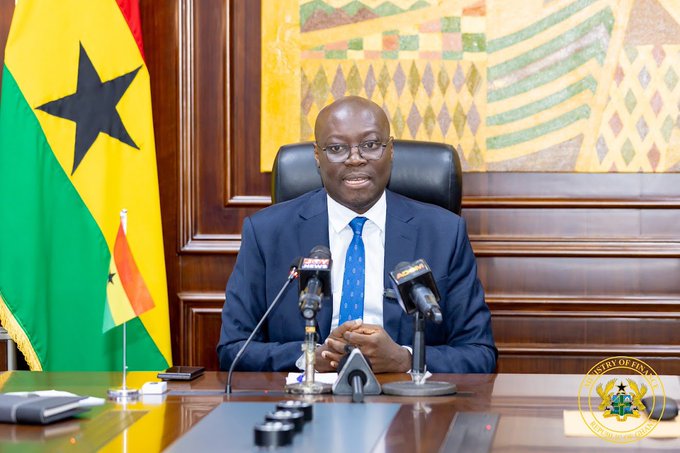

- Ato Forson Begins Work on Ghana’s US$10bn ‘New Economy’ as Government Shifts from Stabilisation to Growth
Ghana’s Finance Minister Cassiel Ato Forson has begun consultations with key economic ministries ahead of the launch of a US$10 billion “New Economy” programme, signalling a potentially decisive shift in government policy from repairing the country’s finances towards rebuilding productive capacity and creating jobs.
Dr Forson, accompanied by his deputy, the Ministry of Finance’s Chief Director and other senior officials, met Trade, Agribusiness and Industry Minister Elizabeth Ofosu-Adjare and officials of her ministry as government begins translating the initiative from a broad political commitment into an economic strategy. The programme is being positioned as the next stage of Ghana’s recovery after a period of severe fiscal and external pressure.
President John Dramani Mahama has said the initiative will involve US$10 billion of investment in priority sectors, with fuller details expected alongside the 2027 Budget in November. The scale is significant, but the more consequential question will be how the capital is mobilised, allocated and protected from the expenditure and borrowing practices that helped push Ghana into its recent debt crisis.
Dr Forson has framed the programme as a deliberate move away from an economy preoccupied with surviving repeated shocks. “Through the New Economy agenda that we will unveil, we will build an economy that does not merely withstand shocks but creates jobs, generates wealth and grows on the strength of what Ghana produces,” he said.
His accompanying declaration that “stabilisation was never the destination. It was the price of entry” captures the challenge confronting the Mahama administration. Restoring fiscal discipline, rebuilding reserves and stabilising macroeconomic conditions can create room for investment, but those achievements do not automatically produce factories, competitive exporters, productive farms or well-paid jobs.
The government is therefore attempting a substantially harder economic transition: converting macroeconomic stability into productive investment. That will require infrastructure, energy reliability, technology, skills, logistics and access to finance, alongside a business environment capable of allowing Ghanaian enterprises to compete domestically and internationally.
The Finance Minister’s decision to begin consultations with the Trade, Agribusiness and Industry Ministry is particularly important because agriculture and manufacturing will be central to any serious attempt to alter Ghana’s production structure. The country has historically earned substantial foreign exchange from primary commodities while capturing comparatively less value from processing and manufacturing those resources domestically.
A successful New Economy programme would therefore need to move more Ghanaian businesses up the value chain, linking agricultural production to food processing and industrial inputs while expanding the domestic transformation of minerals and other raw materials. That would potentially address two persistent vulnerabilities simultaneously: inadequate employment creation and the economy’s dependence on commodity exports for foreign exchange.
The US$10 billion headline will inevitably attract attention, but the financing structure will determine whether the programme strengthens Ghana’s recovery or creates new fiscal vulnerabilities. The unanswered questions include how much will come from direct public expenditure, private capital, development finance, public-private partnerships or sovereign-backed financing.
That distinction is particularly important because Ghana is emerging from debt distress. A programme financed predominantly through fresh sovereign borrowing could weaken the fiscal improvements the government says it has achieved, whereas a framework that uses limited public capital to crowd in substantially larger private investment could generate economic activity without recreating excessive public indebtedness.
Government could, for example, concentrate public resources on infrastructure around industrial zones, power reliability, transport networks, digital systems and regulatory reform while leaving commercially viable production investments to private capital. Under such a structure, the state would not necessarily need to spend US$10 billion itself in order to catalyse investment of that scale.
Jobs will ultimately provide the most politically important measure of whether the programme succeeds. Ghana’s youthful population means economic expansion must become increasingly employment-intensive, particularly because GDP growth concentrated in capital-heavy sectors can improve headline output without generating sufficient opportunities for young people entering the labour market.
Agribusiness, manufacturing, construction, logistics and technology could therefore become critical to the programme’s employment strategy. The objective should be to create firms capable of sustaining employment after government-funded projects are completed, rather than relying primarily on temporary jobs generated through public construction expenditure.
Infrastructure will also need to be evaluated according to its economic impact rather than simply the amount spent. Better roads can reduce post-harvest losses and connect producers to processors, reliable electricity can make manufacturing viable, efficient ports can improve export competitiveness and stronger digital networks can widen access to markets and finance.
The larger risk is execution. Ghana has produced numerous development strategies over several decades, but the persistent difficulty has been converting ambitious policy documents and capital expenditure into commercially productive assets that generate sufficient returns, jobs and exports.
The government will therefore need rigorous criteria for selecting projects, identifying financing sources and measuring outcomes. Investors will want clarity on which sectors will receive priority, whether the US$10 billion represents committed financing or a mobilisation target, how private capital will participate and what safeguards will prevent politically attractive but economically weak projects from consuming scarce resources.
For a country recently confronted by debt distress, capital-allocation discipline will matter almost as much as the ability to mobilise capital. Spending US$10 billion would not in itself constitute economic transformation if the resulting projects fail to improve productivity, exports, private investment or sustainable employment.
The New Economy therefore represents an important conceptual transition for the Mahama administration. The first phase of recovery was centred on stabilisation and restoring fiscal credibility; the second will be judged by whether Ghana can produce more domestically, process more of its raw materials, expand competitive exports and build businesses capable of scaling beyond government support.
The US$10 billion programme could become a significant catalyst, but its success will depend on whether government avoids equating expenditure with development. The relevant measures will be stronger private investment, more productive firms, higher export earnings, improved infrastructure and sustainable employment.
Dr Forson’s assertion that stabilisation was merely the “price of entry” therefore carries a substantial burden of expectation. Ghana has endured the difficult process of restoring macroeconomic stability; the harder task is ensuring that the resulting breathing room becomes the foundation for structural transformation rather than another temporary period of calm before the next fiscal cycle.

