

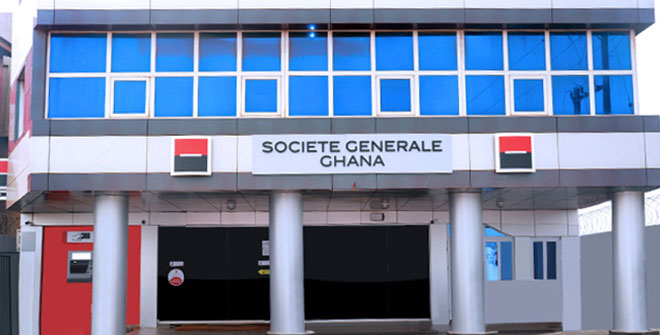

- Societe Generale Ghana Targets Women-Led Businesses with Tailored Finance and Advisory Support
Societe Generale Ghana is intensifying its focus on women-led businesses, seeking to close financing and capability gaps that continue to prevent many promising enterprises from moving beyond survival into sustained growth.
The bank recently brought together women entrepreneurs and senior executives in Accra for discussions on access to capital, cash-flow management, sustainability and the broader banking support required to build competitive businesses. The engagement reflects a wider shift in Ghana’s financial sector, where women-owned and women-led enterprises are increasingly being treated as a distinct commercial segment rather than simply another category of small-business borrowers.
At the centre of Societe Generale Ghana’s approach is the SG Woman proposition, which combines financing with relationship management, mentorship and business advisory support. Qualifying businesses can access credit facilities with little or no collateral, while also receiving support through dedicated relationship managers and the bank’s SG Home of Business platform.
Hakim Ouzzani, Managing Director of Societe Generale Ghana, said the objective was to help Ghanaian businesses move beyond basic survival. “Societe Generale Ghana is committed to seeing Ghanaian businesses do more than survive; they must have the opportunity to grow, compete and create lasting value,” he said.
He added that the bank’s responsibility was to understand the barriers facing businesses and support them as they move towards their next stage of growth. That proposition goes to the heart of Ghana’s SME financing challenge: access to capital matters, but the type, structure and timing of that capital often matter just as much.
Conventional lending can be difficult for businesses whose assets are not readily acceptable as collateral or whose revenues fluctuate according to contracts, invoices and seasonal demand. Women-led enterprises can be particularly exposed to these constraints where ownership of land, property or other traditional forms of collateral is limited.
Societe Generale Ghana’s response is therefore broader than a standard loan product. The bank is attempting to combine financing with the advisory infrastructure required to help entrepreneurs understand cash flow, structure borrowing appropriately and strengthen the management systems needed to absorb capital productively.
That approach mirrors a wider change across Ghana’s banking and development-finance landscape. Development Bank Ghana recently introduced a dedicated women’s lending programme intended to address barriers including collateral, documentation requirements, borrowing costs and access to productive assets.
The programme is expected to reach more than 1,000 women-owned and women-led businesses between 2026 and 2028. Consolidated Bank Ghana and the Social Investment Fund have also announced a US$5.00 million financing arrangement for women, youth and MSMEs, combining credit with business-development services and financial literacy.
The emergence of multiple women-focused financing initiatives suggests that gender-responsive lending is increasingly being viewed as a commercial opportunity rather than purely a social intervention. Women entrepreneurs operate across trading, manufacturing, agriculture, hospitality, professional services and technology, creating a potentially significant customer base for banks able to understand their financing needs.
Societe Generale Ghana has been building towards this position for several years. Its 2023 financial reporting identified the financing gap between women and men and outlined efforts to develop a dedicated segment for women-led businesses, while subsequent reporting highlighted the SG Woman Club as a tailored financing and networking proposition for corporate women, entrepreneurs and MSMEs.
The latest engagement therefore appears to represent a continuation of that strategy rather than a standalone initiative. The bank is increasingly positioning relationship banking and business advisory as part of the commercial proposition around women-led enterprises.
The financing instruments presented during the engagement also reflect the practical cash-flow problems facing SMEs. Societe Generale highlighted overdrafts and revolving advances for working capital, alongside invoice discounting, factoring and purchase-order financing.
Longer-term funding options include term loans and finance leases, while green-finance products can support investment in areas such as solar power and electric vehicles. The breadth of instruments is important because SMEs often struggle not because their underlying businesses are unprofitable, but because their cash inflows and financing obligations are poorly matched.
A company may secure a major purchase order but lack the working capital required to buy raw materials or pay suppliers. Another may have completed a contract but be required to wait 60 or 90 days before payment, creating a liquidity gap that can constrain further production.
Invoice discounting and factoring can help businesses convert receivables into immediate working capital, while purchase-order financing can support fulfilment of confirmed orders before payment is received. The challenge is ensuring that entrepreneurs use the right financial instrument for the right stage of their operating cycle.
That is where advisory support becomes particularly valuable. Capital deployed without adequate financial management can increase rather than reduce business risk, especially where entrepreneurs take on short-term debt for long-term assets or fail to account properly for repayment schedules.
The bank’s SG Home of Business is intended to support entrepreneurs in areas including financing, accounting, taxation, legal services and business development. Angela Bonsu, Company Secretary of Societe Generale Ghana, presented the SG Woman proposition during the engagement and emphasised the importance of combining financial products with broader business support.
The inclusion of green finance also reflects the changing economics of sustainability. For many Ghanaian businesses, installing solar power or energy-efficient equipment is increasingly a commercial decision aimed at reducing energy costs and improving operating resilience rather than simply meeting environmental objectives.
Societe Generale Ghana has itself invested in renewable energy, including a 267kWp hybrid solar photovoltaic installation at its head office. That experience gives the bank an additional basis for positioning sustainable finance as part of the broader discussion around business competitiveness.
The opportunity is significant, but targeted lending also requires disciplined risk management. Collateral-light financing cannot mean weaker credit assessment, and banks will still need to evaluate cash flows, business models, management capacity and repayment ability carefully.
Societe Generale Ghana’s broader SME financing strategy also reflects growing interest from development-finance institutions. In 2024, the International Finance Corporation disclosed a proposed US$25.00 million five-year senior unsecured loan to the bank to support MSME financing, with up to 30.00% of proceeds earmarked, on a best-efforts basis, for women and women-owned MSMEs.
For Ghana’s women entrepreneurs, however, the real test will not be the number of programmes launched or engagement sessions organised. Success will be measured by whether businesses that previously struggled to obtain appropriate finance can increase production, enter new markets, strengthen their balance sheets and hire more workers.
For Societe Generale Ghana, the commercial opportunity is equally clear. A bank that develops expertise in the financing cycles, growth ambitions and risk profiles of women-led businesses can turn a financial-inclusion agenda into a durable SME franchise.
The broader lesson is that access to capital alone will not transform Ghana’s women-led business sector. What matters is whether finance is designed around the way those businesses actually operate and is combined with the advisory support needed to deploy capital productively.
Societe Generale Ghana’s latest initiative is therefore a bet on a more integrated model of SME banking: one in which tailored finance, business advice and long-term relationships work together to help women-led enterprises move from survival to scale.

