


- Banks Welcome Cocoa Capital Deal, but Discipline Will Determine Its Success
Ghana’s attempt to finance its cocoa industry through domestic capital markets has cleared an important first hurdle, but the banking industry is warning that raising money is easier than preserving the confidence needed to repay it.
Cocoa Capital PLC’s GH¢16.3 billion programme, comprising GH¢14 billion in commercial paper and GH¢2.3 billion in bonds, offers Ghana a potentially consequential alternative to the external funding arrangements that have traditionally supported cocoa purchases and other sector activities.
Its inaugural Series 1, Tranche 1 commercial paper raised approximately GH¢3.396 billion from domestic institutional investors after attracting GH¢3.586 billion in bids. The 266-day instrument carries an annual yield of 11 per cent and matures on June 28, 2027.
That reception points to strong demand for credible cedi-denominated assets and suggests local pension funds, banks and other institutions are willing to finance productive activity when the structure, return and safeguards appear attractive.
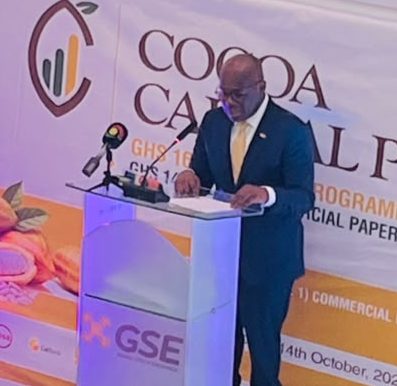
Yet Kwamina Asomaning, President of the Ghana Association of Banks, has injected a necessary note of caution into the celebration. Speaking at the instrument’s admission to the Ghana Fixed Income Market on October 14, he argued that the programme’s real success would be measured not by the size of its launch but by the discipline that follows.
“There’s also a bigger story here. The growing capacity of Ghana to mobilize Ghanaian capital for Ghanaian development,” Mr Asomaning said.
That bigger story matters. Domestic financing can reduce exposure to foreign-currency risk, global refinancing shocks and shifts in international lender appetite. When a strategic export industry earns foreign exchange but finances parts of its operations in cedis, Ghana can potentially create a more balanced funding model while deepening its capital market.
The transaction also begins to connect pools of local savings with agricultural production more directly. Ghana’s financial system has long faced criticism for directing substantial liquidity towards government securities while businesses struggle to obtain affordable, long-term funding. A successful cocoa-linked programme could demonstrate that capital markets can finance productive sectors at scale.
However, domestic funding does not make economic risk disappear. It transfers that risk into the portfolios of Ghanaian institutions and, indirectly, the savings of households whose pensions and investments they manage. This makes governance, disclosure and cash-flow discipline central to the programme’s legitimacy.
“Borrowing must ultimately be anchored in realistic assumptions about production, revenues, costs and repayment capacity,” Mr Asomaning cautioned. “Financial innovation works best when it is accompanied by discipline.”
Those warnings are particularly relevant because cocoa financing depends on variables that issuers cannot fully control. Disease, ageing farms, climate pressures and production volatility can reduce crop volumes. International cocoa prices can move sharply, while domestic producer-price decisions and operational costs can alter the amount of revenue available for debt service.
The financing structure seeks to contain some of those risks by linking repayment to receivables from selected cocoa forward-sales contracts. Collections are to pass through designated ring-fenced accounts, creating a clearer route between export proceeds and contractual payments to investors.
Ring-fencing is valuable, but it is not an insurance policy against weak harvests, revenue shortfalls or administrative leakage. Its effectiveness will depend on the legal strength of the arrangements, the quality of reporting and whether money entering the accounts is protected from competing claims.
Investors will therefore need timely information on crop purchases, export deliveries, forward-sales proceeds and repayment coverage. Transparency cannot be limited to disclosures made at issuance. It must become a continuing obligation throughout the instrument’s life.
The first maturity on June 28, 2027, will be an early credibility test. Full and timely repayment would strengthen confidence in subsequent tranches, potentially lower future financing costs and establish cocoa-backed securities as a viable asset class. Any delay, restructuring or uncertainty would travel quickly through Ghana’s financial system and make later issuances more expensive.
There is also a concentration question. The inaugural paper absorbed nearly GH¢3.4 billion of institutional capital, and the wider programme is considerably larger. If future tranches are issued rapidly, banks and fund managers must ensure their exposure remains compatible with portfolio limits, liquidity needs and depositor or pension obligations.
A programme of this scale could also crowd out private borrowers if it competes aggressively for a finite pool of domestic savings. Its 11 per cent yield may appear favourable against prevailing alternatives, but the broader market impact will depend on issuance frequency, investor composition and the government’s borrowing requirements.
For policymakers, the challenge is to ensure Cocoa Capital expands the market rather than merely reallocating existing liquidity. That requires policy certainty, credible cocoa reforms and an environment in which investors can assess risk without fearing abrupt changes to pricing, taxation, export arrangements or sector governance.
Mr Asomaning welcomed the collaboration among government, COCOBOD, regulators, financial institutions and advisers. “This is what the financial ecosystem should look like: different institutions, different capabilities, but one economy that works,” he said.
That collaboration will matter most when conditions become difficult. Strong governance is rarely tested when prices are supportive and funding is abundant; it is tested when production disappoints, costs rise or cash flows tighten.
Cocoa Capital is therefore more than a financing vehicle. It is a test of whether Ghana can use domestic capital to support development without repeating the weaknesses that have undermined confidence in public and quasi-public borrowing.
The debut indicates that investors are prepared to participate. The burden now shifts to the issuer and sector authorities to prove that proceeds will be prudently used, receivables transparently managed and obligations honoured.
If that happens, the programme could help build a deeper fixed-income market, strengthen cocoa financing and keep more financial intermediation within Ghana. If it does not, the cost will extend beyond one security: it could weaken trust in future attempts to mobilise Ghanaian savings for Ghanaian development.
The banks’ message is therefore simple but consequential. Capital has been raised; credibility must now be earned through execution.
That standard is demanding, but it is unavoidable because domestic capital is not costless public money. It represents savings entrusted to institutions that must protect value, liquidity and future incomes.

