

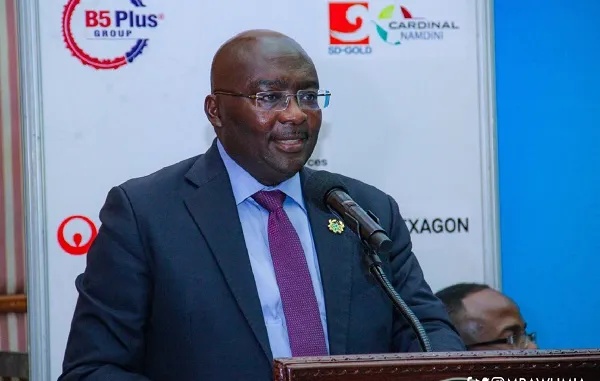

- Bawumia Says Ghana Feared Sri Lanka-Style Shortages as Dollar Squeeze Deepened
Ghana’s foreign-exchange crisis had deteriorated to the point where policymakers feared the country could eventually struggle to finance essential imports, raising the prospect of shortages similar to those experienced by Sri Lanka during its 2022 economic collapse, former Vice-President Dr Mahamudu Bawumia has said.
His account provides a fresh explanation of the pressures that shaped the previous administration’s decision to introduce the Gold-for-Oil and Gold-for-Reserves initiatives as Ghana’s access to foreign currency weakened and the cedi came under intense depreciation pressure.
“In fact, at some point I was very concerned because I could see at the same time what was happening in Sri Lanka,” Dr Bawumia said.
The comparison is significant because Sri Lanka’s crisis went far beyond exchange-rate weakness. Severe foreign-exchange shortages left the country struggling to pay for fuel, food, medicine and other imports, helping trigger shortages, inflation, widespread protests and political upheaval.
But Dr Bawumia’s comments suggest economic managers considered the country’s external position sufficiently fragile that shortages of basic imported goods could no longer be treated as a remote possibility.
“In Sri Lanka, people were out on the streets; they were facing shortages of food because they didn’t have the foreign exchange to pay for food,” he said.
At the centre of Ghana’s vulnerability was a relatively straightforward imbalance: demand for foreign currency was running ahead of available supply.
The Russia-Ukraine war added to an already difficult global environment, while Ghana’s loss of access to international capital markets removed a major source of external financing.
For years, sovereign borrowing abroad had supplemented export receipts and other inflows, providing foreign currency that helped finance imports, debt obligations and balance-of-payments needs.
Once that financing window closed, pressure shifted towards Ghana’s reserves and the domestic FX market. Dr Bawumia said the scale of demand considerably exceeded the Bank of Ghana’s available intervention capacity at the time.
“The demand for foreign exchange for Ghana on a monthly basis was significantly more than US$80 million a month,” he said.
The significance of that constraint lies in how foreign-exchange markets adjust.
A central bank can temporarily ease a shortage by selling dollars from reserves. But when demand continues to exceed supply and reserves cannot absorb the difference indefinitely, the price of foreign exchange begins to carry more of the adjustment. In Ghana’s case, that meant a rapidly depreciating cedi.
“When demand exceeds supply, prices go up. So in that situation, the exchange rate depreciated almost on a daily basis,” Dr Bawumia said.
As the cedi weakened, the local-currency cost of imported fuel, food, raw materials, machinery and medicines increased. Businesses expecting further depreciation could also seek foreign currency earlier than necessary in order to protect themselves against future price increases, adding still more demand to an already tight market.
For an economy heavily dependent on imported goods and production inputs, a foreign-exchange crisis can therefore become an inflation crisis remarkably quickly. Ghana relies heavily on imported refined petroleum products to keep transport, industry, commerce and parts of the energy system functioning.
During a severe FX shortage, every dollar used to pay for petroleum imports competes with demand from pharmaceutical importers, manufacturers, food traders and other businesses. That was the environment in which the previous government introduced Gold-for-Oil.
Dr Bawumia argues that the programme should be understood as an emergency response to external financing constraints rather than simply an unconventional commodity-trading arrangement.
“The background for the gold-for-oil programme is this. It essentially saved us from a bigger crisis,” he said.
The economic logic was to use one of Ghana’s strongest assets domestically produced gold to reduce the immediate dollar requirement associated with fuel imports.
Rather than relying exclusively on scarce foreign exchange to purchase petroleum, the government sought arrangements in which gold could be exchanged or monetised to support the import process.
“The purpose of the programme was to stabilise the currency and build reserves,” Dr Bawumia said.
That strategy was closely linked to the Gold-for-Reserves programme, under which the Bank of Ghana increased its purchases of domestically produced gold as part of efforts to strengthen the country’s reserve position. The broader policy question was whether Ghana could use its position as a major gold producer to reduce vulnerability to conventional external financing shocks.
Ghana is one of Africa’s leading gold producers, yet it could still experience severe shortages of the international currencies required to pay for imports. Producing a valuable globally traded commodity does not automatically guarantee reserve adequacy.
What matters is how export earnings are captured, retained, converted and ultimately reflected in the country’s external balance sheet.
Dr Bawumia said the gold strategy eventually strengthened Ghana’s foreign-exchange position.
“Once we started building the foreign exchange through the gold trades properly, by the end of 2024, Ghana had huge foreign exchange reserves compared to when we started,” he said.
His defence goes to the central argument for the programme: that emergency measures should be assessed partly by whether they helped prevent a deeper balance-of-payments crisis.
The economics of Ghana’s domestic gold programmes have since come under intense scrutiny, particularly over reported losses and policy costs associated with purchasing doré gold for reserves. That means the debate is no longer simply about whether the programme helped accumulate reserves.
A policy can provide strategic benefits while still imposing substantial financial costs. The relevant assessment therefore requires both sides of the ledger: the FX liquidity and reserve support generated by the gold programmes, and the associated purchasing, financing, operational and valuation costs.
Dr Bawumia’s account nevertheless helps explain the severity of the problem policymakers believed they were confronting.
For countries dependent on imported necessities, foreign-exchange reserves are not merely accounting entries on a central-bank balance sheet. They represent the economy’s ability to continue paying for essential imports when access to international financing suddenly disappears.
Once a sovereign can no longer secure enough foreign currency to purchase fuel, food or medicine, an exchange-rate problem rapidly becomes a social and political crisis. Empty fuel stations and shortages on supermarket shelves can destroy confidence much faster than movements in a financial-market indicator.
The country earns substantial foreign exchange from gold, cocoa and petroleum exports, yet import demand, debt servicing and other external obligations can absorb a large proportion of those earnings. That leaves the economy vulnerable when access to external borrowing closes or global conditions deteriorate.
But it cannot eliminate the underlying imbalance on its own. Long-term external stability requires stronger export diversification, sustained remittance inflows through formal channels, competitive domestic production, credible fiscal management and a reserve position strong enough to absorb external shocks.
It also requires reducing the dependence on foreign borrowing that can create the appearance of abundant FX liquidity during good periods but leave the economy exposed when international markets close. That is arguably the larger lesson from Dr Bawumia’s account.
The objective should not simply be to avoid the next currency crisis. It should be to build an economy in which the loss of one financing channel does not immediately threaten access to essential goods.
Gold can play a role in that strategy because it is both an export commodity and an internationally recognised reserve asset.
But the sustainability of any gold-backed policy will depend on transparency, cost efficiency and whether the reserve benefits exceed the economic and financial costs of acquiring the metal.
For Ghana, the episode therefore remains relevant well beyond the political debate over who designed the Gold-for-Oil programme or whether it should continue. It raises a more fundamental question about economic resilience.
At the height of the crisis, according to Dr Bawumia, the concern was not simply that the cedi was depreciating. It was that Ghana could eventually struggle to find enough foreign currency to pay for the fuel, food, medicines and other imports on which the economy depends.
That is the point at which a foreign-exchange crisis stops being something discussed mainly by economists and currency traders. It becomes something citizens encounter at fuel stations, pharmacies and supermarkets.
Ghana avoided that outcome. The harder task is ensuring that it never again comes close enough for policymakers to fear it.

