

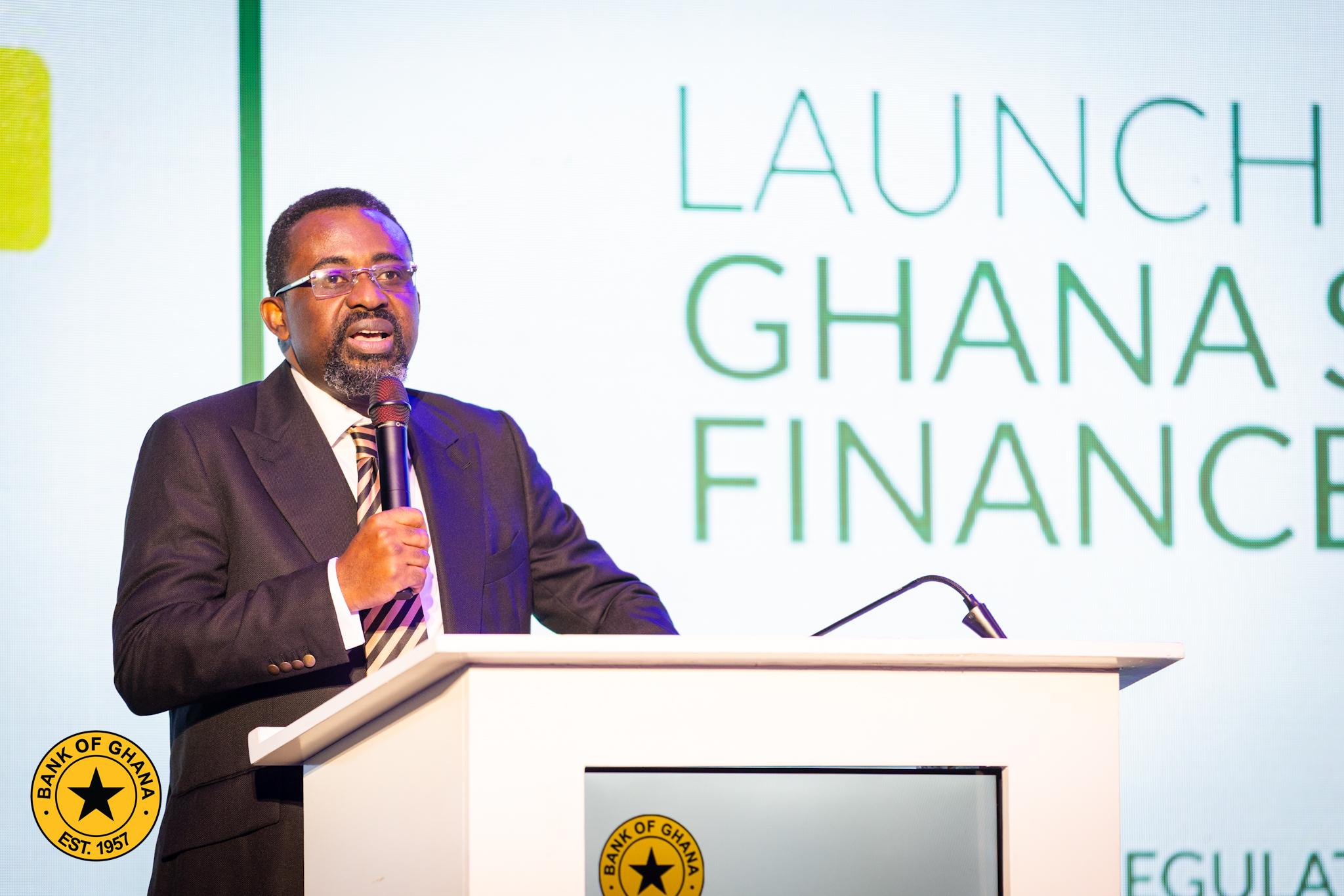

- Sustainable finance is Now Central to Ghana’s Financial Stability – BoG Governor
Bank of Ghana Governor, Dr Johnson Pandit Asiama, has said sustainable finance has become central to financial stability, long-term investment and economic resilience, as Ghana moves to align its financial sector with emerging global capital flows and climate-related risks.
Speaking at the launch of Ghana’s Sustainable Finance Roadmap at the Kempinski Gold Coast Hotel in Accra on Tuesday, June 30, 2026, Dr Asiama said the changing global financial environment requires regulators to rethink how risks are supervised, priced and managed across the financial system.
According to him, sustainable finance is no longer a distant policy concept but a core part of how Ghana must build a resilient and competitive economy.
“Sustainable finance is increasingly central to financial stability, to long-term investment, and to economic resilience,” he said, adding that it is reshaping where global capital flows and what investors expect of financial systems.
The Governor said climate change and other sustainability challenges are already affecting economies, businesses and financial systems, making it necessary for Ghana’s financial regulators to act with foresight, innovation and collaboration.
He noted that recent flooding across Ghana had demonstrated how climate-related risks could move beyond the environment and enter the financial system through asset values, claims costs and lending security.
“The instruments and structures of the past were not built for them and meeting them asks us to recalibrate how we supervise, how we price risk, and how we plan,” Dr Asiama said.
He stressed that ignoring these risks would leave Ghana’s financial system vulnerable, insisting that the country must choose a path of preparedness rather than reaction.
The Sustainable Finance Roadmap is expected to provide a common framework for Ghana’s financial regulators to coordinate their approach to sustainable finance. It covers the banking, insurance, securities and pensions sectors, which together form an interconnected financial system.
Dr Asiama said although each regulator has its own mandate, climate and sustainability risks do not respect institutional boundaries, making coordinated action essential.
“A risk that moves across the whole system cannot be managed by any one institution acting alone,” he said.
The Roadmap is anchored on three main pillars: Environmental, Social and Governance integration; climate-related risk management; and financing sustainability. These pillars, according to the Governor, are intended to embed sustainability at the heart of financial-sector operations and decision-making.
He said the framework moves Ghana from fragmented initiatives to a coordinated system with practical steps assigned to regulators.
For the Bank of Ghana, Dr Asiama said the launch builds on nearly a decade of work to integrate sustainability into the banking sector. In 2015, the central bank convened a multi-stakeholder committee that was later formalised as the Sustainable Banking Principles Steering Committee, bringing together the Bank of Ghana, the Ghana Association of Banks and the Environmental Protection Agency.
That process led to the launch of the Sustainable Banking Principles and Sector Guidance Notes in 2019, which were endorsed voluntarily by all 23 chief executives of commercial banks in Ghana.
With support from the International Finance Corporation and the Swiss Secretariat for Economic Affairs, the Bank of Ghana later developed a standardised compliance framework. Dr Asiama said industry compliance had risen steadily, reaching an average of 73.00% as of September 2025.
In 2024, the Bank also published a four-year Strategic Plan on Sustainability and Climate-Related Risks covering 2024 to 2028, and issued the Climate-Related Financial Risk Directive to strengthen the capacity of regulated financial institutions to identify, assess and manage climate-related financial risks.
Dr Asiama said sustainable finance must be understood not only as a risk-management tool, but also as an opportunity for Ghana to access new pools of global capital, finance critical infrastructure, support the energy transition, deepen financial markets and strengthen long-term growth.
“Our purpose as regulators has always been the safety and soundness of the financial system. But soundness in this era means more than absorbing today’s shocks,” he said.
He argued that a strong sustainable finance framework could position Ghana as a leading destination for sustainable finance in the region, attracting domestic and international capital for the country’s transition and development needs.
“Done well, this is not a cost we carry. It is a market we open,” he said, pointing to deeper access to climate and development finance, a more resilient banking system and a credible claim to leadership in sustainable finance across the region.
The Governor said the launch of the Roadmap was an important milestone, but its real value would depend on implementation.
He commended members of the Sustainable Finance Roadmap Committee, drawn from the Ministry of Finance, Bank of Ghana, National Insurance Commission, National Pensions Regulatory Authority, Securities and Exchange Commission, Institute of Chartered Accountants, Ghana, and the Chartered Institute of Bankers.
He also acknowledged the support of the International Finance Corporation, the Swiss Secretariat for Economic Affairs, and the Sustainable Banking and Finance Network.
“The roadmap we launch today is an important milestone, but its success will be measured by what we do next,” Dr Asiama said.
For Ghana, the launch signals a more deliberate attempt to connect financial stability, climate resilience and capital mobilisation. The test now is whether regulators and financial institutions can turn the Roadmap from a policy document into a working framework that redirects finance toward sustainable growth.
As global investors increasingly demand credible ESG standards, transparent climate-risk management and bankable green projects, Ghana’s financial sector is being asked to do more than respond to risk. It is being asked to help shape the country’s next development frontier.

