
- Cyberattacks Threaten Confidence in Ghana’s Digital Economy as BoG and CSA Tighten Security Controls
Ghana’s financial system is facing a significant cybersecurity challenge after regulators confirmed a series of cyber incidents affecting parts of the country’s banking and digital payments infrastructure, prompting an emergency response involving the Bank of Ghana, Cyber Security Authority (CSA), commercial banks, payment service providers and telecommunications operators.
The coordinated intervention follows disruptions to banking applications and electronic payment services, raising concerns about the security and operational resilience of an increasingly interconnected financial system.
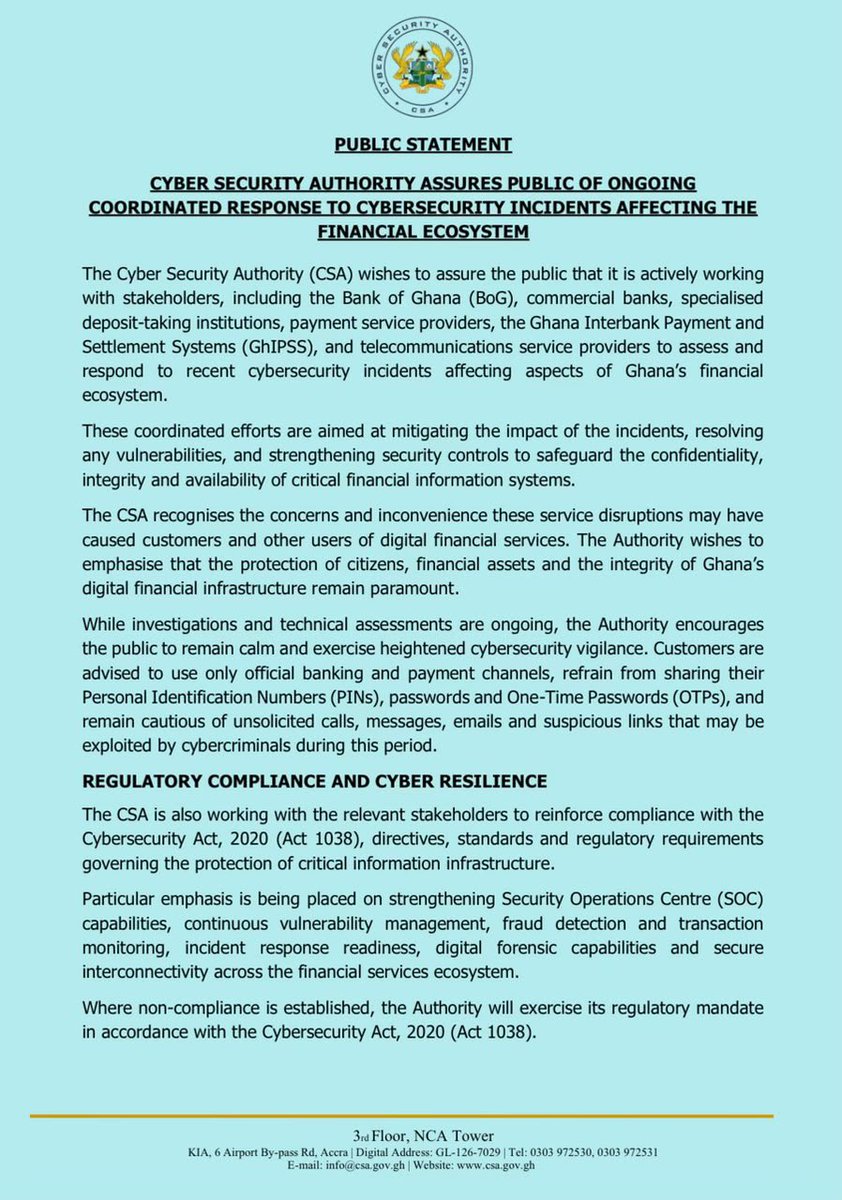
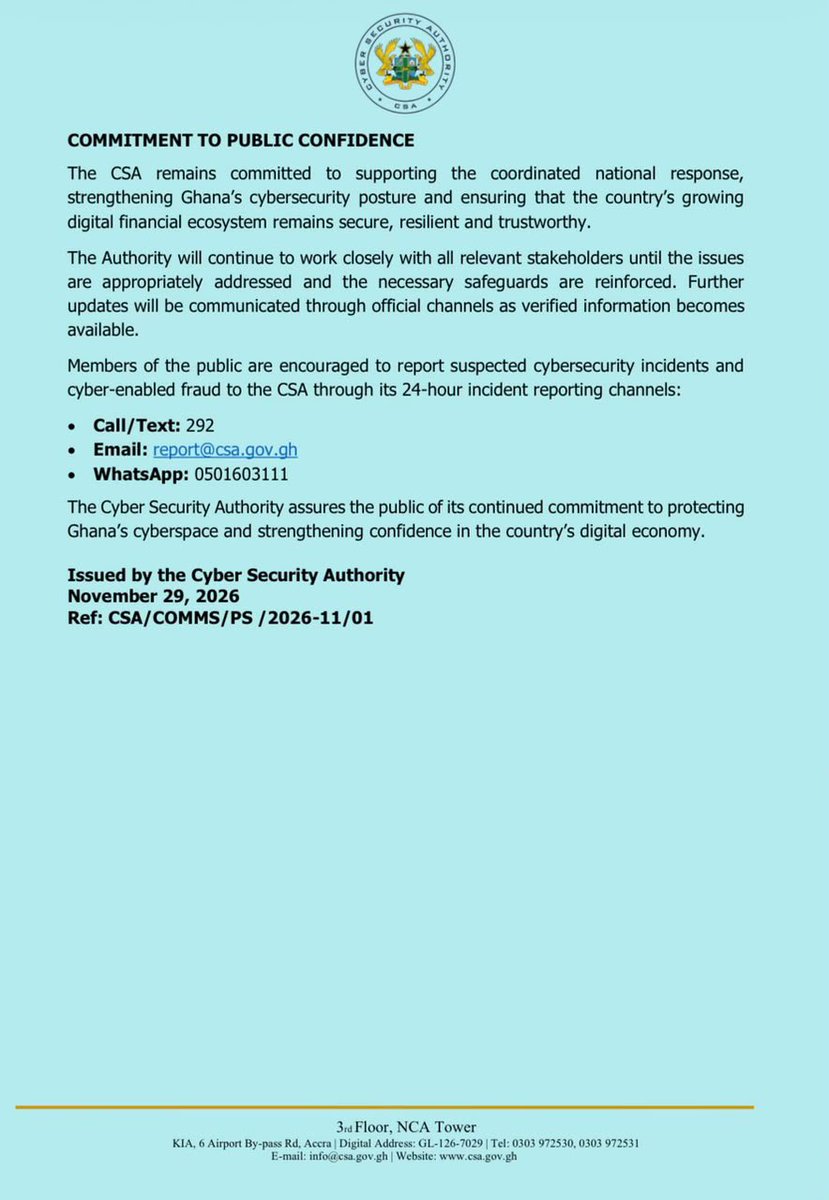
In a public statement issued on Sunday, November 29, 2026, the CSA confirmed that it was working with financial-sector institutions to investigate the incidents, contain potential vulnerabilities and strengthen security controls intended to protect customers and critical financial infrastructure.
The Authority’s intervention comes alongside emergency measures announced by the Bank of Ghana, including temporary reductions in daily transaction limits on bank accounts and mobile money wallets, additional controls on mobile money agents and extended banking hours to accommodate customers unable to complete transactions through digital channels.
The developments represent an important test of Ghana’s digital financial infrastructure at a time when mobile money, electronic transfers and interconnected banking systems have become essential to commercial activity.
Although the central bank has reassured customers that there is currently no indication their deposits have been compromised, the simultaneous intervention by the country’s financial and cybersecurity regulators underscores the seriousness of the operational risks being addressed.
The Bank of Ghana stated, “at this time, there is nothing to suggest that customers’ deposits have been compromised.”
It nevertheless confirmed that financial institutions were actively monitoring transactions and strengthening protective controls while investigations continued.
The distinction is important. The authorities have acknowledged cybersecurity incidents and service disruptions, but have not publicly established the full number of affected institutions, the precise causes of every disruption, the number of compromised accounts, or any aggregate financial losses directly attributable to the current incidents.
The assurances concerning customer deposits should therefore be understood as the regulators’ assessment based on information available at the time, rather than a declaration that the investigations have conclusively ruled out every potential risk.
The CSA’s statement specifically identifies the Bank of Ghana, commercial banks, specialised deposit-taking institutions, payment service providers, the Ghana Interbank Payment and Settlement Systems (GhIPSS) and telecommunications companies as participants in the coordinated response.
Their involvement reflects the interconnected structure of Ghana’s financial services industry, where transactions can move between bank accounts, mobile wallets and payment platforms through infrastructure operated by different institutions.
A weakness affecting one participant can potentially disrupt services provided by others, making coordinated monitoring and incident response essential to financial stability.
The CSA explained that the response is intended to mitigate the effects of the incidents, resolve identified vulnerabilities and strengthen the confidentiality, integrity and availability of critical financial information systems.
These three objectives are fundamental to cybersecurity.
Confidentiality concerns the protection of sensitive information from unauthorised access. Integrity requires that financial records and transactions remain accurate and protected against improper alteration. Availability ensures that customers and businesses can access essential services when required.
A cybersecurity incident can compromise confidence even where financial losses have not been established, particularly if customers are unable to transfer money, access their accounts or complete commercial payments.
For Ghana’s banking industry, this makes the restoration of reliable services as important as identifying the technical causes of the incidents.
The CSA acknowledged the inconvenience experienced by customers, stressing that protecting citizens, financial assets and the country’s digital infrastructure remains its priority.
The Authority also warned that financial institutions must comply with their cybersecurity obligations under the Cybersecurity Act, 2020 (Act 1038), and applicable regulatory requirements governing critical information infrastructure.
It indicated that particular attention was being directed towards strengthening Security Operations Centre capabilities, continuous vulnerability management, fraud detection, transaction monitoring, digital forensics and incident response preparedness.
These measures are intended to improve the ability of institutions to identify threats early, contain suspicious activity and restore affected systems without exposing customers to unnecessary risks.
The statement further indicated that regulatory action could follow where non-compliance is established.
“Where non-compliance is established, the Authority will exercise its regulatory mandate in accordance with the Cybersecurity Act, 2020 (Act 1038).”
The warning places financial institutions on notice that the response will not necessarily end with the restoration of disrupted services.
Investigations may also examine whether affected institutions maintained adequate cybersecurity safeguards, complied with applicable requirements and responded appropriately when incidents were detected.
However, the statement does not identify any institution as having violated the Act, and no regulatory finding of non-compliance was announced.
The Bank of Ghana has taken a parallel approach focused on financial stability and the protection of customer funds.
Its temporary reduction in transaction limits is intended to constrain the movement of potentially unauthorised funds while institutions investigate suspicious activities.
The central bank has also introduced daily and monthly limits for mobile money agents and directed banks to make alternative service channels available where electronic banking applications or payment platforms remain disrupted.
Customers who need to undertake transactions exceeding the revised limits have been advised to visit bank branches for assisted services following verification.
Where digital services are unavailable, alternative arrangements may include automated teller machines, USSD channels, GhanaPay, authorised agents and physical bank counters.
The Bank has also instructed financial institutions to communicate clearly with customers about affected services and anticipated restoration periods.
These interventions demonstrate the difficult balance regulators face when attempting to protect financial systems without unnecessarily restricting legitimate economic activity.
Transaction limits can reduce exposure to certain forms of fraud, but they can also inconvenience customers and businesses whose operations depend on high-value or frequent electronic payments.
Small businesses, traders, transport operators and other users of digital financial services may encounter additional difficulties where payment restrictions or system interruptions delay commercial transactions.
For companies relying on digital collections and transfers, extended disruptions can affect cash flow, supplier settlements and the ability to meet immediate financial obligations.
The economic implications are particularly important because Ghana’s digital payments infrastructure has become an essential component of financial inclusion and business activity.
The widespread adoption of mobile money and electronic banking has enabled individuals and enterprises to conduct transactions without depending entirely on cash or traditional banking channels.
However, greater connectivity also creates new operational risks.
A financial system in which institutions exchange information and transfer funds electronically requires effective coordination between regulators, banks, telecommunications companies and payment infrastructure operators.
The consequences of a cybersecurity weakness may extend beyond the institution where an incident originates.
This systemic dimension was highlighted by Bank of Ghana Governor Dr Johnson Pandit Asiama during the 2026 Governor’s Day Annual Bankers’ Dinner in Accra on November 28.
The Governor disclosed that incidents involving coordinated attacks against mobile money agents had intensified during the preceding week.
He explained that unauthorised funds could potentially move through several institutions and financial channels before investigators had sufficient time to intervene.
“These attacks have shown why our response must extend across the financial system.”
Dr Asiama consequently directed banks and payment service providers to deploy intelligent fraud-monitoring technologies capable of identifying and blocking suspicious transactions.
The central bank has also established a 24-hour cyber emergency response team to facilitate rapid communication between affected institutions.
Under the arrangement described by the Governor, an institution detecting an unauthorised transfer is expected to notify the central bank immediately, allowing other institutions involved in the transaction chain to be alerted.
The Governor further disclosed plans to strengthen digital forensic capabilities and expand the Financial Industry Command Security Operations Centre (FICSOC).
The proposed expansion would connect approximately 900 institutions to a coordinated security monitoring framework, extending protection across financial regulators and other participants in the financial system.
These developments indicate that Ghana’s authorities are increasingly treating financial-sector cybersecurity as a systemic regulatory concern rather than a problem for individual institutions to address independently.
Yet they also expose important questions about whether existing cybersecurity investments, risk assessments and incident response arrangements have kept pace with the expansion of digital financial services.
For financial institutions, cybersecurity expenditure can no longer be treated exclusively as an information technology cost.
It is increasingly an essential component of operational risk management, business continuity and institutional governance.
Boards and senior management must ensure that cybersecurity responsibilities are clearly defined, that response plans are regularly tested and that critical systems can recover effectively when incidents occur.
The Bank of Ghana introduced its Cyber and Information Security Directive in 2026 to strengthen these responsibilities across regulated financial institutions.
The Governor has also indicated that supervisory attention will increasingly focus on proactive defence, vulnerability testing and the effectiveness of business continuity and disaster recovery arrangements.
The current incidents provide an immediate test of those requirements.
However, an important challenge remains: how much information should regulators disclose while technical investigations are still underway?
Prematurely identifying compromised systems or disclosing sensitive vulnerabilities could create additional security risks.
Equally, insufficient communication can encourage speculation, weaken public confidence and make it difficult for customers to determine which services remain safe to use.
An effective response therefore requires timely, accurate public information without compromising investigations.
The central question is whether Ghana’s rapidly expanding digital financial ecosystem has developed the cybersecurity resilience necessary to withstand increasingly sophisticated attacks.
That question extends beyond the immediate disruption of banking applications.
It concerns the effectiveness of security controls, institutional preparedness, cross-platform monitoring and the ability of regulators to coordinate responses when incidents affect interconnected services.
The public also requires clarity about the distinction between a service interruption and an actual compromise of financial assets.
A banking application becoming unavailable does not automatically mean customers’ deposits have been stolen or altered.
Similarly, the absence of confirmed customer losses does not mean that technical vulnerabilities should be treated as insignificant.
The CSA has advised customers to use only official banking and payment channels, refrain from disclosing personal identification numbers, passwords and one-time passwords, and exercise caution when responding to unsolicited messages or suspicious links.
The advice is particularly important during periods of disruption, when criminals may attempt to exploit customer uncertainty through fraudulent messages claiming to offer account verification, technical assistance or service restoration.
Customers have also been encouraged to report suspected cybersecurity incidents through the Authority’s established reporting arrangements.
For Ghana’s financial institutions, the immediate priority remains the containment of threats and restoration of affected services.
For regulators, the more consequential challenge will be establishing what vulnerabilities contributed to the incidents, whether existing controls operated as intended and what corrective measures are required to prevent recurrence.
The CSA has indicated that technical investigations remain ongoing and that verified updates will be communicated through official channels.
The incident therefore remains an evolving situation, with the full extent of the disruption and any associated financial exposure yet to be publicly established.
Ghana has made considerable progress in expanding digital financial services and reducing barriers to electronic payments.
Preserving those gains requires public confidence that transactions can be conducted securely and that institutions can respond effectively when systems come under attack.
The current cybersecurity challenge demonstrates that financial innovation and digital convenience must be accompanied by equally strong investments in security, oversight and operational resilience.
The real test of Ghana’s digital financial transformation is no longer simply how quickly money can move between accounts, but how effectively the financial system can protect that money when its infrastructure comes under attack.
That is the confidence Ghana’s banking industry and its regulators must now demonstrate they can sustain.