


- BoG Microfinance Reforms Must Match Capital, Liquidity Realities — GHASALC
Ghana’s savings and loans industry has backed the Bank of Ghana’s proposed microfinance sector reforms but warned that the transition must be carefully calibrated to reflect the capital, liquidity and operational realities facing institutions if the reforms are to strengthen rather than destabilise the sector.
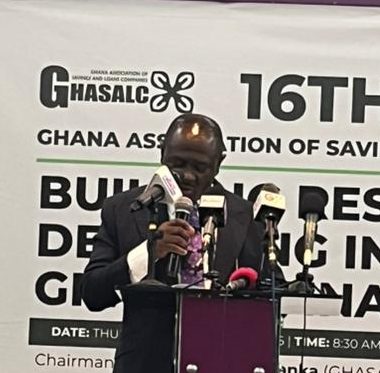
Dr Fred Safo-Kantanka, Board Chairman of the Ghana Association of Savings and Loans Companies and Finance Houses, said the industry accepts the need for stronger regulation, better governance and more resilient institutions, but cautioned that the timing and implementation of the reforms could prove just as important as their objectives.
Speaking at GHASALC’s 16th Annual General Meeting, he described the impending overhaul as one of the most consequential regulatory shifts facing Ghana’s non-bank financial sector.
“The Association recognises and supports the intent and objectives of the reforms,” Dr Safo-Kantanka said. “We appreciate the need to strengthen the regulatory framework, improve institutional resilience, enhance governance and risk management, deepen financial inclusion and create a more sustainable microfinance industry.”
That endorsement is significant because savings and loans companies occupy a critical space in Ghana’s financial architecture. They serve households, traders, micro-enterprises and small businesses that may not always fit comfortably within the risk appetite or operating models of traditional commercial banks.
For that reason, the debate over reform is not simply about tightening prudential standards. It is also about how regulation affects the flow of credit to segments of the economy that depend heavily on non-bank financial institutions.
GHASALC’s position is that stronger regulation is necessary, but poorly sequenced reform could reduce the number of viable institutions, constrain access to finance and place employment at risk.
“While we support the objectives of the reforms, we have also consistently raised concerns about the practical implications, timelines, transition arrangements and sustainability of some aspects of the reform for existing institutions,” Dr Safo-Kantanka said.
The warning highlights the policy dilemma confronting the Bank of Ghana.
A stronger regulatory framework can improve confidence, reduce institutional fragility and promote better governance over time. But stricter capital and liquidity requirements can also become disruptive if institutions are required to recapitalise faster than their balance sheets, shareholders or operating models can realistically support.
That is particularly important in a sector where institutions often serve customers whose financing needs are smaller, more informal and more geographically dispersed than those typically targeted by universal banks.
If reform leads to widespread consolidation or exit without adequate transition arrangements, the result could be a stronger sector on paper but a narrower one in practice.
GHASALC therefore argues that the success of the reforms should not be judged only by whether regulatory thresholds are raised, but by whether institutions are actually strengthened under the new framework.
“Our position has not been one of resistance to reform, but rather shaping it to achieve the intended objectives without jeopardising the entire sector,” Dr Safo-Kantanka said.
He pointed specifically to the realities of institutions that have operated for years, the capital and liquidity constraints facing some firms, the potential impact on jobs and financial inclusion, and the need for an orderly transition.
“We believe that successful reform is not merely about changing the regulatory structure; it is about building stronger institutions within that structure,” he said.
That distinction goes to the heart of the debate.
Regulation can improve resilience only if institutions have the financial capacity, governance systems, technology and management depth required to comply sustainably. If the cost of compliance rises faster than institutions can adapt, reform may unintentionally accelerate closures, mergers or retrenchments.
For Ghana, the stakes extend beyond the financial sector.
Micro, small and medium-sized enterprises remain heavily dependent on alternative forms of credit and savings intermediation. Any contraction in that financing ecosystem could affect working capital, business expansion and employment, particularly among firms that remain outside mainstream bank lending.
GHASALC is already preparing for the possibility that the reforms will fundamentally redraw the institutional map.
The Association said it has expanded its membership to include Finance Houses, with eight institutions responding positively and formally joining.
It is also considering a more significant restructuring of its own identity depending on the final regulatory architecture adopted.
One option under consideration is a transition into an institution representing a broader category of reformed entities under a possible name such as the “Ghana Association of Microfinance Banks”.
“This is not simply a change of name,” Dr Safo-Kantanka said. “It is a transformation of identity, mandate and strategic positioning.”
That potential shift is important because it suggests the reforms could go beyond adjustments to capital levels or licensing rules and instead reshape the classification, positioning and competitive identity of institutions across the sector.
GHASALC is therefore seeking to bring microfinance and micro-credit companies that may transition into any new category into discussions about the future structure of industry representation.
The Association enters this period with a stronger financial base than a year earlier.
Its audited accounts for the year ended December 2025 showed total income rising to GH¢1.84 million from GH¢972,207 in 2024.
Membership dues increased from GH¢542,500 to GH¢807,500, while other income more than doubled from GH¢429,707 to GH¢1.03 million.
GHASALC recorded a surplus of GH¢373,433, compared with GH¢149,029 the previous year, while total assets increased from GH¢690,621 to GH¢1.19 million. Its accumulated fund also rose to GH¢1.00 million.
The stronger financial position could give the Association greater capacity to support advocacy, training, institutional development and reform-readiness among members at a time when compliance costs may rise.
But the more difficult challenge will be at the level of individual institutions.
Recapitalisation, upgraded risk-management systems, stronger governance and improved technology all require funding. For weaker firms, these demands may arrive simultaneously.
That is why liquidity and capital are likely to become the decisive fault lines in the transition.
A financial institution may be solvent but constrained in liquidity. Another may have a viable operating model but insufficient shareholder capital to meet a new threshold. Others may have the balance-sheet strength but lack the systems required to meet more demanding supervisory standards.
The reform process will therefore need to distinguish between institutions that are fundamentally weak and those that are viable but require time and structured transition support.
Digital infrastructure is another major part of the industry’s response.
GHASALC, working with GHAMFIN and CUA, is pursuing an Inclusive Instant Payment System powered by the Mojaloop Foundation.
The objective is to promote interoperability and inclusive instant payments rather than create another closed payment network.
“Our vision is that technology should become an enabler of inclusion rather than another source of exclusion,” Dr Safo-Kantanka said.
That ambition is strategically important because the competitive pressure facing savings and loans companies is no longer coming only from banks.
Fintech companies, mobile-money operators and digitally enabled financial institutions are changing customer expectations around speed, convenience and cost.
For traditional non-bank institutions, digitalisation is therefore not merely an efficiency programme. It is increasingly a condition for remaining competitive.
Shared infrastructure could also lower the cost of technology adoption for smaller institutions by allowing them to access payment capabilities without each having to build expensive systems independently.
GHASALC said it would continue engaging the Bank of Ghana, Ministry of Finance, Ghana Revenue Authority, Ghana Deposit Protection Corporation and GhIPSS as the framework evolves.
It has also adopted a five-year strategic plan covering 2025 to 2029 under the theme “Growth through Advocacy, Community, and Ownership”, anchored on integrity, innovation, customer focus, sustainability and community.
For Dr Safo-Kantanka, however, industry cohesion will be crucial.
“We must remain united as an industry,” he said.
That unity is likely to be tested as the reforms expose differences in capital strength, governance quality, technology readiness and risk-management capacity.
The strongest institutions may be able to absorb new requirements quickly. Others may need mergers, new investors or longer transition periods. Some may not survive at all.
The central policy question is therefore not whether Ghana should reform its microfinance sector.
It is how to ensure that reform produces stronger institutions without creating unnecessary damage to credit access, jobs and financial inclusion in the process.
“The Microfinance Sector Reforms will reshape our industry. Digitalisation will reshape how we deliver financial services. Changing customer expectations will reshape how we compete, and the economic environment will continue to test our resilience,” Dr Safo-Kantanka said.
“Our task is not simply to adapt to the future. Our task is to help shape it.”
For the Bank of Ghana and the industry, that is the real test ahead: building a tougher regulatory framework without hollowing out the very financial ecosystem the reforms are intended to protect.

