

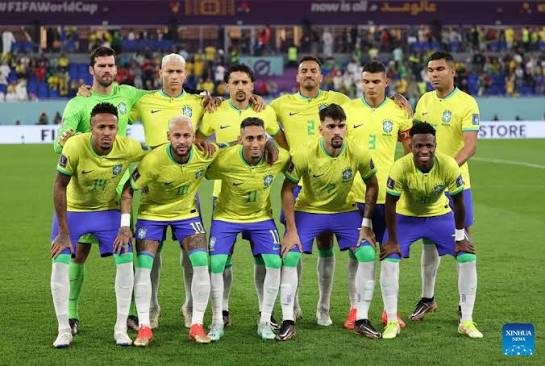

- Brazil Overtake Portugal as World Cup’s Most-Followed Squad on Instagram
Brazil may no longer be in the World Cup, but on Instagram, the Seleção remain the tournament’s most powerful national team brand.
A July 2026 social media study by online entertainment platform Duel.com has ranked Brazil as the most popular World Cup squad on Instagram, after the team added 4.29 million new followers in the last 30 days and lifted its total following to 27.02 million.
That surge has pushed Brazil ahead of Portugal, whose national team account now has 25.24 million followers after gaining 3.06 million in the same period. Brazil also leads the tournament’s hashtag race, with 11.50 million Instagram hashtags linked to the team.
The findings show that in modern football, success is no longer measured only by goals, trophies and tournament progression. It is also measured by attention. And attention, increasingly, is being won on platforms such as Instagram, where national teams now compete for visibility, loyalty, identity and commercial value.
Brazil’s dominance online is not surprising. Few football brands carry the same emotional weight. The yellow shirt remains one of the most recognisable symbols in global sport. The country’s football culture has been built over generations through Pelé, Zico, Romário, Ronaldo, Ronaldinho, Kaká, Neymar and now a younger generation of stars still carrying the burden of expectation.
But the scale of Brazil’s digital lead is significant. The team was already one of the most-followed national squads before the 2026 World Cup began. Its latest 4.29 million follower gain suggests that tournament visibility, nostalgia, star power and global fan loyalty continue to drive attention even when on-field performance does not fully match public expectation.
Brazil’s account now has nearly 2 million more followers than Portugal, despite the Portuguese team also enjoying a major social media boost. Portugal’s follower count rose by more than 3 million in 30 days, supported by 7.90 million hashtags, making it the second-most popular team on the platform.
Portugal’s position shows the continued influence of Cristiano Ronaldo and the country’s recent rise as a global football brand. Even after Portugal’s loss to Spain, the team remains one of the tournament’s biggest digital attractions. The pull of Ronaldo, combined with a new generation of Portuguese talent, continues to keep the national team at the centre of online conversation.
England ranked third in the study, with 13.03 million followers, 442,490 new followers over the last month and 3.20 million Instagram hashtags. Although England’s total following is far below Brazil’s, its digital footprint remains substantial, reflecting the global reach of the Premier League, the strength of English-language sports media and the commercial power of England’s football culture.
France placed fourth, despite having more followers than England. The French national team has 18.27 million Instagram followers and gained 1.19 million in the last 30 days, but its hashtag count of 781,800 was lower than England’s. That difference suggests that follower numbers alone do not fully capture social media energy. Hashtag activity reflects fan conversation, match reaction, emotional engagement and cultural noise around a team.
The United States completed the top five, with 2.91 million followers, 385,170 new followers in the last month and 621,600 hashtags. The US team’s presence in the ranking is particularly important because it points to one of the deeper strategic goals of the 2026 World Cup: expanding football’s commercial and cultural footprint in North America.
A sports analyst from Duel.com said the US team’s follower growth, even after elimination, shows that the tournament may be building a more durable relationship between American audiences and the sport.
“The US team got eliminated, and their follower count keeps growing anyway. Most squads see growth slow down the moment they exit the tournament, which can mean that a younger American audience is building a genuine relationship with the sport for the first time, not just tuning in because the host nation is playing,” the analyst said.
The analyst added that “FIFA’s decision to expand the tournament to 48 teams and bring it to North America was partly a bet on this market. The social data suggests it’s paying off.”
That observation may prove one of the most important insights in the report.
For FIFA, the expanded World Cup was not only about more matches and more participating countries. It was also about growing new audiences, opening new commercial markets and deepening the sport’s reach in countries where football still competes with other major sports for attention.
If the US team can continue gaining followers even after exiting the tournament, it suggests that the World Cup has created interest beyond temporary national excitement. That matters for broadcasters, sponsors, clubs, academies, kit manufacturers and digital platforms.
Spain ranked sixth in the study, with 7.84 million followers, 350,120 new followers and 203,100 hashtags. The Spanish team’s position is notable because, according to the report, it is performing best on the field among the most popular sides, currently ranking second in the FIFA tournament.
This contrast between online popularity and sporting progress is revealing. Brazil, Portugal and England may dominate Instagram attention, but Spain appears to be converting tournament performance into a different type of relevance. Strong results can build social media growth, but national brand power and global fan history still matter more in determining the top of the digital table.
Canada placed seventh, with 513,600 followers, 73,830 new followers and 172,000 hashtags. Mexico ranked eighth with 10.21 million followers, 2.15 million new followers and 134,400 hashtags. Morocco followed in ninth, with 8.34 million followers, 1.22 million new followers and 118,200 hashtags, while the Netherlands completed the top 10 with 3.21 million followers, 237,600 new followers and 86,400 hashtags.
Morocco’s position is particularly interesting because it places Group C at the centre of the social media spotlight. Both Brazil and Morocco came from Group C, making it the only group with two teams in the top 10. That suggests the group carried unusual online attention, helped by Brazil’s global pull and Morocco’s growing profile after its recent rise in international football.
The methodology behind the study is also worth noting. Duel.com did not rank teams only by follower count. It examined two main engagement factors: followers gained in the last 30 days and the number of Instagram hashtags linked to each team. The study tracked team-related keywords, including local-language names, fan nicknames and FIFA abbreviations.
This approach matters because popularity in modern football is fragmented. Some fans follow official accounts. Others post under hashtags. Some engage through local-language communities. Others connect through player-driven content rather than federation accounts. Measuring only one indicator would miss part of the story.
The report therefore captures a broader reality: national teams have become digital media assets.
Their online followings are not just vanity metrics. They influence sponsorship value, merchandise demand, fan engagement, tourism appeal, broadcast interest and the wider commercial narrative around a team. The more attention a squad generates, the more valuable it becomes to brands seeking global visibility.
This is why Brazil’s lead is commercially powerful. A team with 27.02 million followers and 11.50 million hashtags is not simply popular. It is a global advertising platform, a cultural identity and a content machine.
For emerging football nations, the lesson is equally important. Tournament participation can rapidly expand digital visibility, especially if a team performs well or captures a compelling national story. Morocco, Canada and the United States all show different versions of that opportunity.
For African football, Morocco’s inclusion in the top 10 is a reminder that strong tournament identity, continental pride and global diaspora support can translate into digital relevance. If African national teams invest properly in content, storytelling and fan engagement, they can grow their brands well beyond match days.
The 2026 World Cup is therefore not only being fought in stadiums. It is also being contested on social platforms, where millions of fans are choosing which teams to follow, tag, celebrate and argue about.
Brazil may have lost its place on the pitch, but it has not lost its hold on global football imagination.
The Duel.com data makes that clear. In the World Cup’s online economy, Brazil still sit at the top table.
And in modern football, that kind of attention has become a trophy of its own.

