

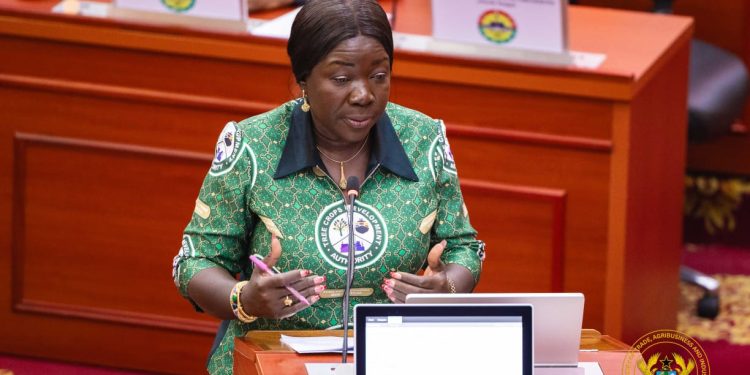

Cabinet Approves Two New Cashew Factories as Government Intensifies Industrial Revival
The Minister for Trade, Agribusiness and Industry, Elizabeth Ofosu-Adjare, has reaffirmed government’s commitment to reviving Ghana’s industrial base, expanding exports and positioning the country as a competitive manufacturing hub within the West African sub-region.
She disclosed that Cabinet has approved the establishment of two new cashew processing factories to be located in the Bono and Bono East regions, as part of efforts to deepen value addition in the agribusiness sector.
Answering questions on the floor of Parliament in Accra on Tuesday, February 17, 2026, the Minister outlined concrete measures being implemented to restore operations at the Komenda Sugar Factory, which was commissioned in 2016 as a flagship agro-industrial project with a daily processing capacity of 1,250 metric tonnes of sugarcane.
According to her, although the facility holds significant potential for job creation and economic development in the Central Region and beyond, prolonged technical, financial and operational challenges have hindered its full-scale operations over the years.
She explained that upon assumption of office, she visited Komenda to engage traditional authorities, farmers and other key stakeholders, after which government set up an Interim Management Committee to undertake a comprehensive technical and financial assessment and develop a sustainable turnaround strategy.
The Minister noted that the Ministry has prioritised the engagement of a Transaction Advisor to attract a strategic investor, adding that provisions have been made in the 2026 Budget to support the full operationalisation of the factory.
Mrs. Ofosu-Adjare also briefed Parliament on progress made on the draft Ghana Automotive Component Manufacturing Development Policy, describing it as a critical pillar of the country’s Industrial Transformation Agenda.
She said the policy is aimed at attracting investment into vehicle component manufacturing, strengthening standards, developing technical skills and integrating local firms into regional and global value chains under the African Continental Free Trade Area (AfCFTA).
According to her, the draft policy has been circulated to relevant ministries and agencies for input, with further consultations expected with the Minister for Finance, Dr. Cassiel Ato Forson, to align proposed incentives ahead of submission to Cabinet.
She stressed that the policy presents a significant opportunity to deepen industrialisation, create skilled employment, boost exports and position Ghana as a leading automotive hub in West Africa.
The Minister further highlighted interventions under the Accelerated Export Development Programme (AEDP), aimed at stimulating domestic production and increasing export volumes.
Among key achievements, she cited the distribution of more than 211,000 coconut seedlings to farmers to diversify export products, advisory support provided to 850 micro, small and medium-sized enterprises to enhance competitiveness, and successful engagement with the Bank of Ghana to extend the export proceeds repatriation period from 60 to 120 days.
She also mentioned the deployment of a single-window export platform by the Ghana Free Zones Authority and the strengthening of certification and inspection systems by the Ghana Standards Authority to improve the competitiveness of Ghanaian products on international markets.
Touching on industrial-agricultural linkages, the Minister underscored the implementation of the “Feed the Industry” initiative under the Ghana FIRST policy, which seeks to ensure a reliable supply of raw materials to local industries through closer integration with agriculture.
On the Accelerated Export Development Advisory Committee, chaired by President John Dramani Mahama, she said the body will provide strategic direction for value addition and economic diversification within the framework of the 24-Hour+ Economy policy.
Mrs. Ofosu-Adjare added that the Ministry is currently pursuing the establishment of three new garment factories through Public-Private Partnerships, alongside the revitalisation of key industrial assets to boost production and employment.
She reaffirmed the Ministry’s commitment to building a resilient, inclusive and export-driven economy that strengthens local industry, creates sustainable jobs and secures Ghana’s position as a competitive industrial hub in Africa.

