
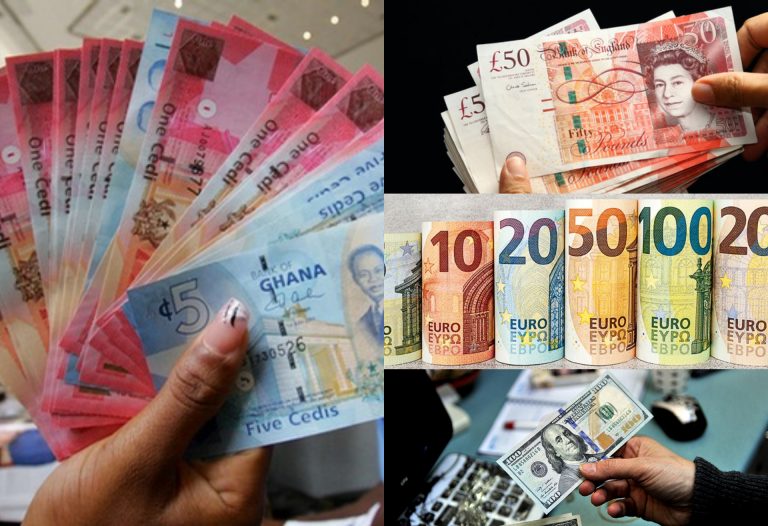

- Cedi Comes Under Renewed Pressure as Dollar Rate Hits GH¢11.41
Ghana’s cedi has come under renewed pressure in 2026, weakening by 8.4 per cent against the US dollar by mid-May, even as the country continues to report strong external reserves, a large trade surplus and rising gold holdings.
According to the Bank of Ghana’s May 2026 Summary of Economic and Financial Data, the cedi traded at GH¢11.4125 to the dollar as at May 15, 2026, compared with GH¢10.45 at the end of December 2025. This represents a year-to-date depreciation of 8.4 per cent against the US currency.
The reversal marks a significant change from the currency’s strong recovery in 2025, when the cedi appreciated sharply during parts of the year. In May 2025, the local currency traded at GH¢10.28 to the dollar, representing a year-to-date appreciation of 43.0 per cent at the time. By December 2025, it had closed the year at GH¢10.45, with a year-to-date appreciation of 40.7 per cent.
The 2026 depreciation therefore suggests that the cedi’s earlier recovery is facing a fresh sustainability test, especially as demand for foreign exchange rises alongside imports, debt-service obligations and private-sector activity.
The pressure has not been limited to the US dollar. Against the British pound, the cedi traded at GH¢15.2055 by mid-May 2026, reflecting a year-to-date depreciation of 7.5 per cent. Against the euro, the local currency traded at GH¢13.2695, also showing a 7.5 per cent depreciation over the same period.
The broader exchange-rate picture shows that the cedi has weakened across the three major trading currencies tracked in the report. This matters because the dollar directly affects fuel, machinery, imported goods and external debt obligations, while the euro and pound also influence trade, travel, education, remittances and import pricing.
The pressure on the local currency is particularly notable because Ghana’s external sector remains relatively strong. Total exports reached $11.15 billion by April 2026, compared with total imports of $5.87 billion, leaving a trade surplus of $5.28 billion, equivalent to 4.4 per cent of GDP.
Gold remains the main anchor of the external sector. Gold exports stood at $6.86 billion by April 2026, accounting for more than half of total export receipts. Cocoa exports stood at $1.86 billion, while oil exports reached $1.28 billion.
Gross International Reserves also remained strong at $13.95 billion in April 2026, equivalent to 5.5 months of import cover. Under the programme definition, reserves stood at $12.09 billion, equivalent to 4.8 months of import cover. The Bank of Ghana further reported that, as at May 18, 2026, total Gross International Reserves had risen to $14.42 billion, while Net International Reserves stood at $12.43 billion.
Ghana’s gold holdings also increased to 22.3 tonnes in April 2026, from 18.6 tonnes in December 2025, with the value of gold holdings rising to $3.47 billion. This reinforces the central bank’s reserve-building strategy, which has increasingly relied on gold accumulation as a buffer against external volatility.
But the cedi’s depreciation despite these buffers points to a deeper market tension. Strong reserves and export earnings may be improving Ghana’s external position, but demand-side pressures in the foreign exchange market remain active.
One possible pressure point is the import bill. Total imports rose from $4.06 billion in March 2026 to $5.87 billion in April 2026, with oil imports increasing to $2.01 billion by April. Non-oil imports also rose to $3.86 billion, suggesting that stronger economic activity may be translating into higher demand for foreign exchange.
The commodity price environment adds another risk. Brent crude oil averaged $103.2 per barrel in April 2026, representing a 67.4 per cent year-to-date increase. Higher oil prices could increase Ghana’s foreign exchange demand for fuel imports and potentially feed into transport and utility costs if sustained.
For monetary policy, the exchange-rate development is important because Ghana’s disinflation gains remain one of the strongest pillars of the recovery story. Inflation fell to 3.4 per cent in April 2026, but renewed cedi weakness could test price stability if imported inflation begins to re-emerge through fuel, food, pharmaceuticals, machinery and other imported inputs.
The policy challenge for the Bank of Ghana is therefore delicate. On one hand, reserves are stronger, inflation is low, and interest rates have declined sharply. On the other hand, the exchange rate has begun to weaken again, raising questions about whether the currency can remain stable without heavy intervention.
The cedi’s performance also has implications for investor confidence. A moderate and orderly depreciation may be manageable, especially if supported by strong reserves and export receipts. But a sharper or persistent weakening could unsettle businesses, revive inflation expectations and complicate the government’s broader fiscal consolidation effort.

