
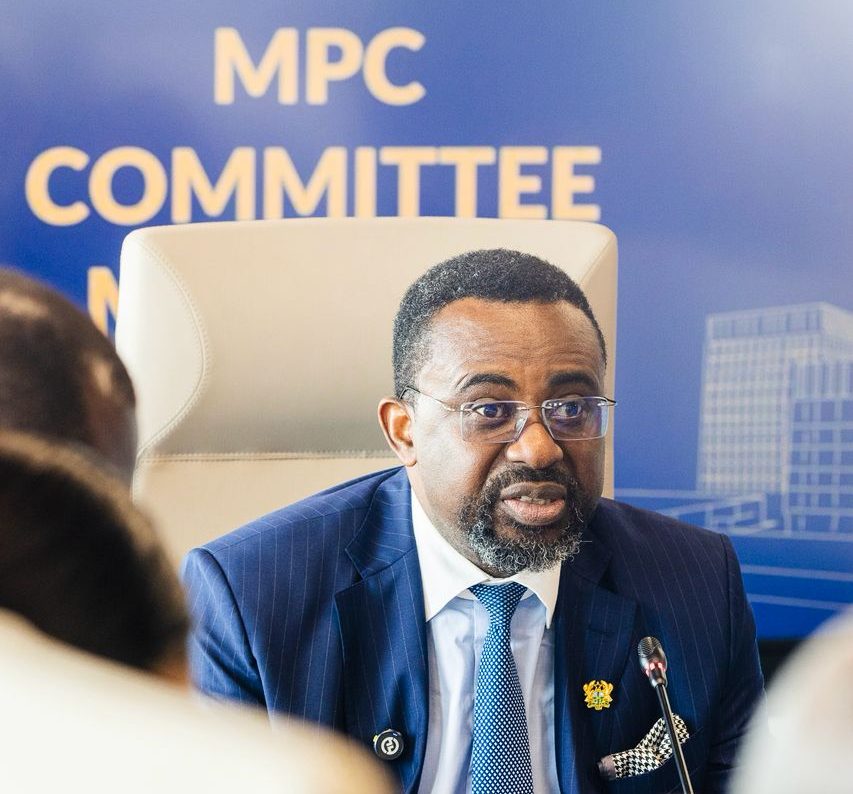

- MPC Likely to Hold Policy Rate at 14% as Oil, Cedi Risks Cloud Inflation Outlook
The Bank of Ghana’s Monetary Policy Committee is likely to keep the policy rate unchanged at 14.0 per cent at the end of its 130th meeting, as policymakers weigh Ghana’s strong domestic disinflation against renewed risks from the cedi, crude oil prices and the deteriorating global environment.
Although the latest macroeconomic data provide a strong case for further monetary easing, Governor Dr Johnson Pandit Asiama’s opening remarks to the MPC suggest the Committee may prefer caution over another rate cut after a sharp decline in interest rates over the past year.
The policy rate has already fallen from 28.0 per cent in April 2025 to 14.0 per cent in April 2026, while the interbank weighted average rate has dropped from 26.92 per cent to 10.36 per cent over the same period. Treasury bill yields have also declined sharply, with the 91-day bill rate falling to 4.90 per cent in April 2026 from 15.47 per cent a year earlier.
On inflation, the domestic case for easing remains strong. Headline inflation fell from 21.2 per cent in April 2025 to 3.4 per cent in April 2026, while food inflation dropped to 2.2 per cent and non-food inflation stood at 4.2 per cent.
But the April inflation outturn also showed the first uptick in the disinflation path, rising from 3.2 per cent in March to 3.4 per cent in April. The Governor specifically flagged this in his opening remarks, noting that “inflation has ticked up, marking the first increase since December 2024.”
That signal is likely to weigh heavily on the MPC members’ decision.
Dr Asiama said the Committee was meeting at a moment of “heightened policy complexity,” with domestic conditions improving but the external environment deteriorating due to the conflict in the Middle East and its impact on global energy and commodity prices. He warned that for an economy such as Ghana a commodity exporter but energy importer the transmission channels include fuel prices, transportation costs, import bills and consumer prices.
The concern is not theoretical. Brent crude oil averaged $103.2 per barrel in April 2026, representing a 67.4 per cent year-to-date increase. Such a steep rise in global oil prices could feed into domestic fuel prices, transport fares, utility costs and broader inflation expectations, particularly if the shock persists.
The cedi is also again under pressure. The local currency traded at GH¢11.4125 to the dollar as at May 15, 2026, representing a year-to-date depreciation of 8.4 per cent. It had also weakened by 7.5 per cent against both the pound and the euro.
For the MPC, cutting the policy rate further in such an environment could risk weakening the attractiveness of cedi assets, especially if market participants begin to price in further depreciation. This creates the central tension facing the Committee: Ghana’s domestic inflation and interest-rate data point toward room for additional easing, but external risks argue for a pause.
The Governor’s remarks also show that the MPC is not only looking at current inflation but at inflation expectations. He said the Committee would consider how to realign the interest-rate structure while ensuring inflation expectations do not become “dislodged,” especially as domestic energy supply disruptions and external commodity price pressures could create a “dual-channel inflation expectations problem.”
That language points to a central bank preparing to defend the credibility of its inflation-targeting framework, rather than one rushing into another aggressive cut.
At the same time, the Bank will take comfort from Ghana’s stronger external buffers. Gross International Reserves stood at $13.95 billion in April 2026, equivalent to 5.5 months of import cover, while total exports reached $11.15 billion, supported by gold exports of $6.86 billion. Ghana also recorded a trade surplus of $5.28 billion, equivalent to 4.4 per cent of GDP.
The banking sector also appears stronger, with capital adequacy rising to 22.3 per cent in April 2026 and non-performing loans declining to 18.0 per cent, from 23.6 per cent a year earlier. Private sector credit is also recovering, with nominal private-sector credit growth reaching 28.7 per cent in April 2026.
These indicators give the MPC some room to argue that previous rate cuts are working through the economy and that the transmission mechanism is improving. But they also reduce the urgency for another immediate cut.
The likely decision, therefore, is a hold at 14.0 per cent, accompanied by a cautious policy statement that acknowledges Ghana’s stronger domestic fundamentals while warning that the inflation outlook is now exposed to external shocks.
It is important to note that the team here at NorvanReports, after going through the data, also sees a possible cut which will be a smaller cut of about 100 basis points that cannot be completely ruled out, particularly because the real policy rate remains strongly positive. But given the Governor’s emphasis on oil prices, cedi pressure, energy-sector risks and inflation expectations, a pause appears more probable.
The MPC’s message is likely to be that Ghana has made substantial stabilisation gains, but the disinflation victory must not be taken for granted.
In effect, we at NorvanReports project that the Committee may decide that this is not the moment to test the market with another cut. The domestic economy may be asking for cheaper money, but the global environment is warning the central bank to wait.

