

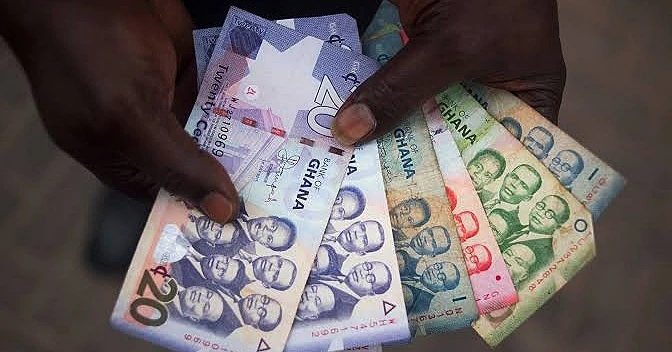

- Cedi Slips 1.06% in a Week as Oil Shock Threatens New FX Pressure
Ghana’s cedi has extended its recent losses against the US dollar just as Brent crude breaches US$100 a barrel, raising the prospect that petroleum imports could become a new source of pressure in an already tightening foreign-exchange market.
The Bank of Ghana’s September 9 reference rate puts the dollar at GH¢11.4143 buying and GH¢11.4257 selling, giving a midpoint of about GH¢11.4200/US$. That compares with roughly GH¢11.30 to the dollar on September 3, implying depreciation of approximately 1.06% in less than a week.
The latest session also shows the weakening has continued rather than stabilised. The BoG selling rate rose from GH¢11.4007 on September 8 to GH¢11.4257 on September 9, equivalent to a one-day depreciation of about 0.22%, while the buying rate similarly moved from GH¢11.3893 to GH¢11.4143. The central bank’s published rates provide the clearest official indication that the cedi remains under modest but persistent pressure.
Retail pricing is considerably weaker than the interbank benchmark. Forex bureaux were selling dollars at around GH¢12.15 on Wednesday, compared with the BoG selling rate of GH¢11.4257, a premium of approximately 6.34%.
That spread should be interpreted primarily as an indicator of tighter retail liquidity and transaction costs rather than, on its own, evidence of broader foreign-exchange instability.
The more significant new risk is emerging from international energy markets. Brent crude futures moved decisively above US$100, trading at US$100.95 a barrel in Wednesday afternoon trading after touching US$101.58, as escalating US-Iran hostilities and attacks on shipping raised concerns about disruption to Middle Eastern supply.
“The move towards and back above $100 Brent is reflecting a market that increasingly has to change its view on how long the Middle East crisis will continue to curb supply from the region,” Ole Hansen, head of commodity strategy at Saxo Bank, told Reuters.
For Ghana, that development matters because the cedi was already facing significant corporate demand for foreign currency before crude crossed US$100.
Reuters reported on September 3 that importers were increasing dollar purchases while foreign investors were repatriating coupon payments, with strong demand also visible at central-bank FX auctions.
The cedi was then trading around GH¢11.30/US$, compared with about GH¢11.20 a week earlier, indicating that depreciation pressure had already begun to build.
A sustained oil price above US$100 could add petroleum-sector demand to those existing pressures. Ghana produces crude oil but imports substantial quantities of refined petroleum products, meaning higher international prices can simultaneously improve upstream export receipts and increase the foreign currency required to pay for petrol, diesel and other refined products. The net FX effect will therefore depend on the timing and scale of export receipts against the dollar needs of importers and bulk distributors.
The transmission risk is particularly important because international fuel markets are already tight. Reuters reported that physical crude benchmarks have been trading above US$100 since September 3 and that refined fuel markets remain under significant pressure because of disruptions to refining and shipping capacity.
Hamad Hussain, senior climate and commodities economist at Capital Economics, said the key risk is whether tanker attacks reduce ship-to-ship transfers in the Gulf of Oman, which have helped maintain supplies to world markets.
The Strait of Hormuz remains the largest uncertainty. About one-fifth of global oil and gas supply traditionally transits the waterway, but Reuters said flows that had recovered to roughly 8 million-9 million barrels per day before fighting resumed on August 30 have since fallen below 2 million barrels per day.
That means the market is increasingly pricing not simply the availability of crude underground, but the ability to transport it safely to buyers.
For Ghana’s FX market, the risk is therefore one of overlapping demand pressures rather than a single shock. Importers, corporate borrowers and investors seeking to repatriate funds are already competing for dollars, while an extended period of elevated crude prices could raise the size of petroleum-related FX settlements.
If those demands coincide with weaker inflows or reduced central-bank supply, pressure on the cedi could become more pronounced.
The Bank of Ghana has meanwhile introduced a new foreign-exchange operations framework designed to clarify how it participates in the market while preserving a flexible exchange-rate regime.
The central bank said the framework “reinforces BOG’s commitment to maintaining macroeconomic stability under its inflation-targeting mandate and a flexible exchange rate regime, where the exchange rate remains market-determined.”
That means interventions can provide liquidity and smooth disorderly conditions, but are not intended to establish a permanently fixed level for the cedi.
The retail-interbank spread will consequently be an important indicator to watch alongside the official rate itself. A persistent gap of more than 6.00% would suggest that end-users are facing materially tighter dollar conditions than the interbank reference rate implies, particularly for cash and small-ticket transactions.
If that spread narrows while the interbank rate stabilises, it would provide stronger evidence that retail liquidity is improving.
The oil shock also has implications beyond the currency market. Higher international fuel prices can increase transport, logistics and production costs, potentially feeding into domestic inflation and complicating the Bank of Ghana’s monetary-policy calculus if second-round price pressures emerge.
Globally, the oil rally is already pushing investors to reassess the outlook for inflation and interest rates, with Reuters reporting that higher crude prices are contributing to greater uncertainty around the direction of major central banks.
For now, the cedi’s roughly 1.06% decline since September 3 remains meaningful rather than disorderly. The greater concern is the combination of weakening momentum, strong corporate dollar demand, foreign-investor repatriation and an external oil shock capable of increasing energy-sector FX requirements at the same time.
Ghana has therefore become the principal African currency to watch in the near term, particularly if Brent remains above US$100 and demand for dollars at both interbank and retail levels continues to strengthen.

