

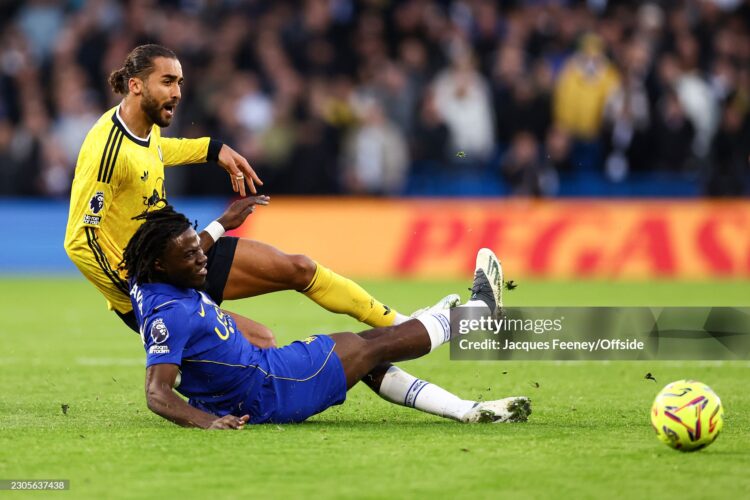

- Chelsea Could Not Handle Our Intensity, Says Calvert-Lewin After Leeds’ Stunning 4-1 Victory
Leeds United striker Dominic Calvert-Lewin has attributed his team’s emphatic 4-1 victory over Chelsea at Stamford Bridge to their relentless pressing, tactical discipline and physical intensity, arguing that the London club struggled to cope with the visitors’ aggressive approach throughout Saturday’s Premier League encounter.
The result ended Leeds’ 27-year wait for a league victory at Stamford Bridge and intensified scrutiny of Chelsea manager Xabi Alonso, whose side suffered their fifth defeat in 11 Premier League matches this season.
Noah Okafor scored twice, while Calvert-Lewin converted a second-half penalty and substitute Brenden Aaronson completed the rout in stoppage time.
Chelsea had taken the lead through Emmanuel Emegha in the 25th minute, but Leeds responded almost immediately and subsequently overwhelmed their hosts with a performance built around coordinated pressing, aggressive movement and sustained attacking pressure.
For Calvert-Lewin, the victory was not simply a consequence of Chelsea’s defensive weaknesses. It reflected the effectiveness of a tactical plan designed to prevent the home side from establishing control.
Speaking after the match, the England international said he had expected Chelsea to respond more strongly after the interval but was surprised by their inability to match Leeds’ intensity.
“Our intensity, the way that we played and the way we set up against them, they couldn’t handle it.”
His assessment captured the contrasting performances of the two sides, with Leeds maintaining their attacking aggression while Chelsea struggled to establish a meaningful response after falling behind.
The visitors entered the match knowing that victory at Stamford Bridge would represent a significant achievement, particularly given their poor historical record at the ground.
Leeds had not won a league fixture away to Chelsea since 1999, making Saturday’s result an important milestone in their campaign.
However, the manner of the victory was arguably more significant than the historical record.
Daniel Farke’s side created opportunities throughout the encounter, repeatedly exploiting spaces in Chelsea’s defensive structure and forcing mistakes through sustained pressure.
Despite conceding first, Leeds demonstrated considerable composure.
Chelsea’s opener arrived against the general direction of play when Emegha beat goalkeeper James Trafford at his near post.
Rather than allowing the setback to disrupt their approach, Leeds continued attacking and drew level three minutes later.
Calvert-Lewin combined with Okafor, who advanced into the penalty area before finishing confidently despite the presence of several Chelsea defenders.
The equaliser exposed the home side’s difficulty containing direct attacking movements, particularly when Leeds accelerated through central areas.
The visitors continued to threaten before half-time, with Calvert-Lewin striking the crossbar and forcing further defensive interventions.
The first half ended 1-1, but the scoreline arguably understated Leeds’ superiority in creating dangerous situations.
Farke’s response during the interval proved decisive.
Rather than instructing his players to adopt a more cautious approach, the German manager encouraged them to maintain their intensity and continue pursuing victory.
He later explained that he would have been disappointed to leave Stamford Bridge with only a draw because his team had already demonstrated an ability to dominate significant periods of the game.
“We wanted to press them high, so they can’t show their world-class potential.”
The remark provides an important insight into Leeds’ tactical intentions.
Against opponents with technically gifted midfielders and attacking players, high pressing can reduce the time available for decision-making and make it more difficult to develop controlled passing sequences.
However, such an approach also carries risks because committing players forward can leave spaces behind the defensive line.
Leeds managed those risks effectively by maintaining compactness and ensuring that players supported one another when pressing.
In the 53rd minute, Calvert-Lewin converted a penalty after Morgan Rogers was penalised for handling Jayden Bogle’s attempted shot.
The goal gave Leeds a deserved advantage and further increased the pressure on Chelsea’s defence.
Five minutes later, Okafor scored his second goal of the afternoon, converting from close range following a delivery involving Leeds captain Ethan Ampadu.
The third goal effectively shifted the contest beyond Chelsea’s control.
With Leeds continuing to press and Chelsea struggling to retain possession, the visitors looked increasingly likely to extend their advantage.
Aaronson eventually completed the scoring in the first minute of stoppage time, finishing a counterattack to seal a comprehensive 4-1 victory.
The result was supported by the underlying performance statistics.
Leeds recorded 21 attempts at goal compared with Chelsea’s 14, while the visitors created seven clear-cut opportunities against none for the home side.
These figures suggest that the outcome was not merely a consequence of clinical finishing or isolated defensive errors.
Instead, Leeds consistently generated higher-quality attacking situations while restricting Chelsea’s ability to create comparable opportunities.
The contrast is particularly significant because Chelsea possess considerable attacking talent.
Players such as Cole Palmer, Estêvão and Emegha provide individual quality capable of influencing matches, but their effectiveness depends partly on the team’s ability to progress possession and create space.
The visitors’ aggressive pressing reduced Chelsea’s opportunities to construct attacks, while their compact organisation limited the space available between defensive and midfield lines.
Chelsea’s inability to manage those pressures became increasingly evident as the match progressed.
The defeat also placed renewed attention on Alonso’s tactical approach.
Chelsea have now recorded five victories, one draw and five defeats from their opening 11 league matches, leaving them with 16 points from a possible 33.
That represents a points return of 48.48%, an inconsistent record for a club seeking to compete near the top of the Premier League.
More concerning is the pattern of recent results.
Chelsea have lost three of their previous four league fixtures, raising questions about the team’s defensive organisation, tactical adaptability and ability to respond when opponents impose sustained pressure.
The Stamford Bridge crowd expressed its frustration during the encounter, with supporters booing the team and some leaving before the final whistle.
Such reactions reflect growing expectations that Chelsea should be delivering stronger performances, particularly in home fixtures.
For Alonso, the challenge extends beyond recovering from one heavy defeat.
He must identify why his team struggled to cope with Leeds’ pressing and develop solutions capable of preventing opponents from repeatedly exploiting similar weaknesses.
The absence of injured players may complicate that task, but injuries alone cannot fully explain the extent of Saturday’s performance.
The more significant issue concerns Chelsea’s collective organisation.
A team with substantial individual quality must still demonstrate the ability to defend effectively, control midfield and maintain composure when confronted with aggressive opponents.
Calvert-Lewin’s performance was central to the visitors’ success, not only because of his penalty but also because of his physical presence, movement and contribution to attacking combinations.
His involvement helped Leeds sustain pressure and provided an important outlet when the team advanced quickly into Chelsea’s half.
Okafor, meanwhile, delivered the decisive attacking contribution through his two goals.
The Swiss international’s movement and finishing repeatedly troubled Chelsea’s defenders, demonstrating the value of attacking players capable of exploiting spaces created by coordinated team pressing.
Farke also credited his players’ tactical understanding rather than attributing the victory solely to superior physical strength.
The distinction matters because high-intensity football depends on organisation as much as athleticism.
Without coordinated movement, aggressive pressing can leave a team vulnerable to counterattacks.
Leeds succeeded because their players appeared to understand when to apply pressure, how to close passing lanes and how to maintain compactness.
The victory moved the Yorkshire club into sixth position in the Premier League standings immediately after the match, providing an important boost to their ambitions for the season.
It also reinforced confidence in Farke’s methods, particularly his ability to prepare the team for difficult away fixtures against opponents possessing greater financial resources.
The broader lesson from Leeds’ victory is that individual quality and substantial investment do not automatically translate into tactical superiority.
Chelsea entered the encounter with talented players and home advantage, but Leeds demonstrated greater collective discipline, intensity and clarity of purpose.
For Calvert-Lewin and his teammates, the challenge will now be maintaining those standards consistently rather than allowing an impressive victory to become an isolated achievement.
For Chelsea, the defeat represents another warning that their ambitions will remain difficult to achieve without significant improvements in defensive stability and tactical cohesion.
Alonso must now restore confidence and establish a clearer identity capable of withstanding aggressive opponents.
The 4-1 result will be remembered as one of Leeds’ most impressive away victories in recent years.
But its significance extends beyond the scoreline: it demonstrated how a well-organised team with a clear tactical strategy can overwhelm opponents who possess considerable individual talent but fail to operate effectively as a collective unit.
For Leeds, it was a triumph of preparation, intensity and execution.
For Chelsea, it was a sobering reminder that Premier League success depends not merely on the quality of individual players, but on the strength of the team as a whole.
NorvanReports | Football

