


- Cocoa Output Faces 16% Decline as Climate and Galamsey Risks Deepen
Ghana’s cocoa production is expected to decline by at least 16% in the 2026/27 crop season as excessive rainfall, crop disease, ageing farms and illegal mining continue to weaken output in one of the country’s most important export industries.
The projected contraction, disclosed by the Ghana Cocoa Board, points to another difficult season for a sector that remains central to Ghana’s foreign-exchange earnings, rural employment and agricultural economy.
The outlook also raises wider concerns for the global cocoa market because Côte d’Ivoire, the world’s largest producer, is similarly expected to record a double-digit decline in production.
Together, Ghana and Côte d’Ivoire account for a substantial share of global cocoa supply, meaning weaker harvests in both countries could keep international markets tight and sustain elevated price volatility.
COCOBOD attributed Ghana’s expected decline to a combination of climatic and structural factors.
Excessive rainfall during May and June disrupted flowering and pod development, while the increasing likelihood of El Niño conditions has added uncertainty to the growing season.
The regulator also cited cocoa’s natural alternate-bearing cycle, under which strong production years may be followed by weaker yields as trees recover.
The impact appears particularly severe in the Western and Western North regions, Ghana’s principal cocoa-producing belt.
A low cherelle load, referring to the number of young pods expected to mature, has signalled significantly weaker production ahead of the new crop season beginning in September.
Farmers have also reported unusually limited pod formation, reinforcing expectations that the country may struggle to reverse several years of disappointing output.
The supply problem extends beyond weather.
Cocoa swollen shoot virus disease continues to damage farms and reduce the productive lifespan of trees, particularly in long-established growing areas.
The disease can cause gradual yield decline before eventually killing affected trees, requiring farms to be cut down and replanted.
Rehabilitation is costly and can leave farmers without meaningful income for several years while new trees mature.
Ageing plantations present a related challenge.
Older trees generally produce lower yields and are more vulnerable to pests, disease and climate stress. Without sustained replanting and farm renewal, Ghana’s productive capacity is likely to remain under pressure even when weather conditions improve.
Illegal small-scale mining has become another major threat.
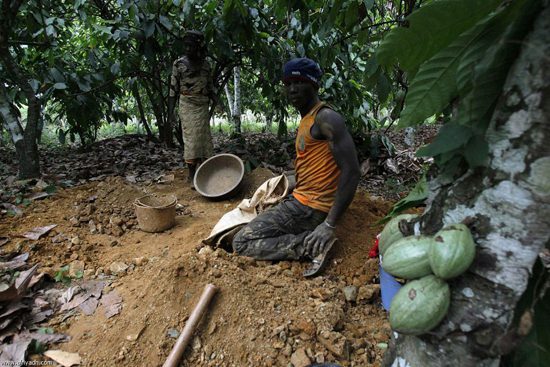
Galamsey has displaced cocoa farms, degraded fertile land and contaminated water sources used by farming communities.
The attraction of immediate cash payments from miners can also encourage some landowners and farmers to abandon cocoa production, reducing cultivated acreage in established growing districts.
The expansion of mining into cocoa areas therefore creates both an environmental and economic risk.
Unlike temporary weather shocks, the destruction of farmland can permanently reduce production capacity unless the land is restored and returned to agriculture.
COCOBOD said it had intensified measures aimed at cushioning the expected decline.
These include the rehabilitation of diseased farms, nationwide insecticide and fungicide spraying programmes and the reinstatement of free fertiliser distribution for the 2026/27 season.
The interventions are intended to improve yields, protect healthy trees and support farmers facing rising input costs.
Their effectiveness, however, will depend on timely implementation, adequate funding and whether inputs reach farmers before critical stages of the production cycle.
Rehabilitation programmes must also provide sufficient support to farmers whose diseased trees are removed, as the loss of short-term income can discourage participation.
The production decline carries significant macroeconomic implications.
Cocoa remains one of Ghana’s leading export commodities and a major source of foreign currency. Lower volumes could weaken export receipts, constrain foreign-exchange supply and reduce income for farming households.
High international cocoa prices may partly offset the fall in volume, but the benefits will depend on the scale of the decline, pricing arrangements and the proportion of export earnings transmitted to farmers.
For chocolate manufacturers and global commodity buyers, lower Ghanaian and Ivorian output could prolong supply shortages and raise procurement costs.
The tightening market may support producer prices, but it also increases the risk that manufacturers reformulate products, reduce cocoa content or pass higher costs on to consumers.
Ghana’s latest forecast shows that the cocoa crisis is no longer driven by a single factor.
Climate instability, disease, ageing farms and illegal mining are interacting to weaken both immediate production and the sector’s long-term capacity.
The central policy challenge is therefore not simply to manage one poor season, but to protect cocoa land, rehabilitate farms and rebuild productivity before declining output becomes structural.

