


- COCOBOD Secures GH¢3.4bn at 11% As Domestic Institutions Back Cocoa Purchases
Ghana Cocoa Board’s inaugural domestic commercial-paper issuance has raised GH¢3.396 billion, opening a new chapter in the financing of the country’s cocoa purchases while shifting a greater share of the industry’s funding risk onto the domestic capital market.
The 266-day senior unsecured instrument, issued through Cocoa Capital PLC, attracted GH¢3.586 billion in bids from 38 institutional investors. COCOBOD accepted 36 bids worth GH¢3,395,783,000 at a clearing yield of 11 per cent.
The transaction is the first issuance under Cocoa Capital’s GH¢16.3 billion Domestic Cocoa Notes Programme. The programme comprises GH¢14 billion in commercial paper intended to finance cocoa purchases and GH¢2.3 billion in bonds to refinance existing obligations associated with earlier cocoa-debt restructuring.
Its importance therefore extends beyond the amount raised. COCOBOD is attempting to replace a financing model historically dominated by offshore syndicated loans with one that relies substantially on savings accumulated within Ghana’s banking, pension and investment sectors.
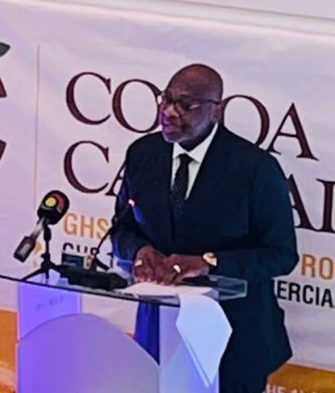
Speaking at the instrument’s admission to the Ghana Fixed Income Market, COCOBOD Chief Executive Dr Ransford Annetey Abbey described the transaction as an important milestone in the evolution of Ghana’s cocoa-financing framework.
“Today’s ceremony is more than the listing of a financial instrument,” he said. “It represents an important milestone in the evolution of Ghana’s cocoa-financing framework and demonstrates what can be achieved when public institutions, regulators, capital-market participants, professional advisers and domestic investors work together towards a shared national objective.”
Demand exceeded the accepted allocation by approximately GH¢190 million, producing a bid-to-allocation ratio of about 1.06 times. This shows that investors were willing to commit almost GH¢3.6 billion, although the level of oversubscription was not large.
The issuance also fell approximately GH¢604 million below the indicative GH¢4 billion target. That difference matters because strong participation does not mean COCOBOD raised everything it initially sought.
The outcome can therefore be read in two ways. It demonstrates that Ghana’s domestic market can mobilise several billion cedis for strategic agricultural financing. It also shows that institutional demand has limits, especially when a quasi-government obligation competes with Treasury securities, corporate debt and other investment opportunities.
COCOBOD described the transaction as the largest cash raise undertaken by a quasi-government-sponsored special-purpose vehicle in Ghana’s domestic market.
If subsequent issuances are executed successfully, the programme could broaden the range of investible securities available to banks, pension funds and asset managers. It could also establish a template through which public institutions raise financing without relying exclusively on central government borrowing or foreign creditors.
Borrowing in cedis reduces the currency mismatch associated with foreign-denominated debt. COCOBOD will not have to repay this instrument in dollars while earning and spending across different currencies. But domestic borrowing exposes the regulator to local interest rates, refinancing conditions and the availability of institutional liquidity.
The 11 per cent clearing yield represents a financing cost that must be supported by proceeds from cocoa sales. The sustainability of the instrument will therefore depend on effective procurement, export execution and cash-flow management.
Its 266-day maturity adds a timing risk. Cocoa receivables must arrive early enough to meet repayment obligations. Any delay in shipments, export receipts or settlement could create liquidity pressure, particularly if the regulator must return to the market while investors are demanding higher yields.
To strengthen repayment arrangements, selected receivables from executed cocoa forward-sales contracts have been assigned to Cocoa Capital. Collections will pass through ring-fenced accounts governed by an agreed payment waterfall.
This structure is intended to improve discipline and give investors clearer visibility over the cash flows expected to service the debt. However, the instrument remains senior and unsecured. Investors are relying primarily on the quality of the assigned receivables, the strength of the transaction structure and confidence that obligations will be honoured.
The proceeds will finance cocoa purchases during the 2026/27 crop season. This links the capital-market transaction directly to COCOBOD’s ability to purchase beans and ensure that farmers receive payment.
The producer price has been set at GH¢42,400 per tonne, equivalent to GH¢2,650 for a 64-kilogramme bag. This represents 71.18 per cent of the realised gross free-on-board value and complies with reforms requiring farmers to receive at least 70 per cent of realised gross FOB prices.
Raising the money is therefore only the first test. The next is whether it produces timely purchasing, predictable farmer payments and greater stability across the cocoa supply chain.
The inaugural allocation represents approximately 24.3 per cent of the planned GH¢14 billion commercial-paper component. COCOBOD must consequently raise considerably more capital through subsequent transactions if the programme is to meet its stated financing objective.
Future issuances will test whether the inaugural demand reflected lasting confidence or the attraction of a first transaction carrying an 11 per cent yield. Investors will assess repayment performance, reporting standards and the condition of the cocoa industry before committing additional funds.
There are also wider implications for Ghana’s financial system. Banks and pension funds gain another investment instrument tied to a major export industry. Yet greater exposure to cocoa-linked quasi-sovereign debt could concentrate institutional portfolios and absorb liquidity that might otherwise finance private businesses.
The programme must therefore demonstrate that it expands the domestic market rather than merely redirecting a fixed pool of capital from one public-sector-related obligation to another.
Dr Abbey acknowledged that confidence would have to be maintained after the inaugural issuance.
“We recognise that investor confidence must be earned and sustained through robust governance, disciplined execution, transparent reporting and the consistent fulfilment of our obligations,” he said.
Investors will need regular information on the use of proceeds, cocoa purchases, assigned receivables, export performance and repayment preparations.
The GH¢3.396 billion transaction is an important demonstration of Ghana’s capacity to mobilise domestic savings for a strategic industry. It reduces immediate dependence on offshore borrowing and creates a potentially significant asset class.
Its lasting success, however, will not be measured by the ceremony accompanying the first listing. It will be determined by whether farmers are paid promptly, investors are repaid fully and subsequent issuances can be completed without destabilising domestic liquidity or creating another cycle of refinanced cocoa debt.

