

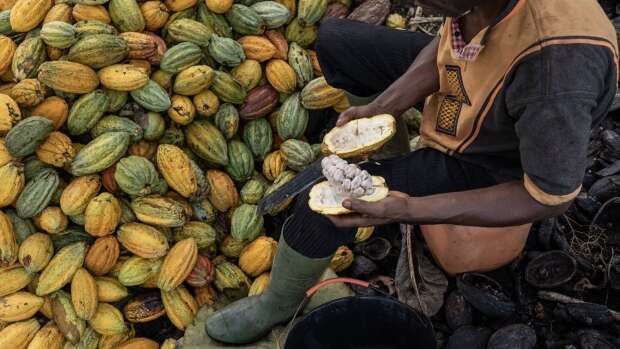

- COCOBOD Targets 50.00% Local Processing as Ghana Seeks More Cocoa Value
Ghana Cocoa Board is pushing to increase local processing of the country’s cocoa output to at least 50.00%, as the world’s second-largest cocoa producer seeks to capture a larger share of the global chocolate value chain and reduce its dependence on raw bean exports.
The policy direction, reaffirmed by COCOBOD Chief Executive Officer Dr Randy Abbey at an industry forum, signals a strategic shift in Ghana’s cocoa economy: from a model largely built around primary commodity exports to one focused on value addition, industrial jobs and stronger local participation in downstream cocoa processing.
Dr Abbey said the future of Africa’s cocoa industry cannot rest only on producing more beans. Instead, cocoa-producing countries must process more of their crop locally and build domestic capacity in semi-finished and finished products such as cocoa liquor, butter, powder and chocolate.
“We cannot continue exporting raw materials while others create the jobs, industries and wealth from our cocoa,” he said.
The argument goes to the heart of one of Africa’s longest-running commodity dilemmas. Ghana and Côte d’Ivoire dominate global cocoa production, but most of the high-value processing, branding, manufacturing and retail profits are captured outside the continent. African countries therefore remain exposed to raw commodity price swings while earning only a limited share of the final consumer value of chocolate and cocoa-based products.
Cabinet has already directed that, beginning from the 2026/27 crop season, a minimum of 50.00% of Ghana’s cocoa beans should be processed locally, with the state-owned Cocoa Processing Company expected to be revived as part of the strategy.
The Ministry of Finance has also linked the processing target to a broader reform of COCOBOD’s financing model. Under the new framework, COCOBOD is expected to use domestic cocoa bonds to finance cocoa purchases and repay them with cocoa proceeds within each crop year, creating room to sell beans of any volume to local processors and promote value addition and job creation.
That shift is important because Ghana’s previous financing model was heavily tied to forward sales of raw beans. According to the Ministry of Finance, the use of raw bean contracts as collateral limited Ghana’s ability to optimise installed domestic processing capacity.
Reuters reported earlier this year that Ghana was processing between 30.00% and 40.00% of its cocoa beans locally, with the government aiming to raise that share to at least 50.00% in the 2026/27 crop season.
If achieved, the 50.00% target would represent a major industrial policy milestone. Local processing can increase export earnings, create manufacturing jobs, deepen technical skills, strengthen domestic enterprise participation and reduce the country’s vulnerability to raw bean market cycles.
But the target will not be easy to deliver. Processing cocoa at scale requires reliable electricity, affordable long-term financing, modern plants, skilled labour, consistent bean supply, export market access and policy predictability. Without those conditions, the value-addition agenda could remain strong in ambition but weak in execution.
Energy reliability will be particularly important. Cocoa grinding and processing facilities require stable power to run efficiently. Interruptions raise production costs, affect quality and weaken competitiveness against processors in Europe, Asia and other cocoa-processing hubs with more dependable industrial infrastructure.
Financing will also be a major test. Local processors need access to working capital to buy beans, maintain inventories and export processed products. If domestic firms cannot secure competitive financing, the value-addition agenda could be dominated by larger multinational processors rather than creating the broader local industrial base policymakers want.
Dr Abbey’s call for stronger collaboration among African cocoa-producing countries is therefore critical. A coordinated continental approach could improve bargaining power, support fairer pricing, harmonise standards, strengthen traceability and attract investment into processing infrastructure across producing countries.
Such cooperation would also reduce the risk of producer countries competing against each other in a race that benefits international buyers more than farmers, processors or governments.
For Ghana, the processing agenda is also linked to export diversification. Cocoa remains one of the country’s most important foreign-exchange earners, but exporting raw beans limits the full industrial value the economy can capture. Moving further into cocoa liquor, butter, powder, confectionery and branded chocolate would allow Ghana to compete not only as a producer of beans, but as a manufacturer of cocoa-based products.
The policy could also support the government’s wider industrialisation and jobs agenda. Processing plants create direct jobs, but the larger economic benefit comes from linkages with packaging, logistics, quality certification, machinery maintenance, warehousing, marketing and export services.
However, value addition must not come at the expense of farmer welfare. Ghana’s cocoa sector has faced liquidity stress, producer price tensions and concerns over delayed payments to farmers. Any industrial processing strategy must therefore be built on a sustainable financing model that pays farmers promptly, keeps producer prices competitive and avoids weakening incentives for farm maintenance and output growth.
That balance will define the success of the reforms. Ghana must capture more value from cocoa, but it must also keep farmers at the centre of the value chain. Processing more beans locally will have limited political and economic legitimacy if growers do not benefit from a stronger and more transparent cocoa economy.
The global cocoa market is also changing. Buyers are under growing pressure over traceability, sustainability, deforestation, farmer income and supply-chain transparency. Ghana’s move into more local processing must therefore be matched by compliance with evolving international standards, especially in key export markets.
For COCOBOD, the task ahead is execution. The 50.00% processing target must be backed by clear timelines, credible financing, processor capacity audits, reliable bean allocation, infrastructure support and incentives that attract private investment without creating unsustainable fiscal costs.
Dr Abbey’s message is ultimately a challenge to Ghana and the wider continent. Africa cannot continue to supply the raw material while others dominate the profitable stages of the industry.
If Ghana succeeds, it could reposition itself from a raw cocoa exporter into a serious cocoa-processing hub, capturing more value, creating better jobs and strengthening its voice in the global cocoa economy.
But success will depend on whether policy ambition is matched by industrial discipline. The cocoa value-addition agenda is no longer just a slogan. It is now a test of Ghana’s ability to turn commodity strength into manufacturing power.

