

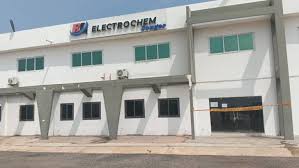

- GRA’s GH¢8.6m Electrochem Action Signals Tougher Era for Tax Defaulters
The Ghana Revenue Authority’s decision to seal the administration block of Electrochem Ghana Limited over an outstanding GH¢8.6 million tax liability is more than a routine enforcement exercise. It is a signal that the state is increasingly willing to move from negotiation to direct action in its search for revenue.
The Ada-based salt producer, a subsidiary of the McDan Group, has been given seven days to settle the outstanding debt, which the GRA says dates back to 2021. The Authority’s action followed what officials described as years of unsuccessful attempts to recover the amount through demand notices and engagements.
The enforcement team accepted an immediate payment of GH¢200,000 from the company during Wednesday’s exercise after officials were presented with a cheque. But the amount represents only 2.33% of the total outstanding obligation, leaving a balance of about GH¢8.4 million still unpaid.
For a government under pressure to raise more domestic revenue, reduce leakages and create fiscal space, such cases have become politically and economically important. Ghana’s post-debt restructuring environment has made tax compliance a central part of fiscal policy. Borrowing space is limited, expenditure pressures remain high, and the state is under pressure to fund public services, infrastructure, debt obligations and social interventions without returning to old patterns of excessive borrowing.
That makes enforcement not just a tax administration issue, but a test of fiscal credibility.
Electrochem’s case is particularly notable because the GRA did not completely shut down the company’s operations. Instead, it sealed the administration block while allowing mining activity to continue. This reflects a careful balancing act: the Authority wants to apply pressure, but it also wants the company to remain operational enough to generate the cash flow needed to meet its obligation.
That approach may be pragmatic. A total shutdown could weaken the company’s ability to pay. It could also affect workers, suppliers and the local economy around the Ada salt project. But allowing operations to continue also raises the question of whether enforcement pressure will be strong enough to compel full payment within the seven-day deadline.
Accra Area Enforcement Manager Joseph Annan warned that the Authority would escalate its action if the remaining balance is not paid within the period. That could include restricting access to the entire mining facility.
The warning matters because the GRA is trying to change the behaviour of taxpayers. If companies believe that tax arrears can remain unresolved for years, enforcement loses credibility. If, however, the Authority follows through on threats when deadlines are missed, businesses will begin to treat tax obligations with greater urgency.
The deeper issue is not only Electrochem. It is the culture of tax compliance in Ghana.
For years, the country has struggled with a narrow tax base, weak enforcement, under-declaration, arrears accumulation, informal sector leakages and uneven compliance across businesses. Governments often announce ambitious revenue targets, but collection depends heavily on whether the tax authority can enforce obligations fairly and consistently.
The GRA’s latest action suggests that prolonged negotiations may no longer be the default response to long-standing arrears.
For businesses, that is an important message. The enforcement environment is changing. Companies that delay tax payments, ignore demand notices or assume that engagements will continue indefinitely may increasingly face direct action, including sealing of premises, asset restrictions or operational disruption.
This shift will not be comfortable for the private sector. Many businesses continue to face high operating costs, expensive credit, energy challenges, exchange-rate pressures and a difficult consumer environment. Some may argue that aggressive tax enforcement can strain already fragile companies.
But the state will counter that tax arrears are not an optional liability. Businesses benefit from public infrastructure, legal protection, regulatory systems and market access. The fiscal system cannot work if large taxpayers are allowed to delay obligations for years while government searches for revenue elsewhere.
This is the central tension in the Electrochem case: how does the state enforce tax compliance without undermining productive businesses?
If enforcement is selective, it will be viewed as unfair. If it is unpredictable, it will create business uncertainty. If it is too soft, it will not change behaviour. If it is too aggressive, it may damage investment confidence.
The GRA must therefore show that its actions are rule-based, not arbitrary. It must apply the same standards to politically connected firms, large local companies, foreign-owned businesses and smaller taxpayers. That is the only way tax enforcement can build confidence rather than suspicion.
Electrochem’s prominence adds another layer to the story. The company is associated with one of Ghana’s most visible business groups and operates in a sector with significant economic potential. Ghana’s salt industry has often been described as underdeveloped relative to its natural advantage, with potential links to industrial chemicals, exports, regional trade and job creation.
The Ada salt project has therefore been seen not only as a private investment but as part of a broader industrial opportunity. That makes the tax enforcement action symbolically powerful. It suggests that even companies linked to major industrial ambitions will not be exempt from compliance obligations.
The GH¢200,000 payment made during the enforcement visit is small compared with the total debt. The real test will come after the seven-day deadline. If the company pays, the GRA will claim a quick enforcement victory. If it does not, the Authority will have to decide whether to escalate as warned.
A failure to follow through could weaken the message. A heavy-handed escalation, however, could raise concerns about business continuity and jobs. The next step must therefore be handled carefully.
For Ghana’s fiscal managers, the case fits into a wider revenue mobilisation agenda. The government needs stronger domestic revenue to reduce dependence on borrowing and support macroeconomic stability. Tax enforcement is one route, but it cannot be the only one.
The country also needs a simpler tax system, better taxpayer education, fewer loopholes, stronger digital tracking, improved dispute resolution and a wider tax net. Enforcement can recover arrears, but sustainable revenue growth depends on making compliance easier, fairer and more predictable.
There is also a reputational issue for businesses. In a more transparent fiscal environment, tax compliance is becoming part of corporate governance. Companies that seek public support, community goodwill, licences, concessions and policy cooperation must also demonstrate that they meet their obligations to the state.
For Electrochem, the immediate issue is settlement of the GH¢8.6 million liability. But the broader issue is corporate credibility. How the company responds in the coming days will determine whether this becomes a brief enforcement episode or a deeper reputational challenge.
For the GRA, the case is equally important. It provides an opportunity to show that tax enforcement is no longer limited to letters, reminders and closed-door engagements. But it also places responsibility on the Authority to act fairly, communicate clearly and enforce consistently.
The Ghanaian taxpayer will be watching.

