


- Damang Gold Mine Rejects Stockpile Claims, Says Active Mining Is Underway
Damang Gold Mine’s insistence that it is extracting fresh ore, rather than merely processing stockpiles, addresses a persistent question surrounding Ghana’s transfer of the asset to Engineers and Planners: whether the new operator inherited a functioning mine or a finite pile of previously mined material.
Frank Dankyi Agyei, the company’s manager responsible for mining, said operations were underway at the Amoanda and Juno pits, with plans to extend activity to the Rex pits. He rejected claims that production depended exclusively on stockpiles as “absolutely false”.
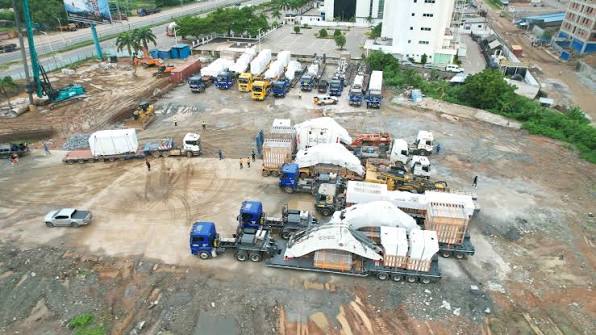
“We are actively mining here, as you can see,” Mr Agyei told Asempa FM’s Ekosiisen. His argument rests partly on the machinery deployed across the concession and partly on the physical restructuring of the pits.
At Amoanda, the company is undertaking a major cutback intended to combine the former Tometo East Pit, Amoanda Pit 4 and Amoanda Pits 2 and 3 into a larger operation. The expanded pit is expected to have a strike length of approximately 1.8 kilometres.
Mr Agyei said two Liebherr 9400 excavators were working at Amoanda alongside a Hitachi EX2000 and another excavator. At least four excavators were operating there, while five had been assigned to the Juno pits. Damang also has approximately 50 haul trucks, according to the manager.
The equipment provides visible evidence of activity, but the important question is what it produces. Excavators and trucks can demonstrate capital commitment; they do not establish ore grades, recoverable reserves, stripping ratios or sustainable production costs.
That distinction matters because the controversy has never been purely about whether machines are moving earth. It concerns whether fresh ore is being extracted at a scale and quality capable of extending Damang’s productive life, sustaining employment and generating royalties, taxes and foreign-exchange value for Ghana.
The dispute has roots in the mine’s history. Gold Fields planned to complete mining at certain pits and rely on stockpiles as Damang approached the end of its projected life. During the transition, officials accused the former operator of concentrating on stockpile treatment rather than reinvesting in mining.
A later transitional agreement allowed Gold Fields to restart open-pit operations while continuing to process stockpiles and completing a feasibility study. Gold Fields said mining resumed in May 2025 and that the study delivered to government in December positioned the asset for an extended mine life.
Engineers and Planners formally assumed control in April 2026 after emerging as the successful bidder in a competitive process supervised by the Minerals Commission following the expiry of Gold Fields’ lease. The transfer was presented as an important test of Ghanaian participation in large-scale mining.
The new operator therefore carries an unusually heavy burden of proof. Damang must be commercially successful, but it is also being watched as evidence for or against the argument that Ghanaian-owned companies can mobilise capital, technical competence and management systems to control major mineral assets.
Mr Agyei placed considerable emphasis on machinery costs. He said a Liebherr 9400 excavator could cost about €9 million, while each haul truck could cost approximately €4.5 million. Such figures illustrate the capital intensity of large-scale mining and challenge any assumption that local ownership means inexpensive operations.
Yet headline equipment values should be treated cautiously. The relevant measure is not simply the catalogue value of machinery on site, but how the assets were financed, whether they are owned or leased, their remaining useful lives and the productivity they deliver. Mining economics depend on tonnes moved, ore recovered, processing efficiency and the cost per ounce not the visual scale of a fleet.
For this reason, Damang’s rebuttal would be strengthened by disclosure of measurable operating data. Production reports should distinguish ore mined from stockpiles processed, state grades and recovery rates, identify waste stripping, and show output against the approved mine plan. Independently verifiable figures would resolve the argument more decisively than competing assertions.
Transparency is particularly important because questions about stockpiles have become entangled with scrutiny of the concession award. A parliamentary request under Ghana’s Right to Information law previously sought production returns separating active mining from stockpile processing, as well as details of stockpile quantities, values and ownership during the transition.
Publishing these figures would protect the operator as much as the public. If fresh mining is occurring at the scale described, production data would counter suggestions that output is being sustained mainly by inherited material. It would also establish a baseline against which communities, regulators and investors could judge future performance.
The distinction between stockpile treatment and active mining is not merely semantic. Processing stockpiles can produce gold and preserve plant utilisation, but the resource is finite. Continued extraction from pits requires drilling, blasting, waste removal, mine planning, safety systems and sustained capital. It therefore provides a stronger indication that the asset may support employment and economic activity over a longer horizon.
For workers and host communities, the outcome will determine whether the transition provides lasting continuity or only postpones contraction. A mine supported by viable reserves can maintain contractor activity, local procurement and community investment. An operation dependent mainly on shrinking stockpiles faces a shorter runway, regardless of ownership.
Government also has responsibilities. Regulators must verify compliance with the mine plan, environmental permits and safety requirements while disclosing enough information to protect confidence in the transition. Local ownership should not mean lighter scrutiny; if anything, Damang’s symbolic importance demands higher standards of accountability.
Mr Agyei’s statement is consequential, but it should begin rather than end discussion. The machinery at Amoanda and Juno supports the company’s claim that physical mining is taking place. The decisive evidence will be the volume and quality of fresh ore extracted, the economics of processing it and the reserves capable of supporting future production.
Damang can become a persuasive case for Ghanaian ownership only if national control is matched by operational performance and transparent reporting. Moving earth is visible. Creating durable mineral value is harder. Ghana’s interest lies not merely in who operates the excavators, but whether the mine remains productive, accountable and commercially sustainable long after the handover ceremony.

