


- Dr Jinapor Puts Efficiency and Accountability at Centre of Ghana’s 2027 Energy Agenda
Ghana will place reliable and affordable energy at the centre of its 2027 policy agenda, setting up a demanding test of whether the country can improve electricity supply without transferring the full cost of the sector’s financial and operational weaknesses to consumers.
Energy and Green Transition Minister John Abdulai Jinapor said the government’s priorities would focus on building a “reliable, affordable, sustainable and resilient” energy sector capable of supporting economic growth and improving living standards.
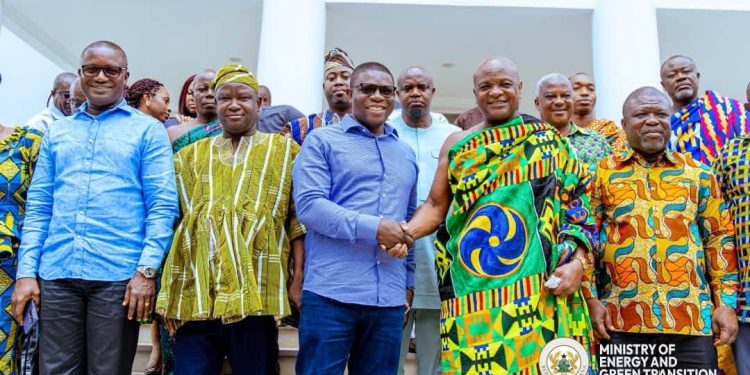
The agenda was outlined during an engagement with the leadership of agencies and institutions under the ministry to assess their performance in 2026 and establish targets for the coming year.
The meeting reviewed progress in electricity generation, plans to install 3,000 transformers, the expansion of national electricity access to 89.13 per cent and efforts to revive domestic petroleum refining.
The proposed interventions reflect the broad nature of Ghana’s energy challenge. The country must secure enough generation to meet demand, expand and maintain its distribution network, ensure adequate fuel supply and keep tariffs within the reach of households and businesses.
These objectives are connected, but they do not always move in the same direction.
Improving reliability requires investment in generation, transmission, distribution equipment and maintenance. Unless operational inefficiencies and commercial losses are reduced, those investments eventually place pressure on tariffs, public finances or both.
The government’s 2027 programme will therefore be judged not only by the amount of infrastructure installed, but by whether the investments reduce outages, technical losses and the cost of delivering each unit of electricity.
The plan to install 3,000 transformers indicates that the government is paying greater attention to the distribution end of the electricity value chain.
Ghana may have sufficient installed generation capacity at particular times, but that electricity cannot reach consumers reliably when substations, transformers and distribution lines are overloaded or poorly maintained.
New transformers could relieve pressure in rapidly expanding residential and industrial areas, reduce localised outages and improve voltage stability. They may also support the connection of new communities and businesses.
However, the number installed will offer only a partial measure of success.
A more meaningful assessment would examine where the transformers are deployed, whether they reduce interruptions, how quickly damaged units are replaced and whether the distribution companies have the technical and financial capacity to maintain them.
Without these performance indicators, infrastructure targets risk becoming procurement statistics rather than evidence of better service.
Dr Jinapor’s emphasis on affordability comes at a time when households and businesses are particularly sensitive to electricity and fuel costs.
Power prices affect almost every part of the economy. Higher tariffs raise production, refrigeration, transportation and service-delivery costs, eventually feeding into consumer prices.
Businesses also require predictability. An enterprise may be able to plan around a known electricity tariff, but repeated interruptions force it to purchase fuel, generators, batteries or alternative power systems. The effective cost of unreliable electricity can therefore exceed the official tariff.
Affordability cannot be delivered sustainably by keeping tariffs artificially low while payment arrears and sector liabilities accumulate. Nor can financial stability be achieved solely through repeated tariff increases if inefficiencies remain unresolved.
The durable route lies in reducing technical and commercial losses, improving revenue collection, enforcing payment discipline and ensuring that power is purchased from generators under commercially defensible arrangements.
The minister’s insistence on operational efficiency and value for money is therefore central to the affordability pledge.
Every cedi lost through defective metering, electricity theft, weak procurement, delayed projects or poor collection ultimately increases pressure on paying customers or the public budget.
The government’s renewed effort to revive domestic oil refining introduces another important dimension to the 2027 energy strategy.
A functioning refinery could strengthen fuel security, reduce dependence on imported finished petroleum products and support local value addition. It could also create a domestic market for Ghanaian crude, following the commencement of sales of Jubilee and TEN oil to local refiners.
But domestic refining does not automatically guarantee cheaper fuel.
The final cost will depend on the price of crude, refinery efficiency, financing costs, utilisation levels, taxes, levies and distribution margins. An inefficient refinery can produce fuel at a higher cost than imported products and create additional public liabilities if government repeatedly absorbs its losses.
Any refining strategy must therefore be commercially credible and supported by transparent crude-supply, financing and product-offtake arrangements.
The relevant policy question is not simply whether Ghana can refine crude locally, but whether it can do so competitively and consistently.
Ghana’s electricity access rate has risen to 89.13 per cent, placing the country among the more extensively connected electricity markets in sub-Saharan Africa.
The remaining access gap, however, may be more expensive to close.
Many unconnected communities are likely to be remote, sparsely populated or located far from existing grid infrastructure. Extending conventional transmission and distribution networks to such areas can produce high connection costs relative to immediate electricity demand.
The government may therefore need a combination of grid extension, mini-grids and stand-alone renewable systems to achieve broader access without imposing excessive costs on the national network.
Access must also mean more than the presence of a power line. A household is not meaningfully served if supply is unreliable or the tariff is unaffordable.
The quality, duration and affordability of electricity use will consequently be as important as the headline connection rate.
Dr Jinapor warned agencies that unnecessary delays and persistent underperformance would not be tolerated, calling for accountability, transparency and measurable improvements in service delivery.
That position recognises a recurring weakness in Ghana’s energy sector: ambitious policies frequently underperform because responsibilities are fragmented across several institutions.
Generation companies, fuel suppliers, transmission operators, distribution utilities and regulators depend on one another. Failure in one part of the chain can create financial and operational problems throughout the system.
Stronger coordination will be essential if the government is to connect transformer installations, generation planning, fuel procurement, domestic refining and tariff policy into a coherent programme.
The ministry will also need measurable indicators against which its agencies can be assessed. These should include outage frequency, distribution losses, collection rates, project completion times, customer complaints, fuel availability and the financial performance of state-owned energy institutions.
The government’s 2027 ambition is therefore broader than keeping the lights on.
Its real challenge is to create an energy system in which reliable supply does not require recurring emergency expenditure, affordability does not depend on hidden subsidies and expansion does not deepen financial losses.
If the ministry can translate its infrastructure plans into lower losses, improved collections and more consistent service, reliability and affordability could reinforce each other.
If underlying inefficiencies remain, however, the cost of the promised reliability will eventually return through higher tariffs, public debt or renewed pressure on the national budget.

