- Dreams FC Emerge Ghana’s Highest-Ranked Club in CAF Rankings as Hearts, Kotoko Miss Out
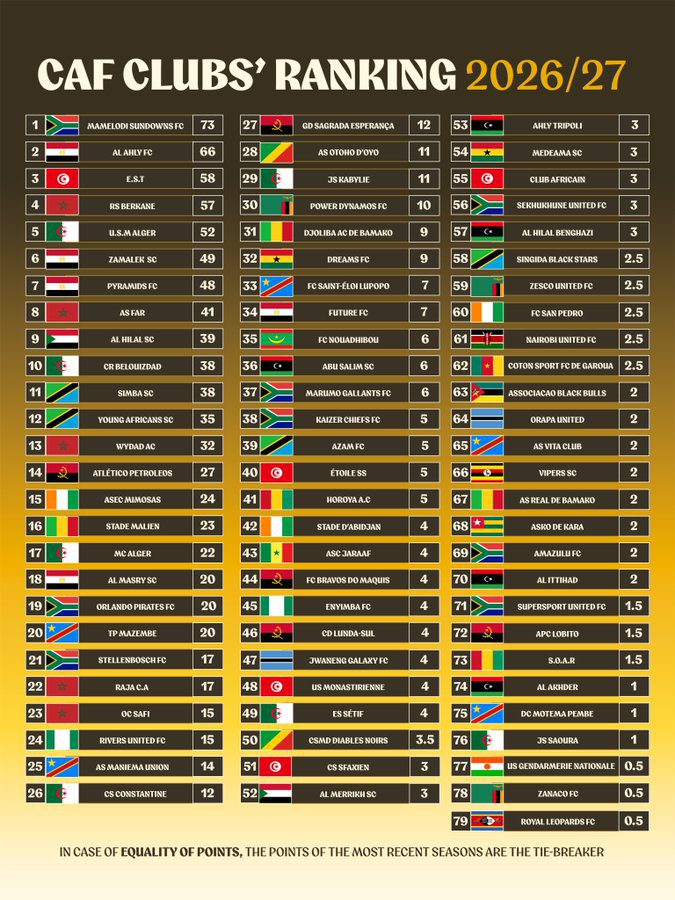
Dreams FC have emerged as Ghana’s highest-ranked club in the latest Confederation of African Football club rankings ahead of the 2026/27 season, underlining a significant shift in the country’s continental football hierarchy as traditional giants Hearts of Oak and Asante Kotoko failed to make the list.
The Still Believe side occupy 32nd position in the latest rankings, reflecting the points accumulated from their recent participation in CAF inter-club competitions and, most notably, their historic run in the CAF Confederation Cup.
For Dreams FC, the ranking represents one of the clearest indications yet of how rapidly the club has developed from a relatively young domestic side into one of Ghana’s most visible representatives on the African stage.
Their memorable Confederation Cup campaign placed them against some of the continent’s established teams and provided the club with valuable ranking points, international exposure and experience that has now translated into their position as Ghana’s highest-ranked club.
The development is particularly significant because Dreams FC now sit above Ghana’s two most decorated football brands Hearts of Oak and Asante Kotoko neither of which appears in the latest CAF ranking.
The absence of the two traditional giants provides a sharp contrast between historical reputation and recent continental performance.
Asante Kotoko remain Ghana’s most successful club historically in African competition, having won the continent’s premier club title twice, while Hearts of Oak famously lifted the CAF Champions League trophy in 2000.
But recent seasons have produced limited success for both clubs in African inter-club competitions, weakening their current standing under a ranking system shaped heavily by recent performance and sustained participation.
Dreams FC’s emergence illustrates how continental relevance is increasingly being determined by current results rather than historical pedigree.
In that respect, their rise is also a reflection of a changing competitive structure within Ghanaian football.
Clubs outside the traditional Hearts-Kotoko rivalry are increasingly becoming important representatives of Ghana internationally, with continental exposure creating new opportunities for player development, commercial visibility and institutional growth.
Medeama SC are the only other Ghanaian club to feature in the latest rankings, occupying 54th position.
The Tarkwa-based side have built their own continental profile through participation in CAF competitions and remain one of the country’s most consistent representatives in recent years.
With Medeama set for another continental campaign, their position could strengthen further depending on their performance during the 2026/27 season.
The latest ranking therefore leaves Ghana with just Dreams FC and Medeama SC among the clubs recognised on the continental table.
That reality raises broader questions about the competitiveness of Ghanaian clubs in African football.
For a country with a significant football tradition, Ghanaian clubs have struggled in recent years to establish sustained runs in CAF competitions.
Financial limitations, squad turnover, player departures, infrastructure constraints and difficulties maintaining competitive teams across domestic and continental competitions have all complicated efforts to challenge Africa’s best-resourced clubs.
By contrast, sustained participation is increasingly becoming important to building a strong CAF ranking.
Clubs that consistently qualify, progress beyond preliminary rounds and compete in group-stage football accumulate the experience and ranking points needed to establish themselves among Africa’s leading sides.
Their Confederation Cup campaign did more than produce memorable results. It strengthened their standing within the continental system and positioned the club ahead of domestic rivals with far greater historical reputations.
The rankings also reflect broader changes at the top of African club football. South Africa’s Mamelodi Sundowns have moved into first position with 73 points, replacing Egyptian giants Al Ahly, who sit second with 66 points.
Tunisia’s Espérance Sportive de Tunis, Morocco’s RS Berkane and Algeria’s USM Alger complete the top five.
The composition of the leading positions highlights the growing financial and competitive strength of clubs from South Africa, North Africa and parts of West Africa.
For Ghana, bridging that gap will require more than isolated strong campaigns. Domestic clubs will need sustained investment in playing squads, technical development, sports science, infrastructure and administration if they are to qualify consistently and progress deep into African competition.
Continental football imposes substantial costs through travel, accommodation, player bonuses and squad depth requirements, often placing pressure on clubs whose domestic revenues remain comparatively limited.
That means maintaining competitiveness across both the Ghana Premier League and CAF competitions can become difficult without strong commercial and institutional structures.
Dreams FC’s rise nevertheless offers evidence that Ghanaian clubs can still compete effectively when preparation, squad quality and continental strategy align.
Their achievement may also provide motivation for other clubs seeking to establish themselves beyond domestic football.
For Hearts and Kotoko, however, the latest rankings provide another reminder that continental history alone no longer guarantees relevance.
Both clubs retain enormous supporter bases and powerful football identities, but returning to prominence in Africa will require sustained qualification and strong performances rather than reliance on past achievements.
That creates a particularly interesting dynamic heading into future seasons. The clubs traditionally regarded as Ghana’s biggest remain outside the ranking, while Dreams FC and Medeama, institutions with far shorter continental histories, currently carry the country’s presence.
For Dreams FC, 32nd place is therefore more than a statistical milestone. It is evidence of how quickly the competitive order can change when clubs translate domestic qualification into meaningful continental results.
And for Ghanaian football more broadly, it reinforces a simple reality: reputation may open doors, but in modern African club football, rankings increasingly belong to those who consistently perform when they get onto the continental stage.