

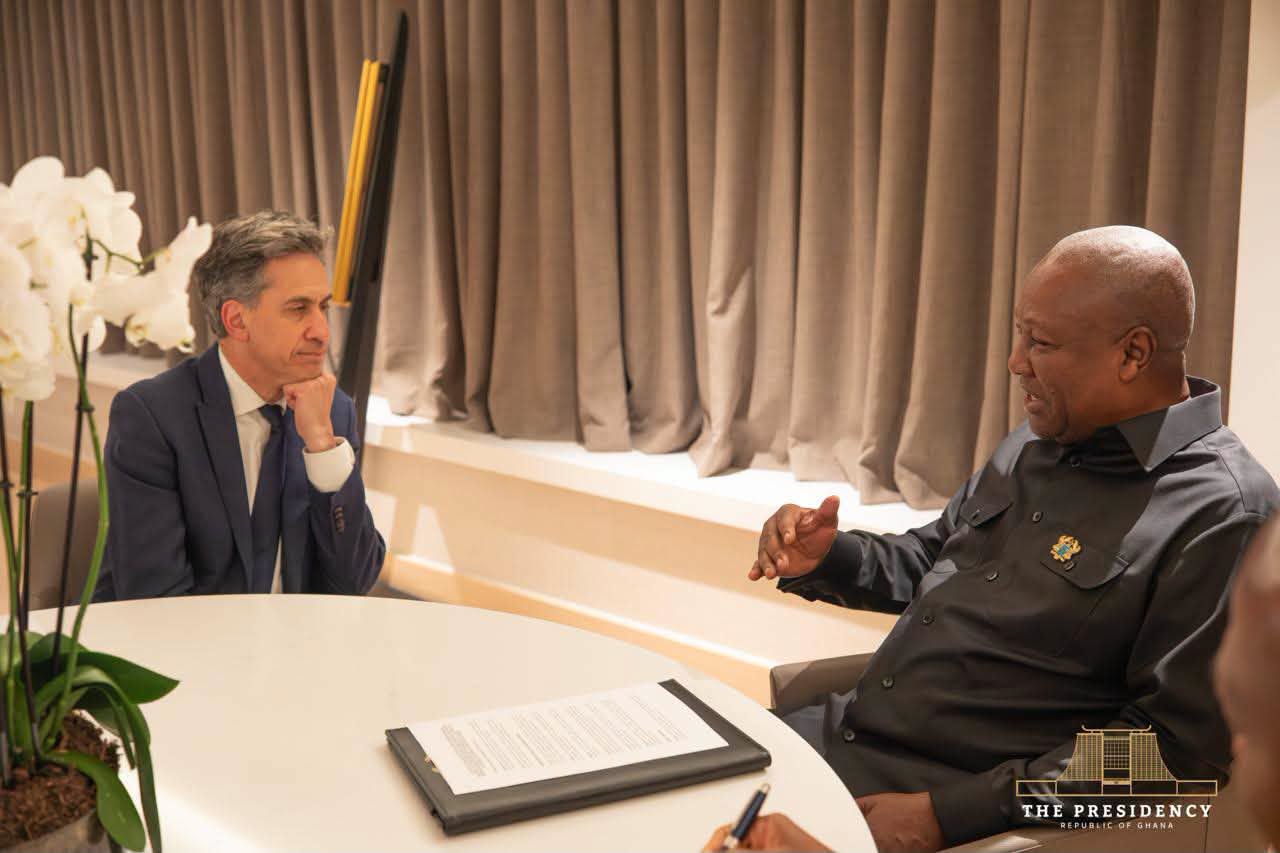

- Mahama and UK Foreign Secretary Talks Seek to Turn Historic Ties into Economic Value
President John Dramani Mahama’s latest talks with Britain’s Foreign Secretary, Ed Miliband, have placed trade and investment at the centre of Ghana–United Kingdom relations, but the commercial value of the engagement will depend on whether existing commitments move from diplomatic language into operating businesses, infrastructure and jobs.
The London meeting focused on expanding bilateral trade and investment, promoting sustainable economic growth and deepening cooperation on shared priorities. President Mahama reaffirmed Ghana’s commitment to strategic international partnerships capable of advancing national development and delivering shared prosperity.
The discussions build on the UK–Ghana Growth Partnership covering 2026 to 2028, which seeks to attract private finance, make cross-border trade easier, support infrastructure and industrial development, and expand education and skills cooperation.
The framework gives the latest meeting greater significance than a routine diplomatic encounter. Both governments have already identified the areas in which they intend to cooperate. The challenge is now execution: converting policy alignment into financed projects, increased exports, technology transfer and employment.
The partnership was announced following the Ghana–UK Investment Summit in London and is intended to build on deals worth up to £215 million. Those commitments provide an initial pipeline, but headline values should not be confused with completed investment.
Deals move through several stages, from expressions of interest and memoranda of understanding to financing, regulatory approval, construction and commercial operation. Ghana’s success should ultimately be measured by the capital deployed, businesses established, jobs created and domestic suppliers integrated into resulting value chains.
President Mahama has consistently presented Ghana as a stable gateway to African markets and an emerging production base under the African Continental Free Trade Area. Bilateral trade with Britain already exceeds £1.5 billion annually, according to figures he cited at the June investment summit.
The figure demonstrates an established economic relationship, but it also raises questions about composition. An expansion in trade will generate greater development value for Ghana if it involves more processed agricultural goods, manufactured products, professional services and technology-enabled exports rather than primarily raw commodities.
That is where Britain could become particularly important. The UK offers deep pools of institutional capital, established financial and professional-services industries, research capacity and firms with expertise in infrastructure, renewable energy, pharmaceuticals, technology, education and advanced manufacturing.
Ghana, in turn, offers political stability, natural resources, a young workforce, regional market access and opportunities across agribusiness, mining-related value addition, financial services, logistics, digital infrastructure and clean energy.
These complementary strengths do not automatically produce investment. International capital compares Ghana with competing destinations on tax predictability, currency risk, energy reliability, regulatory efficiency, access to land, contract enforcement and the availability of skilled labour.
President Mahama’s diplomatic engagement must therefore be supported by domestic reforms that reduce the time and uncertainty involved in establishing and operating businesses. Investors may be attracted by high-level assurances, but their final decisions are shaped by everyday encounters with tax, customs, licensing, utility and local-government institutions.
The Growth Partnership recognises this by combining investment attraction with trade facilitation, infrastructure and skills. Treating these priorities as interconnected is essential. A factory cannot compete without reliable electricity and transport; improved infrastructure delivers limited export value if customs procedures remain slow; and technology investment cannot scale without adequately trained workers.
The most effective UK support would consequently blend capital with technical expertise, market access and institutional development. Financing should help Ghana expand productive capacity while partnerships with British companies and universities strengthen local management, engineering, research and vocational skills.
The stronger proposition is a predictable environment in which all credible investors can plan over the long term. Regulatory stability, transparent procurement and effective dispute resolution may be more valuable than generous incentives that can later become politically or fiscally unsustainable.
The talks also come at a time when traditional development assistance is under pressure and governments increasingly emphasise private-sector-led growth. This shift makes investment mobilisation more important, but it does not eliminate the state’s responsibility to shape projects around national priorities.
Foreign capital should complement Ghana’s development strategy rather than determine it. Projects must be assessed for employment, technology transfer, local procurement, export potential, environmental sustainability and their contribution to Ghanaian productive capacity.
The government should consequently publish measurable targets for the Growth Partnership. These could include the number of projects reaching financial close, capital actually deployed, jobs created, Ghanaian firms entering UK supply chains and workers completing recognised skills programmes.
Regular public reporting would distinguish the partnership from diplomatic initiatives that attract attention at launch but become difficult to evaluate. It would also allow businesses to identify opportunities and hold implementing institutions accountable for delays.
For Britain, deeper cooperation with Ghana offers commercial access to one of West Africa’s politically stable markets and a platform for engagement with the broader AfCFTA area. For Ghana, the relationship offers investment, export opportunities and expertise that could accelerate industrialisation.
But the partnership must remain balanced. Ghana should seek capital that expands domestic production rather than merely financing imports or extracting resources with limited processing. British investors should see local supplier development and workforce training as commercial necessities, not charitable additions.
The latest Mahama–Miliband engagement also reflects Ghana’s broader foreign-policy approach of maintaining constructive relations with multiple global partners. In an increasingly competitive geopolitical environment, Ghana can use that openness to attract capital from different sources while avoiding excessive dependence on any single country.
Such strategic flexibility will be valuable only when Ghana negotiates from a clear understanding of its priorities. Investment diplomacy should begin with bankable projects, credible feasibility studies and defined local benefits, allowing the country to engage partners around specific opportunities rather than general appeals.
The meeting in London has reaffirmed political support for stronger Ghana–UK economic relations. The next phase belongs to finance ministries, investment agencies, regulators, companies and project developers responsible for turning that support into transactions.
Diplomacy can open doors, but it cannot substitute for implementation. The true measure of the Mahama–Miliband talks will ultimately be visible in factories financed, exports expanded, infrastructure delivered and Ghanaian workers employed—not in the number of meetings held or statements issued.

