


- From Hamilton’s Missed Pit Call to Mclaren’s Collision: The Decisions That Reshaped Singapore
Max Verstappen’s commanding Singapore Grand Prix weekend confirmed that Red Bull has recovered the competitiveness it lacked earlier in the season, while strategic and driving errors by Lewis Hamilton and McLaren exposed how quickly points, podiums and championship positions can disappear in modern Formula One.
Verstappen claimed pole position and victory in both the sprint and the main race, completing a clean sweep at Marina Bay and securing his third successive win after his triumph in Malaysia.
The Dutch driver controlled Sunday’s race from the front, overcoming intense heat, a malfunctioning radio and early pressure from Ferrari’s Charles Leclerc to take his first victory at the Singapore circuit on his 250th Formula One start.
Yet the result was about more than another Verstappen victory. It offered an early indication that Red Bull may have solved enough of its car’s weaknesses to return as a serious championship force in 2027.
It also exposed contrasting decision-making across the leading teams. While Verstappen and championship leader Kimi Antonelli maximised their opportunities, Hamilton, Lando Norris and Oscar Piastri surrendered positions through strategic misjudgements or unnecessary aggression.
Sky Sports analyst Martin Brundle described the weekend as belonging firmly to Verstappen and Red Bull, noting that the driver had “all bases covered” once he established control at the front.
Verstappen’s success was his first at Marina Bay and arguably Red Bull’s clearest demonstration that its recent improvement is not limited to one circuit configuration.
Singapore demands strong mechanical grip, predictable braking and confidence over kerbs. These were areas in which Red Bull had previously struggled, particularly on slow street circuits. Securing both pole positions and both victories therefore suggests the team’s upgrades have produced a broader improvement.
Leclerc came close to challenging Verstappen at the beginning of Sunday’s race, but the Red Bull driver used his fresh soft tyres to retain the lead into the opening corner.
Once clear, Verstappen managed his tyres and gradually extended his advantage. The growing gap allowed Red Bull to respond to potential safety-car interventions or strategic moves without being forced into a defensive decision.
He finished 7.335 seconds ahead of Leclerc, with Antonelli more than 34 seconds behind in third. The margin reinforced the impression that Verstappen was operating in a separate competitive category.
Brundle argued that Verstappen’s championship deficit remains too large for a realistic comeback. He trails Antonelli by 119 points, with only 150 potentially available and uncertainty surrounding whether every remaining race will proceed because of continuing global conflicts.
The more important prize may therefore be 2027. Red Bull has now demonstrated that its development programme can transform the car during a difficult season. Data gathered from Singapore and Malaysia should feed into next year’s model, potentially allowing Verstappen to begin the campaign as a title contender rather than spend another year attempting to recover lost ground.
Red Bull is also closing rapidly on McLaren in the constructors’ championship. The Singapore result left it only seven points behind the British team in the contest for third place. That position carries significant prize money, commercial prestige, sponsor value and operational consequences, including pitlane allocation for the following season.
Ferrari appeared capable of securing a double podium before Hamilton rejected an opportunity to pit under a Virtual Safety Car.
The seven-time world champion started third on medium tyres but stopped as early as lap 18 for softs. That decision strongly indicated a two-stop strategy because the softer compound was unlikely to remain competitive for the rest of the race.
When Lance Stroll’s stranded Aston Martin triggered a Virtual Safety Car, Ferrari prepared to stop Hamilton again. The reduced time loss would have allowed him to fit fresher tyres while preserving his challenge for the podium.
Hamilton continued past the pit entrance.
The decision left him attempting to complete 44 laps on the same set of soft tyres. His pace collapsed in the closing stages, allowing Antonelli, Norris and Piastri to pass him. He eventually fell from a likely third position to sixth.
Hamilton accepted responsibility after the race, apologising to Ferrari and describing the outcome as a painful lesson. Team principal Fred Vasseur subsequently confirmed that the team had expected its driver to enter the pits and that the instruction had been communicated.
Brundle regarded the episode as telling, arguing that it was effectively impossible for a driver to operate a modern Formula One car while simultaneously managing the broader strategic picture from the cockpit.
Drivers possess valuable information about tyre grip, balance and track conditions. They do not, however, have the same access to rival lap times, tyre projections, pit-window calculations and race simulations available to the strategy team.
Hamilton may have believed track position was worth protecting on a circuit where overtaking is difficult. But Ferrari’s strategists could see the rate at which his tyres would deteriorate and the advantage available under the Virtual Safety Car.
The incident will intensify scrutiny of communication and trust within Ferrari. Successful strategy requires the driver and pit wall to challenge each other, but a final instruction must be clear enough to prevent hesitation.
Hamilton’s decision was particularly expensive because Ferrari had shown the second-strongest pace across the weekend. Leclerc’s second place demonstrated what was achievable, while Hamilton’s fall cost the team a significant points haul against Mercedes.
Hamilton’s declining pace created a late opportunity for Norris, but the McLaren driver again chose the wrong moment to attack.
Norris attempted to pass the Ferrari into Turn One. Both cars ran wide, contaminating their tyres as they returned to the racing line. Antonelli read the situation perfectly and swept past both drivers to secure third.
Norris later admitted the move was unnecessary because Hamilton’s tyre condition made an eventual overtake almost inevitable.
“I should have done a better job battling Lewis,” Norris said. “It was inevitable that I was going to pass him at some point. I just shouldn’t have tried to overtake him when I did.”
The error followed an even more damaging incident during Saturday’s sprint.
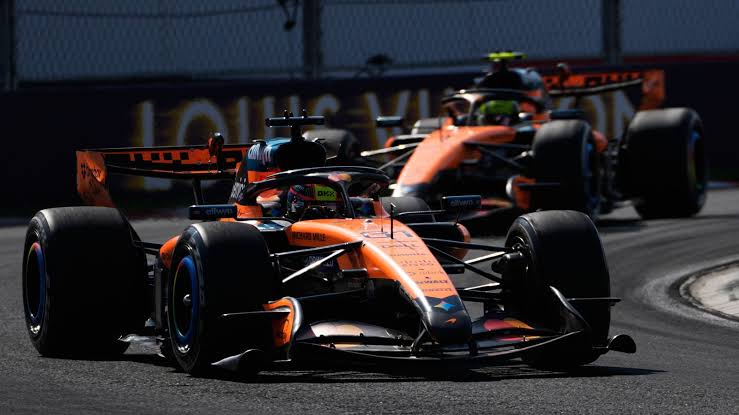
Norris attempted an aggressive move on teammate Piastri at Turn Five on the final lap. The McLarens made contact, sending both cars into spins and Piastri into the wall. Norris recovered to finish eighth and score one point, but McLaren lost what should have been secure fourth and fifth places.
Brundle described the move as “a lunge too far”, particularly because the damp circuit and slippery kerbs made the risk disproportionate to the limited sprint points available. McLaren’s management was reportedly extremely unhappy with the collision.
Drivers are employed to race, but teammates must also understand the competitive context. McLaren is no longer chasing Ferrari for second in the constructors’ standings; it is attempting to hold off a resurgent Red Bull.
The sprint collision therefore represented more than an internal dispute. It damaged one car, surrendered points and increased pressure on a team that currently lacks the development momentum of its rivals.
Norris offered a blunt assessment, describing McLaren as the slowest of Formula One’s leading four teams and conceding that the team would struggle to resist Red Bull without upgrades.
McLaren team principal Andrea Stella characterised the competitive cycle as “ping pong”, with teams moving forward when new parts arrive. For McLaren, however, the problem is that Red Bull’s latest step has arrived precisely when its own development appears to have slowed.
Antonelli’s third place demonstrated why he is on the verge of becoming Formula One’s youngest world champion.
Mercedes no longer appears to possess the fastest car, yet the 20-year-old continues to accumulate points. Starting fourth, he remained patient as Ferrari and McLaren fought around him and then exploited the late confrontation between Hamilton and Norris.
The result extended his championship lead over teammate George Russell to 102 points. Antonelli could secure the title at the next round in Austin if he wins, Russell finishes ninth or lower and Hamilton finishes fifth or lower.
His approach contrasted sharply with the decisions made by more experienced rivals. Hamilton attempted to control strategy from the car. Norris forced moves when waiting would have produced a better result. Piastri became the victim of his teammate’s aggression. Antonelli remained within range and allowed the race to come to him.
That patience has become one of the defining features of his campaign. Championship success is not built exclusively on spectacular victories. It also requires recognising when rivals are likely to create an opportunity without being forced.
Singapore may ultimately be remembered as a race that clarified Formula One’s changing hierarchy.
Verstappen and Red Bull have rediscovered winning form too late to claim the 2026 drivers’ championship but early enough to alter expectations for 2027. Ferrari has the pace to challenge at the front but continues to lose points through strategy and communication. McLaren is being pulled backwards by slower development and costly driver errors.
Mercedes, meanwhile, is approaching the drivers’ championship without consistently possessing the fastest car because Antonelli has made fewer damaging mistakes than his rivals.
The race itself may not have been a classic, but the decisions surrounding it carried consequences far beyond one weekend.
Verstappen demonstrated what happens when elite driving is supported by a competitive and strategically flexible car. Antonelli showed the value of discipline. Hamilton and Norris provided the opposite lesson: in a field separated by fine margins, attempting to control too much or forcing an opportunity too early can turn a podium into an apology.

