

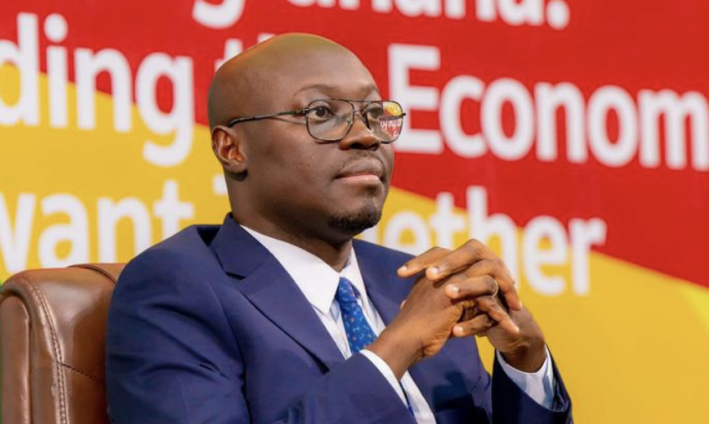

- Public Money Belongs to Ghanaians, Not Officials — Ato Forson
Finance Minister Dr Cassiel Ato Forson has called for a fundamental change in Ghana’s approach to public financial accountability, warning that state resources belong to citizens and must never be treated as the property of political officeholders or public administrators.
Speaking during an engagement on the Auditor-General’s Report, attended by regional ministers and metropolitan, municipal and district chief executives, Dr Forson demanded accountability for every cedi entrusted to public officials.
His message was direct: officials exercise temporary authority over public resources, but ownership remains with the Ghanaian people.
“Public money does not belong to government officials, we are only the custodians of those resources,” the Finance Minister said.
“Those resources belong to the people of Ghana: our constituents, our citizens.”
The statement strikes at one of the most persistent weaknesses in Ghana’s public financial management system: the gap between rules formally governing expenditure and the practical consequences facing officials when those rules are breached.
Successive Auditor-General reports have identified irregularities across ministries, departments, agencies and local government institutions. These commonly relate to procurement, contracts, payroll administration, unsupported expenditure, uncollected revenue, cash management and failures to follow established financial procedures.
Dr Forson’s intervention suggests that government wants audit findings to move beyond documentation and become triggers for recovery, correction and institutional reform.
“So let us recover every cedi that is recoverable. Let us account for every cedi that is entrusted to us as public officials,” he stated.
Recovering lost or improperly applied funds is important, particularly where public resources can be traced to specific transactions or responsible officers.
But the Finance Minister acknowledged that recovery alone is an inadequate measure of accountability. A system that repeatedly loses money and celebrates recovering part of it remains structurally weak.
“But above all, let us build systems where recovery becomes the exception, not an annual ritual,” he said.
That distinction is central to the credibility of Ghana’s public financial reforms. Recovery happens after a failure has occurred. Prevention reduces the probability that the loss will occur in the first place.
For citizens, this matters because an audit irregularity is not merely an accounting entry. It may represent medicines that were not purchased, classrooms that were not completed, roads that deteriorated prematurely or public services that became more expensive because procurement rules were ignored.
The annual repetition of similar audit findings can also weaken confidence in institutions. When the same weaknesses appear across reporting periods, citizens may reasonably question whether audit recommendations are being implemented and whether public officers face meaningful consequences.
Dr Forson’s call therefore places responsibility on the officials who attended the engagement. Regional ministers and MMDCEs sit close to the point where central government policy becomes local expenditure. Their decisions shape procurement, project implementation, revenue collection and service delivery within communities.
Decentralised expenditure can improve responsiveness because local authorities understand community needs better than distant institutions. However, decentralisation without strong controls can also multiply opportunities for waste, weak contracting and fragmented oversight.
Preventing losses requires internal controls that operate before payments are made. Procurement plans must match approved budgets, contracts must pass proper review, suppliers must be verified and payment documentation must establish that goods or services were delivered.
Internal audit units must also be independent enough to challenge questionable transactions. Their role cannot be reduced to reviewing documents after management has already committed public funds. Effective internal auditing should identify risks early and compel corrective action before money leaves government accounts.
Technology can strengthen this process, but digital systems are not substitutes for accountability. Electronic procurement, integrated financial management platforms and digital payroll controls can create records, reduce manual interference and flag unusual transactions.
Yet these tools will deliver limited results if officials can override controls without explanation or if irregularities detected by the systems do not lead to investigation and sanctions.
The real test of Dr Forson’s position will consequently be enforcement. Public officers must know that disregarding procurement requirements, authorising unsupported payments or failing to collect public revenue carries personal and institutional consequences.
Audit recommendations need named officers, implementation deadlines and transparent follow-up. Where funds are recoverable, the responsible institutions should publish how much has been retrieved, from whom and within what period. Where recovery is impossible, authorities should explain the reason and identify the reforms introduced to prevent recurrence.
The engagement also carries implications for Ghana’s fiscal consolidation programme. Government is asking taxpayers to comply with their obligations while attempting to create space for development spending and manage public debt.
That effort becomes harder to defend when public institutions fail to protect existing revenue. Citizens are less likely to accept new taxes or higher charges if they believe previously collected funds are being wasted, misapplied or inadequately accounted for.
Protecting public money is therefore not separate from revenue mobilisation. It is a condition for building the trust required to sustain it.
The Finance Minister’s custodianship argument also challenges the culture of political entitlement that can develop around public office. Authority to approve expenditure does not confer ownership of the funds. Neither political loyalty nor administrative discretion can replace the obligations created by law, budget approval and public trust.
Turning that principle into daily practice will require more than speeches. It will demand timely financial reporting, empowered internal auditors, credible sanctions, stronger procurement supervision and public disclosure of progress on audit recommendations.
Government should eventually be judged not by the volume of money recovered after successive audits, but by whether irregularities decline, repeat findings disappear and public projects deliver the value originally promised.
Dr Forson has articulated the correct standard: public officials are custodians, citizens are the owners and prevention must take priority over repeated recovery exercises.
The next step is to make that standard measurable. Every institution should be able to show which audit findings it has resolved, which funds it has recovered, which officers it has held accountable and which controls it has strengthened.
Only then will the principle that public money belongs to the people move from a powerful declaration to an enforceable culture of governance.

