

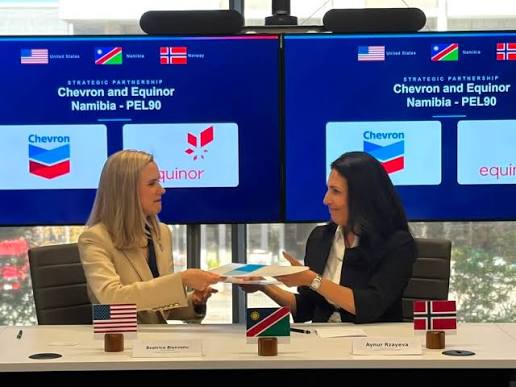

- Equinor Enters Namibia Oil Exploration with 17.40% Stake in Chevron Block
Norway’s Equinor is entering Namibia’s offshore oil exploration sector through the acquisition of a 17.40% stake in Chevron-operated Petroleum Exploration Licence 90, marking the company’s first upstream expansion into a new country since its entry into Argentina in 2017.
The transaction gives Equinor exposure to the Orange Basin, one of the most closely watched frontier oil regions globally following a series of discoveries that have drawn international majors into Namibia’s offshore acreage. A new exploration well on the licence is scheduled to be drilled before the end of 2026, although Equinor did not disclose the price being paid for the stake.
The interest is being acquired from Harmattan Energy, a subsidiary of US energy major Chevron, which held 52.50% of PEL 90 before the transaction. The other existing partners are QatarEnergy with 27.50%, Namibian company Trago Energy with 10.00% and state-owned NAMCOR with 10.00%.
The deal remains subject to regulatory approvals and completion requirements. Equinor said the investment forms part of its strategy to “strengthen and replenish” its international oil and gas portfolio, placing Namibia within a wider effort by the Norwegian group to secure future upstream opportunities.
Equinor’s entry is significant because it comes as the company recalibrates its portfolio following a scaling back of some renewable-energy ambitions. Like several other international energy groups, it is maintaining greater emphasis on hydrocarbons as it seeks assets capable of supporting production and cash flow over the longer term.
“We are always looking for interesting opportunities,” an Equinor spokesperson said when asked whether the group could pursue further acquisitions in Namibia. The company declined to indicate whether the PEL 90 transaction could be followed by additional acreage purchases.
For Namibia, the arrival of another major international producer adds further credibility to a petroleum sector that has moved rapidly from frontier exploration to one of Africa’s most competitive upstream investment destinations. The country has attracted growing interest as companies seek positions around discoveries in the Orange Basin and attempt to determine whether they can be developed commercially.
Equinor’s participation also strengthens the technical and financial depth behind PEL 90. Chevron will continue to operate the licence, while QatarEnergy and NAMCOR provide additional international and domestic participation, creating a consortium with considerable experience across large-scale exploration and development projects.
The immediate focus will be the exploration well planned before year-end. A successful result could increase the strategic value of the acreage and potentially move the partners towards further appraisal, while an unsuccessful well would underline the geological uncertainty that remains even in basins where major discoveries have already been made.
That risk is central to the economics of frontier exploration. International companies can spend substantial amounts acquiring seismic information, drilling deepwater wells and evaluating discoveries before knowing whether sufficient recoverable resources exist to justify a multibillion-dollar development.
Namibia’s attraction is therefore based not on guaranteed production but on geological potential. Recent discoveries have increased confidence that the Orange Basin contains commercially significant petroleum systems, encouraging companies to secure acreage before competition and asset valuations rise further.
For Equinor, the transaction provides entry without requiring the company to operate the block itself. Acquiring a minority interest allows it to participate in exploration upside while sharing the financial and geological risk with Chevron, QatarEnergy, Trago Energy and NAMCOR.
The structure also reflects a common strategy among international oil companies entering emerging basins. Rather than building a large portfolio immediately, companies frequently take minority positions in selected licences, use drilling results to refine their geological understanding and then decide whether to expand their exposure.
The deal therefore represents more than another investor entering Namibia. It adds one of Europe’s largest energy companies to a widening group of international players positioning themselves for what could become a major new African oil province.
For Namibia, however, exploration success will only be the first stage of the economic challenge. If commercially viable discoveries continue, the country will need to build fiscal, regulatory and local-content frameworks capable of converting offshore petroleum resources into durable public revenues, domestic investment and employment.
Equinor’s 17.40% entry into PEL 90 reinforces the momentum behind Namibia’s upstream sector, but the next exploration well will provide the more important test. The Orange Basin has already attracted global capital; the question now is how much of that geological promise can ultimately be converted into commercially sustainable production.

