

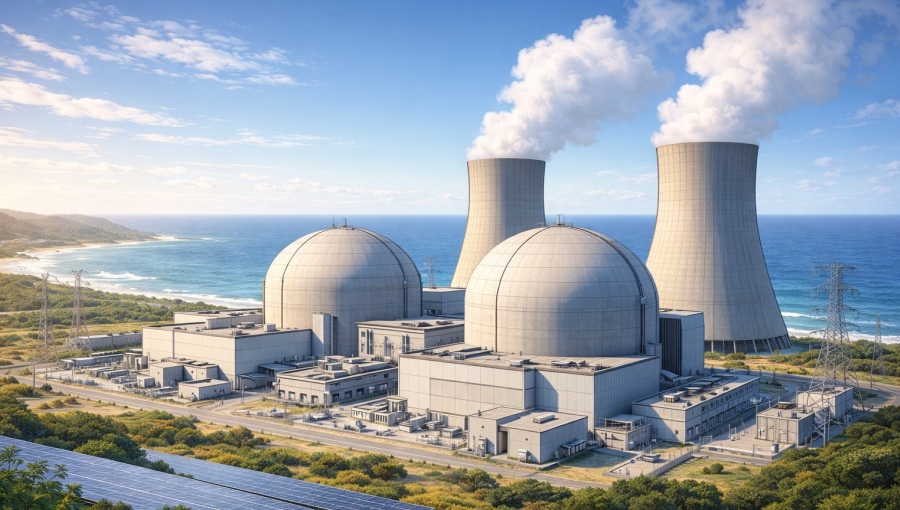

- Eskom Opens Funding Talks With World Bank, AfDB for Nuclear Expansion
South Africa’s state power utility, Eskom, has opened exploratory talks with the World Bank, the African Development Bank and other potential funders as it seeks financing for a multibillion-dollar nuclear expansion programme aimed at strengthening baseload electricity supply.
The utility is preparing a request for information for up to 5,200 megawatts of new nuclear capacity, as South Africa looks for stable, always-on power while gradually reducing dependence on coal, which still supplies most of the country’s electricity.
Eskom currently operates Africa’s only operational nuclear power station near Cape Town. Its proposed expansion would include 4,800 megawatts from conventional pressurised water reactors and 400 megawatts from small modular reactors. At least half of the small modular reactor capacity is expected to support Eskom’s coal-to-nuclear strategy.
Bheki Nxumalo, Eskom’s group executive for generation, said on the sidelines of an energy conference in Cape Town that the utility was exploring different funding models for the nuclear programme.
“We are in exploratory discussions with most of the potential funders … [over] different ways of funding this,” he said.
He added that Eskom was open to ideas from several financing partners, including commercial banks and development finance institutions.
“We are … looking for anyone with ideas, there are different options,” Mr Nxumalo said.
The funding discussions come at a delicate moment for Eskom, which remains financially constrained and unable to fund new nuclear plants from its own balance sheet. The company is therefore seeking support from partners, including commercial banks and institutions such as the African Development Bank.
The World Bank declined to comment on the specific discussions, saying as a matter of policy it does not comment on potential or exploratory talks with member countries or utilities. The institution, however, signalled last year that it was returning to nuclear financing and would support countries that choose nuclear power as part of their energy mix.
Funding options under consideration include public-private partnerships and vendor financing, where a developer builds and funds a plant. Mr Nxumalo cited Russia’s Rosatom-backed El Dabaa project in Egypt as an example of the vendor-financing model.
“There is some work we need to do internally but we want to go to the market for both technologies [conventional and SMR] within the next 12 months,” he said.
South Africa’s nuclear ambitions remain controversial. Environmental groups and some communities have long opposed nuclear expansion, citing concerns around cost, safety, procurement transparency, waste management and the risk of locking the country into expensive long-term obligations.
For Eskom, however, the case for new nuclear rests on energy security. South Africa has endured years of power shortages and load-shedding, exposing the fragility of its coal-heavy electricity system and the urgent need for more reliable generation capacity.
The proposed nuclear expansion therefore sits at the centre of a difficult policy trade-off: how to secure dependable power for Africa’s most industrialised economy while managing fiscal constraints, climate commitments and public concern over nuclear costs.
If Eskom moves ahead, the financing structure will be as important as the technology choice. A poorly designed funding model could deepen public debt and tariff pressures, while a credible risk-sharing framework could help South Africa add firm power without placing the full burden on the state.

