

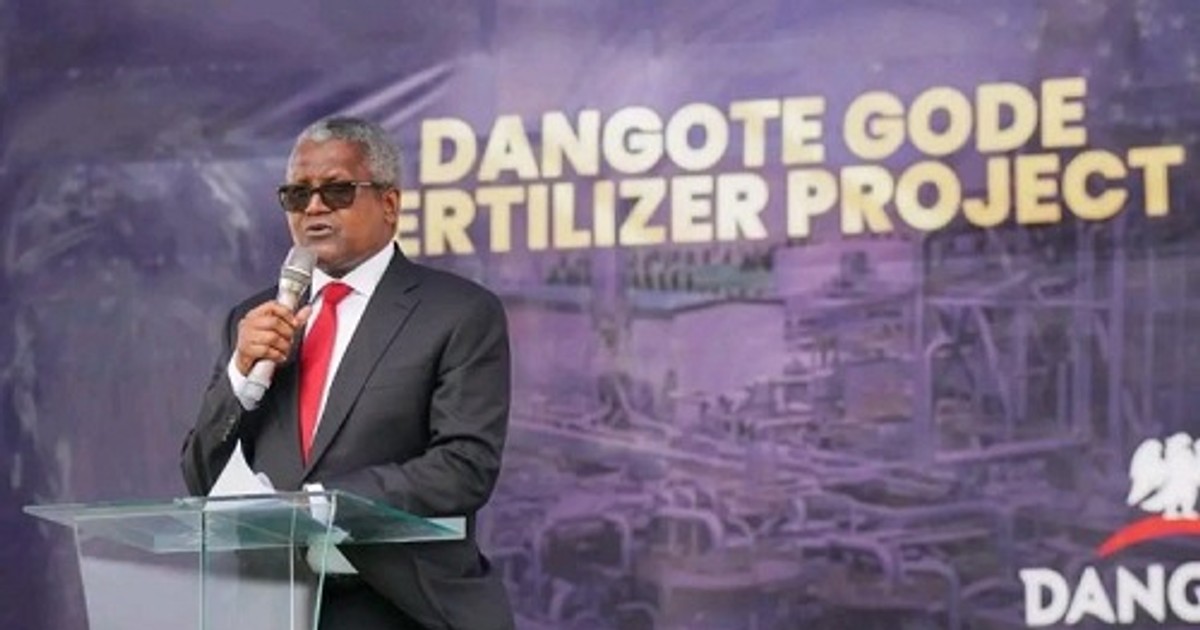

- Ethiopia, Dangote Expand Gode Fertilizer Project With Power, Pipeline and NPK Facilities
Dangote Group has increased its investment commitment in Ethiopia’s landmark fertilizer project to more than US$4 billion, expanding the scope of one of the country’s largest industrial agricultural investments.
The project, being developed in partnership with the Ethiopian government, is located in Gode and is expected to produce 3 million metric tonnes of urea annually when completed. It is designed to strengthen Ethiopia’s domestic fertilizer production, support millions of farmers and reduce dependence on imports.
The expanded investment marks a significant increase from the initial US$2.5 billion commitment, reflecting additional infrastructure tied to the project. According to Dangote Group, the expanded scope now includes a 110-kilometre pipeline, a 120-megawatt power plant, a polypropylene packaging facility and a two-million-tonne NPK blending plant.
This development was highlighted after Ethiopian Prime Minister Abiy Ahmed visited the Gode project site with Aliko Dangote to assess construction progress. Mr Abiy said the project was advancing steadily across multiple sections of the site, describing the momentum as evidence of strong collaboration between the government and private-sector partners.
“This initiative represents far more than infrastructure. It is a strategic investment in Ethiopia’s agricultural transformation, food security, industrial growth, and economic self-reliance,” the Prime Minister said.
The shareholders’ agreement for the project was signed in August 2025, while construction officially commenced in October 2025. Work is now progressing across several parts of the site, according to the report.
For Ethiopia, the project carries major economic and strategic significance.
Agriculture remains central to employment, rural livelihoods and national output. But like many African economies, Ethiopia has historically depended on imported fertilizer products, exposing farmers and the wider economy to global price shocks, foreign exchange pressures and supply-chain disruptions.
A large domestic fertilizer plant could therefore reshape the economics of agricultural production by improving access to inputs, stabilising supply and reducing the import bill over time.
The urea facility is also expected to support Ethiopia’s wider industrialisation agenda by linking energy, logistics, packaging and agro-input production into a single industrial ecosystem.
The inclusion of a dedicated power plant and pipeline suggests that the Gode project is being designed not only as a standalone fertilizer factory, but as an integrated industrial platform capable of supporting large-scale production and distribution.
The two-million-tonne NPK blending facility is equally important. While urea provides nitrogen, NPK blends combine nitrogen, phosphorus and potassium, allowing fertilizer products to be better tailored to different crops and soil needs. That could strengthen productivity gains if supported by extension services, distribution systems and farmer affordability.
For Dangote Group, the project extends its growing role in Africa’s industrial and fertilizer sectors. The group has increasingly positioned itself as a major continental supplier of agricultural inputs, building on its broader industrial footprint across cement, refining, petrochemicals and manufacturing.
The Ethiopia project also shows how African governments are seeking to attract large private-sector capital into strategic industrial assets that support food security and reduce external dependence.
The timing is significant. Across the continent, fertilizer affordability has become a major concern after years of global supply shocks linked to energy prices, war-related disruptions and currency depreciation. Countries with limited domestic production have been particularly exposed.
Ethiopia’s bet is that local production can help insulate farmers from some of those pressures while improving national food security.
But the project’s success will depend on execution. Large industrial projects of this scale require reliable gas or feedstock supply, strong logistics, financing discipline, power stability, efficient distribution and predictable policy support. Delays or cost overruns could weaken the expected benefits, while high production costs could limit affordability for farmers.
If completed as planned, the Gode fertilizer plant could become one of Ethiopia’s most important agro-industrial anchors, reducing import dependence, supporting farmers and creating opportunities for jobs and investment.

