

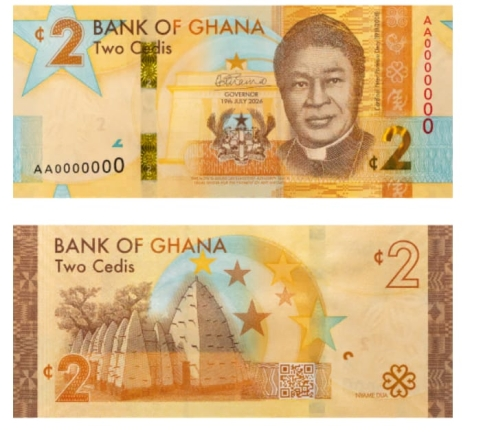

- FACT-CHECK: Bank of Ghana Did Not Describe Cardinal Dery as Ghana’s First Cardinal — Historical Records Settle GH¢2 Note Controversy
Claims that the Bank of Ghana committed a historical error by describing the late Cardinal Peter Poreku Dery as Ghana’s first Cardinal on the newly unveiled GH¢2 banknote are misleading, as a review of the central bank’s description and official Vatican records establishes a clear distinction between the two Ghanaian Catholic leaders at the centre of the controversy.
The controversy follows the unveiling of the Bank of Ghana’s new Cedi Heritage Series, which features Cardinal Dery on the GH¢2 denomination in recognition of his contribution to Ghana’s religious and social development.
Criticism has centred on suggestions that the central bank incorrectly identified Cardinal Dery as the first Ghanaian elevated to the rank of Cardinal, overlooking Cardinal Peter Kodwo Appiah Turkson, who received the honour three years earlier.
However, the description attributed to the Bank of Ghana identifies Cardinal Dery as the first Ghanaian from the northern region to attain the position, rather than the first Ghanaian nationally. This distinction is also reflected in published accounts of the Heritage Series unveiling.
The historical records support that distinction.
Cardinal Peter Kodwo Appiah Turkson was elevated to the College of Cardinals by Pope John Paul II during the consistory held on October 21, 2003, becoming the first Ghanaian to receive the honour.
The Vatican’s official biographical records confirm the appointment date and identify Cardinal Turkson, who previously served as Archbishop of Cape Coast, among the Cardinals created by Pope John Paul II.
Also, Cardinal Peter Poreku Dery, who served as Archbishop of Tamale, was subsequently made a Cardinal by Pope Benedict XVI on March 24, 2006, nearly two and a half years after Cardinal Turkson’s elevation.
Official Vatican records confirm the date, establishing that Cardinal Dery was not Ghana’s first Cardinal but occupied a distinct position in the country’s Catholic history as the first Cardinal from northern Ghana.
Consequently, the two historical descriptions are not contradictory.
One identifies the first Ghanaian appointed Cardinal, while the other recognises the first person from a particular geographical area of the country to attain the same ecclesiastical position.
The distinction matters because omitting the geographical qualification materially changes the meaning of the statement and creates an impression of historical inaccuracy where the underlying facts are consistent.
The selection of Cardinal Dery for the GH¢2 note has also raised questions about why the central bank chose him rather than Cardinal Turkson.
Cardinal Dery died on March 6, 2008, and his inclusion fits a commemorative approach that honours deceased national personalities whose contributions can be assessed within an established historical context.
Selecting deceased figures can help preserve historical perspective and reduce the possibility that commemorative currency designs become associated with contemporary personalities. However, this is an explanatory consideration, not evidence of a formally established Bank of Ghana rule requiring honourees to be deceased.
The banknote’s broader theme of religious freedom also places Cardinal Dery’s recognition within Ghana’s history of religious coexistence and national development.
Fact-check verdict: The claim that the Bank of Ghana described Cardinal Dery as Ghana’s first Cardinal is false on the wording examined.
Cardinal Turkson holds the historical distinction of becoming Ghana’s first Cardinal in October 2003. Cardinal Dery became the first Cardinal from northern Ghana in March 2006.
The two descriptions refer to different historical distinctions and can therefore both be accurate.
There is consequently no established historical contradiction in the central bank’s description of Cardinal Dery.
Verification: Vatican biographical records for Cardinals Turkson and Dery, and published descriptions of the Bank of Ghana’s Cedi Heritage Series.

