


- Producer Inflation Rises to 5.20% as Energy and Manufacturing Costs Intensify
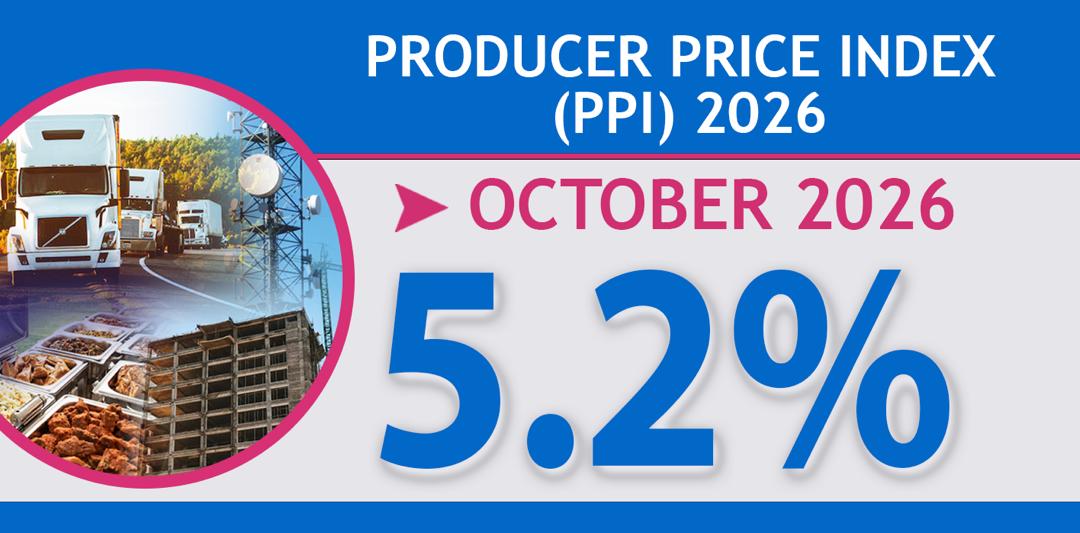
Ghana’s producer price inflation accelerated to 5.20% in October 2026, from 4.90% in September, reflecting mounting cost pressures across the industrial sector and raising questions about the sustainability of the country’s broader inflation gains.
The latest Producer Price Index (PPI) report released by the Ghana Statistical Service on November 18 shows that inflation at the production level increased by 0.30 percentage points, driven largely by mining, manufacturing and electricity-related activities.
On a monthly basis, producer prices increased by 1.60%, compared with 1.40% in September, indicating that businesses experienced a faster increase in production costs during October.
The development is particularly significant because producer prices often provide an early indication of cost pressures that could eventually influence prices paid by consumers.
Although Ghana has recorded a substantial moderation in inflation over the past year, the latest figures suggest that rising costs in selected industries could complicate efforts to sustain price stability.
Industrial producer inflation, excluding construction, increased to 8.00% in October from 7.20% in September, substantially exceeding the national producer inflation rate.
The sector also recorded a month-on-month increase of 2.20%, suggesting that cost pressures were particularly concentrated in industrial activities.
The acceleration was accompanied by an increase in electricity and gas producer inflation to 10.80%, from 9.80% in September.
Within the sector, electricity generation, transmission and distribution recorded annual producer inflation of 11.00%, while gas manufacturing and distribution registered 3.30%.
These developments raise concerns about the cost of electricity as a major input for domestic production.
For manufacturers, mining companies, agro-processors and other electricity-intensive businesses, rising energy costs can affect profitability and competitiveness, particularly when firms cannot immediately pass additional expenses to customers.
The implications extend beyond the electricity sector itself.
Higher electricity costs can increase expenditure on processing, refrigeration, storage and other activities essential to domestic supply chains.
Where businesses absorb these increases, profit margins may weaken. Where they transfer the additional costs to customers, inflationary pressures could spread into consumer markets.
However, producer price inflation does not translate mechanically into consumer inflation, as retail prices are also influenced by competition, wages, taxes, margins and demand conditions.
The report’s mining data reveal an especially striking divergence.
Producer inflation in crude oil and natural gas extraction increased sharply to 30.20% in October from 18.30% in September, representing an acceleration of 11.90 percentage points.
In contrast, the mining of metal ores recorded producer price deflation of 7.30%, compared with deflation of 2.30% in September.
This divergence illustrates how different commodity-related activities can experience substantially different pricing conditions within the same economy.
It also demonstrates why movements in the overall producer inflation rate should not be interpreted as evidence that all domestic industries are experiencing similar pressures.
The mining and quarrying sector, which carries a weight of 43.70% in the PPI basket, recorded annual inflation of 6.20%, up from 5.60% in September.
The sector contributed approximately 2.70 percentage points to the overall producer inflation rate of 5.20%, making it the largest contributor.
Manufacturing, which accounts for 35.00% of the index, recorded inflation of 4.80%, compared with 4.60% in September.
Together, mining and manufacturing account for 78.70% of the producer price index, meaning movements in these two sectors exert substantial influence over the national figure.
The manufacturing data reveal considerable differences across industries.
The manufacture of leather and related products registered inflation of 15.80%, the highest among the sector’s 23 major manufacturing groups.
Fabricated metal products followed at 14.20%, while beverage manufacturing recorded inflation of 12.50%.
Food manufacturing registered 5.00%, while the production of coke and refined petroleum products recorded 5.40%.
In contrast, the manufacture of other non-metallic mineral products registered deflation of 1.10%.
The variation indicates that Ghana’s production environment is becoming increasingly uneven, with some industries facing relatively substantial price increases while others experience stable or declining producer prices.
For businesses, this unevenness matters because it influences pricing decisions, inventory management, profitability and investment planning.
A manufacturer facing higher input costs may become more cautious about expanding production unless demand conditions allow those increases to be recovered through selling prices.
The food manufacturing sector deserves particular attention because of its potential relationship with consumer food inflation.
Although annual producer inflation in food manufacturing moderated to 5.00% from 6.60% in September, the sector continues to experience rising prices relative to a year earlier.
The moderation could provide some relief along the food supply chain, but the extent to which households benefit will depend on distribution costs, retail competition and other factors.
Transport presents another important concern.
Overall producer inflation in transportation and storage declined marginally to 5.40% from 5.80% in September.
However, land transportation recorded annual producer inflation of 30.00%, significantly higher than the overall transport sector figure.
This suggests that substantial pricing pressures remain concentrated within land transport activities, even as the wider sector records more moderate inflation.
The implications for the broader economy could be considerable.
Road transport plays an important role in moving agricultural products, manufactured goods and imported commodities across Ghana.
Higher transport charges can increase distribution costs and weaken the benefits of lower prices at earlier stages of production.
For consumers, the effect may appear through prices of goods delivered to markets and retail outlets, rather than as a direct change in the cost of production.
The accommodation and food services sector also experienced rising producer inflation, increasing to 4.60% in October from 2.70% in September.
Accommodation services recorded inflation of 4.90%, while food and beverage service activities registered 3.10%.
These developments suggest that cost pressures are extending into selected service industries.
Construction, however, presented a contrasting picture.
Annual construction producer inflation declined to 2.10% from 4.70% in September, a reduction of 2.60 percentage points.
Civil engineering inflation fell to 1.60% from 3.70%, while construction of buildings recorded inflation of 3.00%.
The moderation could provide some relief for developers and contractors, although positive inflation still indicates that producer prices remain higher than a year earlier.
For Ghana’s infrastructure and housing sectors, lower rates of construction cost inflation could improve project budgeting and investment planning if the trend persists.
Nevertheless, individual projects may experience different cost movements depending on material requirements, labour, equipment and financing conditions.
The broader economic significance of the October PPI figures lies in the relationship between producer prices, consumer inflation and monetary policy.
A rise in producer inflation does not necessarily mean that consumer inflation will increase by the same magnitude.
Businesses may absorb some cost increases, delay price adjustments or offset higher expenses through productivity improvements.
Nevertheless, persistent cost pressures in electricity, petroleum-related activities and transportation can increase the risk of broader inflationary transmission.
This creates an important consideration for monetary authorities seeking to preserve price stability while supporting private-sector investment.
The challenge is particularly relevant because Ghana’s economy depends heavily on imported machinery, petroleum products and industrial inputs, exposing production costs to exchange rate movements and international commodity prices.
If increases in producer prices become sustained, businesses may eventually adjust selling prices to protect profit margins.
Conversely, continued stability in the exchange rate, improvements in domestic supply conditions and lower financing costs could help moderate these pressures.
The October figures therefore present a mixed assessment of Ghana’s economic cost environment.
Overall producer inflation remains relatively moderate, while some sectors, particularly construction and parts of manufacturing, are recording slower price increases.
Yet the acceleration in industrial inflation and the substantial increases recorded in energy-related activities suggest that underlying cost pressures have not disappeared.
The central question is whether Ghana’s recent gains in price stability can be sustained when some of the economy’s most important production inputs continue to experience significant price increases.
The October PPI figures provide an important reminder that maintaining low consumer inflation requires more than controlling demand. It also depends on addressing structural production costs, improving energy efficiency, strengthening transport infrastructure and creating conditions that allow businesses to produce competitively.
For policymakers, the priority should be to ensure that inflation stabilisation translates into a genuinely lower-cost production environment.
For businesses, the challenge will be managing emerging cost pressures without undermining competitiveness.
And for households, the ultimate test will be whether Ghana can prevent rising producer costs from translating into renewed increases in the prices of essential goods and services.

