


Fan Milk Revenue Hits GH¢635.5m as Net Profit More Than Triples
Fan Milk Plc is extending a sharp earnings recovery into 2026, with first-half revenue rising 25% and net profit more than tripling as stronger margins, improved route-to-market execution and operational efficiencies reinforce the dairy producer’s turnaround.
The Ghana Stock Exchange-listed manufacturer reported revenue of GH¢635.5 million for the six months ended June 2026, while gross profit climbed 89% to GH¢316 million. Net profit surged 214% to GH¢81.9 million, pointing to a much faster improvement in profitability than in underlying sales.
That divergence is particularly significant for investors because it suggests Fan Milk is extracting considerably more value from every cedi of revenue. A 25% expansion in sales indicates continued demand and market penetration, but the much stronger growth in gross and net profit points towards improving product economics, cost discipline and operating leverage.
The performance extends the momentum recorded in 2025, when revenue increased 46% to GH¢1.0 billion from GH¢683.8 million in 2024. Gross profit rose 47% to GH¢364.5 million, while net profit increased 38.00% to GH¢68.3 million and earnings per share advanced by the same rate to GH¢0.59.
Crossing the GH¢1 billion revenue mark in 2025 represented an important milestone, but the first-half 2026 numbers suggest the more consequential change may now be taking place at the bottom line. Net profit of GH¢81.9 million for the first six months of this year has already exceeded the GH¢68.3 million earned in the whole of 2025.
Management has linked the improvement to the execution of its strategy, “Bringing Back the Pride by Fixing the Fundamentals,” which has focused on strengthening the commercial and operational foundations of the business while sustaining double-digit growth across key product categories.
The company has also strengthened its route-to-market operations, a critical part of the business model given the extensive distribution system required to move dairy and frozen products across Ghana. Improvements in distribution efficiency can have a disproportionate impact on profitability because cold-chain logistics, product losses and delivery costs materially affect margins in the sector.
The improvement comes after a difficult operating environment for consumer-goods manufacturers, which have had to contend with currency depreciation, expensive imported inputs, energy costs and pressure on household purchasing power.
Fan Milk’s ability to grow profitability substantially faster than revenue therefore suggests the recovery is increasingly being driven by internal efficiencies rather than volume growth alone.
Earlier company disclosures have also highlighted localisation as an important tool for reducing exposure to foreign-exchange volatility, although some critical dairy inputs remain difficult to source domestically. That leaves productivity gains, supply-chain management and cost discipline central to protecting margins as the business expands.
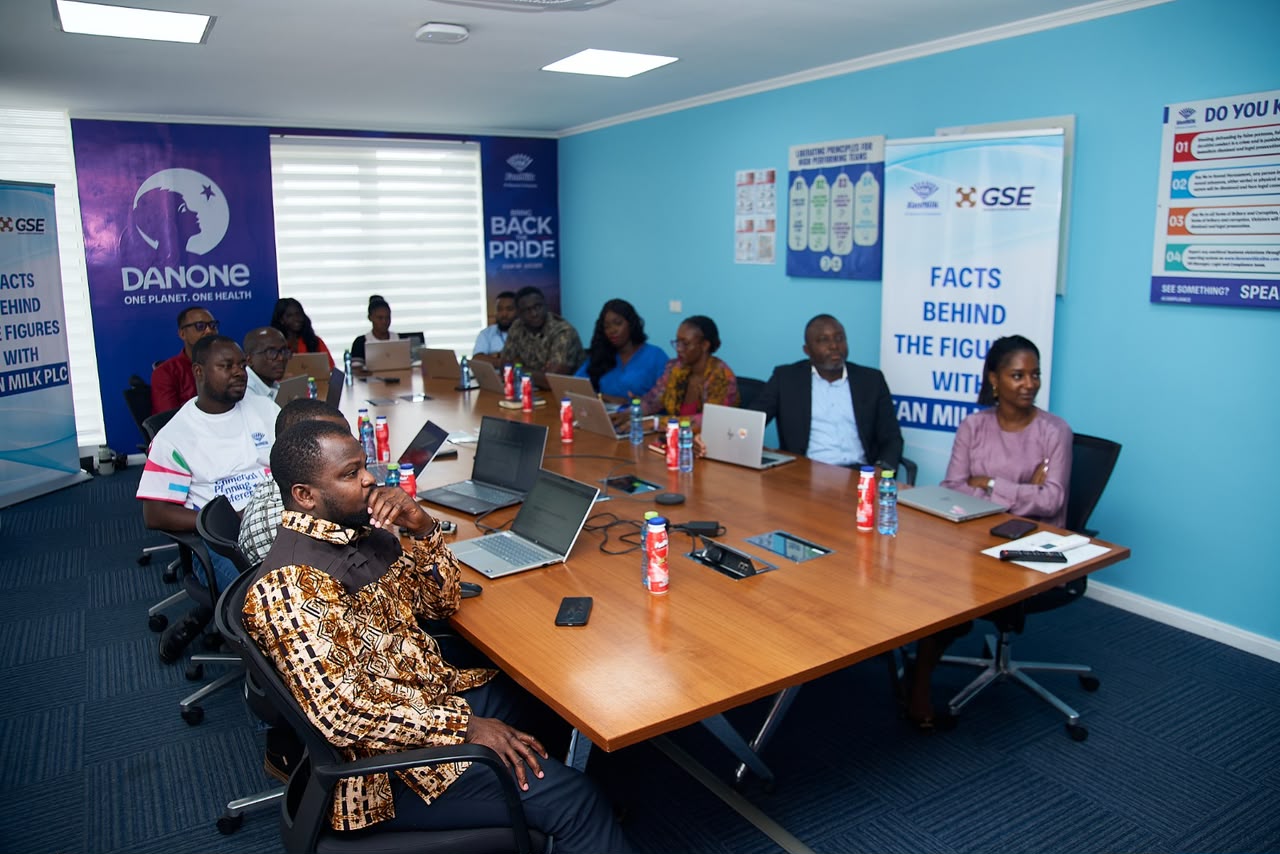
The stronger earnings profile is also giving Fan Milk greater capacity to fund investment beyond immediate commercial growth. At its Facts Behind the Figures stakeholder engagement, which brought together more than 100 shareholders, analysts, regulators, media representatives and other stakeholders virtually, management linked the company’s financial recovery to a broader sustainability strategy.
Fan Milk said it has recovered more than 11.2 million plastic wrappers and achieved 100% recyclable packaging across its portfolio. It has also expanded renewable-energy investment through solar installations while advancing initiatives around responsible water management.
At its Ghana operations, wastewater generated from factory processes is treated before discharge into the Korle River. The company said its treatment facility has capacity of about 1,100 cubic metres per day and operates in line with domestic environmental requirements as well as standards established by parent company Danone.
The sustainability strategy reflects a wider shift across global consumer-goods markets, where companies are increasingly assessed not only on earnings growth but also on packaging waste, energy consumption, water use, employee welfare and broader environmental performance.
Fan Milk said it secured B Corp Certification and Living Wage Certification in 2025, which it presents as evidence of progress in responsible business practices and employee welfare. Through its Dan’Care programme, employees also receive health and income protection support.
For shareholders, however, the immediate question is whether the company can sustain the current pace of earnings expansion as the comparison base becomes more demanding. First-half profitability provides a strong starting point, but future performance will remain sensitive to consumer demand, input costs, exchange-rate movements and the company’s ability to maintain cost discipline.
Higher internally generated earnings also give management greater strategic flexibility. Stronger cash generation can support capital expenditure, distribution expansion, sustainability investment and shareholder returns without increasing dependence on external financing.
Fan Milk’s recovery is therefore moving beyond a straightforward rebound in sales. The more important development is the strengthening of the economics underpinning those sales, with gross profitability expanding substantially faster than revenue and a greater proportion of turnover being converted into bottom-line earnings.
Management is now targeting accelerated growth across product categories between 2026 and 2030 while maintaining its stated purpose of “bringing health through food to as many people as possible.” If execution remains disciplined, the first-half numbers suggest Fan Milk is entering a phase in which its turnaround is being measured increasingly by margins and earnings quality rather than sales growth alone.

